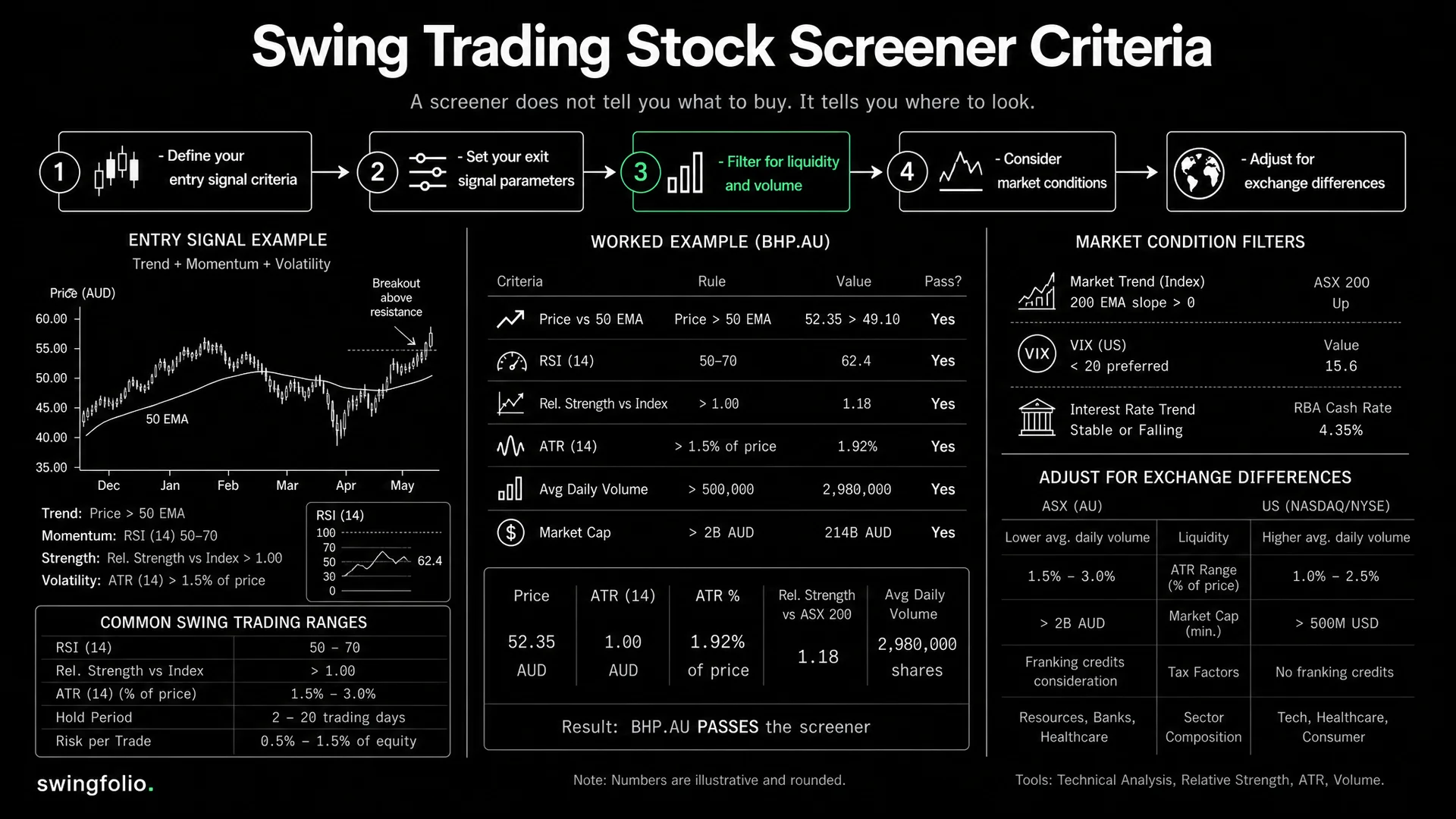
A stock screener for swing trading should reduce a market to a list you can review. It does not choose an entry. Build the screen around liquidity, volatility and trend, then rank the survivors by relative strength and setup quality.
This guide explains what each criterion does and includes two complete example screens. The thresholds are starting points for testing, not promises that a stock is suitable or that a setup will work.
Separate the universe from the setup
A useful workflow has two stages:
- Apply stable filters that define what you can trade, such as market, price, liquidity and a volatility ceiling.
- Review timing and setup conditions, such as a pullback, breakout, volume expansion or engulfing candlestick pattern.
If you put every preference into hard filters, the list can become too narrow. If you treat every screen result as a buy signal, you lose the chart level, trigger and stop that make the idea testable.
Liquidity: can you enter and exit near the quoted price?
Measure liquidity with average dollar volume:
Average dollar volume = share price x average daily volume
A $20 stock trading one million shares a day and a $100 stock trading 200,000 shares both turn over about $20 million. Share volume alone hides that comparison.
Set a floor that is high enough for your order size and market. Then inspect the spread and order book before trading. Thin stocks can gap through stops or fill across several prices, so the realised loss can exceed the planned amount.
Price: exclude names that do not fit your execution
A price floor can remove securities where a small tick or wide spread represents a large percentage move. Some traders use $5 or $10, but the useful threshold depends on the exchange, order size and strategy.
Price is not a quality score. Use it with turnover and spread rather than assuming an expensive stock is liquid or a low-priced stock is untradeable.
Volatility: enough movement for the holding period
Average True Range, or ATR, measures recent daily range and includes gaps. Divide ATR by price to compare stocks at different prices:
ATR percentage = 14-day ATR / current price x 100
A low ATR percentage may leave too little movement for a short holding period. A high ATR percentage requires a wider stop and fewer shares. Test a band against the strategy rather than copying one universal range.
ATR also connects screening with risk. If the chart requires a $2 stop and your risk budget is $400, the maximum size is 200 shares. Use the position size calculator after the screen produces a candidate.
Trend: define the direction you want to trade
For a long-trend screen, common conditions include price above the 50-day moving average and the 50-day above the 200-day. Requiring the 200-day average to rise adds another test of longer-term direction.
Those criteria suit continuation strategies. A mean-reversion strategy may deliberately search for a pullback within the larger trend. Write the intended setup first, then choose trend filters that describe it.
The triple moving average guide shows how moving-average alignment can become a repeatable rule.
Relative strength is not RSI
Relative strength compares a stock's return with an index, sector or universe. RSI is an oscillator calculated from the stock's own recent gains and losses. They answer different questions.
Use relative strength to rank stocks that already pass your structural filters. You might compare three-month returns with a benchmark, use a percentile rank or sort by distance from a 52-week high. Keep the measure and lookback consistent when testing.
Sector strength can add context. A stock may rank well inside a weak group or lag inside a strong one. Review the ASX sector comparison before deciding whether sector exposure supports the idea or creates concentration.
Market capitalisation: a rough behaviour filter
Market cap can separate larger, usually more liquid companies from smaller names with greater event and gap risk. It overlaps with liquidity, so you may not need both as hard filters.
Use market cap when your strategy is built for a company-size range. Otherwise, let price, turnover and volatility do the work and keep market cap as a sorting field.
Timing filters belong in a second pass
Relative volume, gaps, range expansion and moving-average crosses can identify a stock that is active today. They also make result counts change sharply from session to session.
Run the stable universe first. Then apply a timing filter or review the charts. This keeps a quiet session from forcing you into the only stock that happened to pass every condition.
ASX and US screens need different thresholds
The US market has more highly traded stocks, so a dollar-volume floor that leaves a broad US list can remove most ASX names. Use the same logic in both markets but calibrate the numbers separately.
For the ASX, you can start with an index universe such as the ASX 200 or ASX 300, then test turnover, spread and volatility thresholds against your intended order size. For US stocks, a higher dollar-volume floor can still return a large list. Keep a dated record of each preset so later results use the same rules.
Two complete swing trading screener presets
These hypothetical presets show how the criteria fit together. Backtest and paper trade them before risking money.
Preset 1: steadier trend continuation
Universe filters
- Market: ASX or US, tested separately
- Price: above $15
- Average dollar volume: above $10 million
- Market cap: above $2 billion
- 14-day ATR: 1.5% to 4% of price
- Price above a rising 200-day moving average
- 50-day moving average above the 200-day moving average
Ranking and chart review
- Sort by three-month relative strength against the market
- Prefer stocks within 15% of their 52-week high
- Look for an orderly pullback, consolidation or breakout level
- Reject entries that do not offer a defined stop and acceptable reward relative to risk
Preset 2: faster small and mid-cap momentum
Universe filters
- Market: ASX or US, tested separately
- Price: above $5
- Average dollar volume: above $5 million
- Market cap: $300 million to $10 billion
- 14-day ATR: 3% to 10% of price
- Price above the 50-day moving average
Timing and chart review
- Rank in the top 20% for relative strength in the chosen universe
- Price within 10% of its 52-week high
- Relative volume above the preset's tested threshold
- Review the catalyst, gap risk, spread, entry trigger and stop before creating an idea
The second preset accepts more price movement and event risk. Its position sizes should usually be smaller for the same dollar risk because stops tend to be wider.
Which criteria Swingfolio offers
Swingfolio's stock screener covers ASX and US stocks. It includes price, volume, market cap and sector filters, plus technical criteria such as RSI, ADX, ATR, MACD, stochastic and moving-average relationships. You can load built-in presets, save custom presets and open a result for chart review before creating a trade idea.
For additional checks such as benchmark-relative performance or proximity to a 52-week high, use a data source that supports them alongside Swingfolio's filters. Keep those checks in your written screening rules so you apply them consistently.
After a screen, build a watchlist from the candidates. Record why each name passed, the chart trigger and the price that invalidates the setup. That turns a changing result list into a process you can review.
From a screen result to a reviewable trade plan
A screen tells you which names passed your filters at that moment. Save the date and preset, then write the entry trigger, invalidation level and size before deciding whether to trade. Keep candidates separate from positions you actually opened.
Example: Microsoft position sizing
Microsoft (MSFT) opened at $415.53 on 3 June 2024. Its previous session low, on 31 May, was $404.51. These are historical prices in USD. They do not establish that MSFT passed either screener preset above.
Use that opening price as an entry reference and the previous low as an illustrative stop reference. With an assumed $100 planned price-risk budget:
- Stop distance: $415.53 − $404.51 = $11.02 per share.
- Whole-share size: floor($100 ÷ $11.02) = 9 shares.
- Planned price risk: 9 × $11.02 = $99.18, before costs.
- Position value: 9 × $415.53 = $3,739.77.
The budget and stop choice are practice assumptions, not recommended limits or an executed trade. Fees, slippage and gaps can increase the actual loss. Reproduce the calculation in the position size calculator with an assumed $10,000 account, 1% risk, entry 415.53 and stop 404.51.
Keep the plan with the trade
For your own executed trades, Swingfolio's Log New Trade form records the ticker, portfolio, strategy, date, units, entry price and stop. Use Notes to keep the reason for entry with the record. Later, compare your actual actions with the original plan in your trading journal.
Also check the money tied up across the account. A position's $99.18 planned price risk and its $3,739.77 value answer different questions. Portfolio tracking puts a trade alongside your other holdings so you can review exposure before adding another position.
Frequently asked questions
Is a stock screener a buy signal?
No. It finds stocks that meet chosen conditions. The chart setup, entry trigger, stop and position size determine whether you have a trade.
What volume should a swing trading screener require?
Use average dollar volume and choose a floor from your order size, market and acceptable slippage. Test ASX and US thresholds separately.
What ATR is suitable for swing trading?
The useful range depends on the strategy and holding period. Express ATR as a percentage of price, then test whether that band produces enough movement without stops that are too wide for your account.
How many filters should a screen have?
Use enough hard filters to define a tradable universe. Rank the survivors with softer preferences and inspect the charts. If no names pass for long periods, test which condition is excluding otherwise valid candidates.
What is the best free stock screener for swing trading?
As at September 2026, Finviz covers US listings only. For ASX stocks, free starting options include TradingView with the market set to Australia, a screener included with your existing broker account, or Market Index scans. Swingfolio's screener is another option during its 30-day trial when you want ASX and US filters connected to trade ideas and journal review.
Explore Swingfolio’s stock screener to connect your screening criteria with chart review and trade ideas.
General information only. Not financial advice.