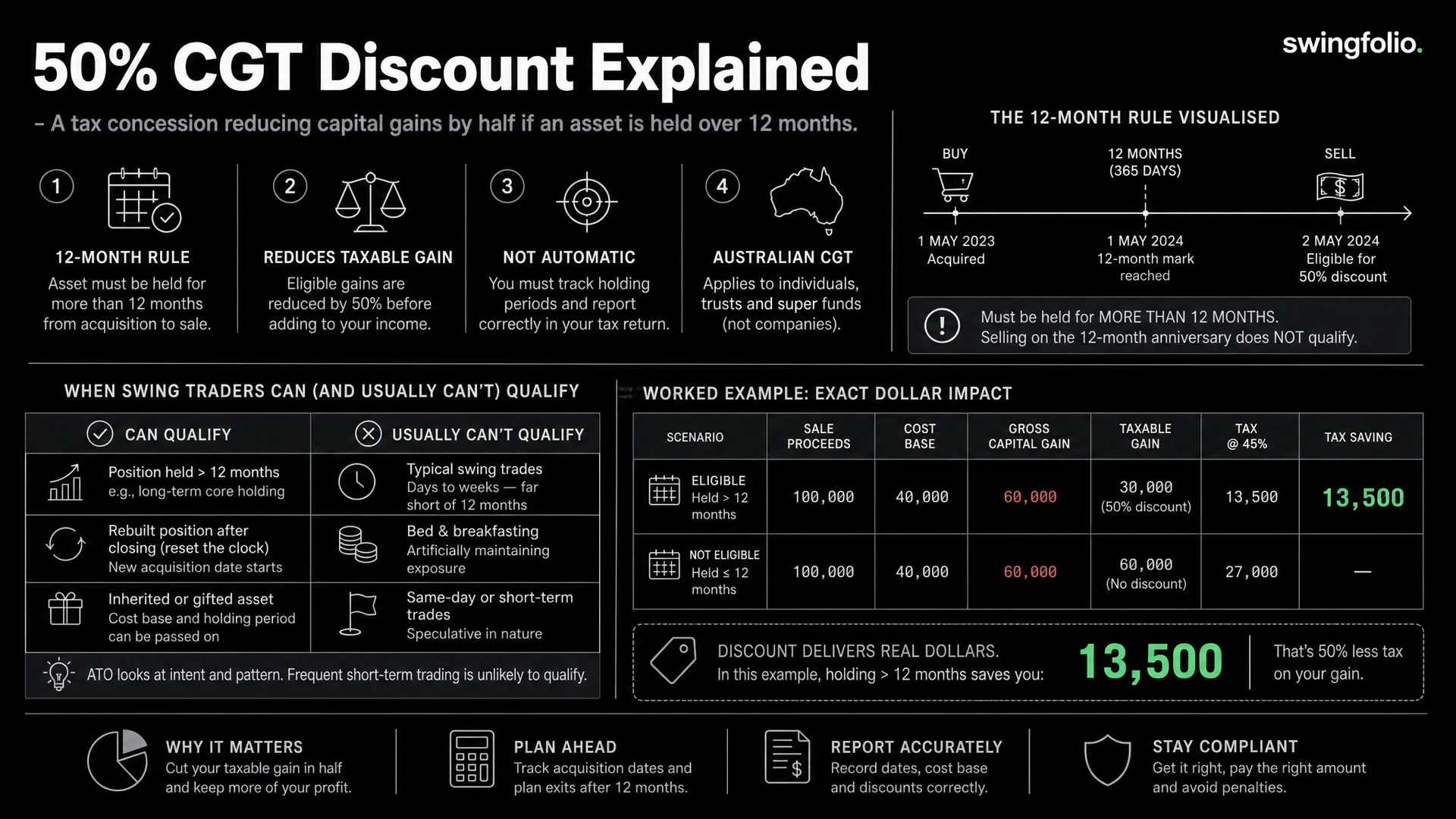
For the 2025-26 income year, an eligible Australian resident individual can generally reduce a capital gain by 50% after holding the asset for at least 12 months. Capital losses are applied before the discount.
Two boundaries matter for active traders. First, the discount belongs to the capital gains tax rules. If you carry on a business of share trading and hold shares as trading stock, your sale proceeds are ordinary business income and the CGT discount does not apply. Second, Parliament changed the rules for gains that accrue from 1 July 2027. The 2025-26 examples below use the rules for that year.
Who can use the 50% discount in 2025-26?
The discount method can apply when:
- a CGT event produces a capital gain
- an eligible individual or trust owns the asset
- the owner acquired it at least 12 months before the CGT event
- no exclusion removes the discount
Complying super funds generally use a one-third discount. Companies cannot use the general CGT discount.
The word "trader" in everyday conversation does not decide the tax result. The ATO looks at what you did and how you operated. An active investor can still make capital gains. A person carrying on a share trading business generally accounts for shares as trading stock and reports profits as ordinary income.
Read swing trading tax in Australia for the investor-versus-business factors.
Count the holding period carefully
The ATO excludes both the acquisition day and the CGT event day when testing the 12-month period. In common date examples, this means waiting until the day after the anniversary.
If an investor buys shares on 1 March 2025, a sale on 1 March 2026 is too early. A sale on 2 March 2026 can satisfy the time test, assuming the other requirements apply.
Contracts can control the CGT event date rather than settlement. Do not count only from the day cash or shares move. Corporate actions, deceased estates and relationship breakdown rollovers can also change the acquisition-date analysis.
Apply losses before the discount
For the 2025-26 rules, use this order:
- Work out the capital gain or loss for each CGT event.
- Add the capital gains.
- Apply current-year capital losses.
- Apply unapplied net capital losses from earlier years.
- Apply the CGT discount to eligible remaining gains.
- Apply any other concessions that are available.
You can generally choose which capital gains absorb available capital losses. That choice can matter when some gains qualify for a discount and others do not.
Worked loss-before-discount example
In 2025-26, Priya has:
- a $10,000 gain on shares held for 14 months
- a $4,000 capital loss on a short-term position
She applies the $4,000 loss first. The eligible gain falls to $6,000. She then applies the 50% discount, leaving a $3,000 net capital gain to include in assessable income.
Applying the discount first would produce $1,000. That calculation is wrong because it gives the loss the benefit of offsetting an already discounted gain.
If Priya also had a $4,000 non-discountable capital gain, she could examine whether applying the loss to that gain first produces a better result. The final choice depends on all gains, losses and concessions for the year.
Partial exits need parcel-level records
Each purchase parcel has its own cost base and acquisition date. A partial sale may include shares from more than one parcel.
Consider this 2025-26 example:
- 1 January 2025: buy 500 WDS.ASX shares at $26
- 15 June 2025: buy 300 WDS.ASX shares at $24.50
- 2 April 2026: sell 400 shares at $28
If the investor identifies 400 shares from the January parcel, those shares pass the 12-month test. If the sale instead uses all 300 June shares and 100 January shares, only the January shares qualify.
The cost bases also differ. The investor needs records that support the parcel selection. A label added after seeing the tax result is poor evidence. Keep contract notes, dates, quantities, brokerage and the parcel mapping made at the time.
Short-term strategy, long-term parcel
Active investors can hold different parcels for different purposes. A fictional example shows the issue.
Marco owns 500 CSL.ASX shares as a long-term investment. He later buys 100 more for a short swing. When he sells 100 shares, he records which parcel he disposed of. Selling the older parcel could create a discount capital gain but leave the short-term parcel in the account. Selling the newer parcel could preserve the older investment's holding period.
The choice must match the actual records and cannot be changed freely after the event. If Marco also carries on a separate share trading business, he needs clear separation between investment assets and trading stock.
Should tax change an exit decision?
The discount can affect the after-tax outcome, but it does not protect the market value.
Suppose an eligible 2025-26 investor has an unrealised $12,000 gain and is ten days from passing the holding test. Ignoring the Medicare levy, offsets and other details, a 50% discount would reduce the amount added to taxable income from $12,000 to $6,000. A 6% fall in a $100,000 position during those ten days would remove $6,000 of value before tax.
Compare the possible tax reduction with the price and gap risk. Do not replace an exit rule with an anniversary date without measuring both.
The enacted change from 1 July 2027
The Treasury Laws Amendment (Tax Reform No. 1) Act 2026 received Royal Assent on 26 June 2026. For most assets, it replaces the flat 50% discount with cost-base indexation for gains accruing from 1 July 2027. It also introduces a 30% minimum tax framework for relevant real gains.
The reform is prospective. Broadly, assets already held across 30 June 2027 are treated as sold and reacquired at that boundary for working out the pre-reform and post-reform portions. The pre-1 July 2027 accrued portion retains the old treatment when it is later realised, while the later portion enters the new framework. The Act contains detailed valuation, apportionment, trust and exception rules.
Do not apply that reform to the earlier example. Priya's 2025-26 sale remains under the 50% discount rules then in force. New residential dwellings and certain other categories have separate treatment under the enacted law.
See our 2026-27 federal Budget CGT guide for the reform in more detail.
Records to keep
For every parcel, retain:
- purchase and sale contract notes
- acquisition and CGT event dates
- quantity and parcel identification
- purchase price, sale proceeds and brokerage
- corporate-action adjustments
- calculations for capital losses and the discount
- Australian-dollar conversion records for foreign shares
Keep tax records for the period the ATO requires. Assets held for many years need records that survive for the full ownership period and the later retention period.
Swingfolio can help you organise entries, exits, fees and parcel history. It does not decide your tax status or certify a tax return. Import your CSV during an active trial, review the rows before Save, and reconcile the result with broker statements.
Frequently asked questions
Can a swing trader receive the 50% discount in 2025-26?
An investor can receive it on an eligible capital gain if the parcel passes the holding test. A person carrying on a business of share trading generally reports trading-stock profits as ordinary income instead.
Can a capital loss reduce salary income?
An investor's net capital loss cannot reduce salary. It can be carried forward to offset future capital gains. Business losses follow different rules and may face non-commercial loss restrictions.
Do I discount the gain before subtracting losses?
No. Apply capital losses before the CGT discount.
Will shares bought before July 2027 lose the old discount entirely?
The enacted transition preserves the treatment of gains accrued before 1 July 2027 and applies the new framework to later accruals. Working out those portions can require a boundary value or statutory apportionment.
Keep the tax year attached to the calculation
A correct CGT example can become wrong when copied into a later year. Label the year, identify whether the shares are an investment or trading stock, and calculate each parcel before applying losses and concessions.
Start the 30-day trial to organise trade and fee records, then verify the tax treatment against ATO guidance and your circumstances.
This article is general information and not tax advice.