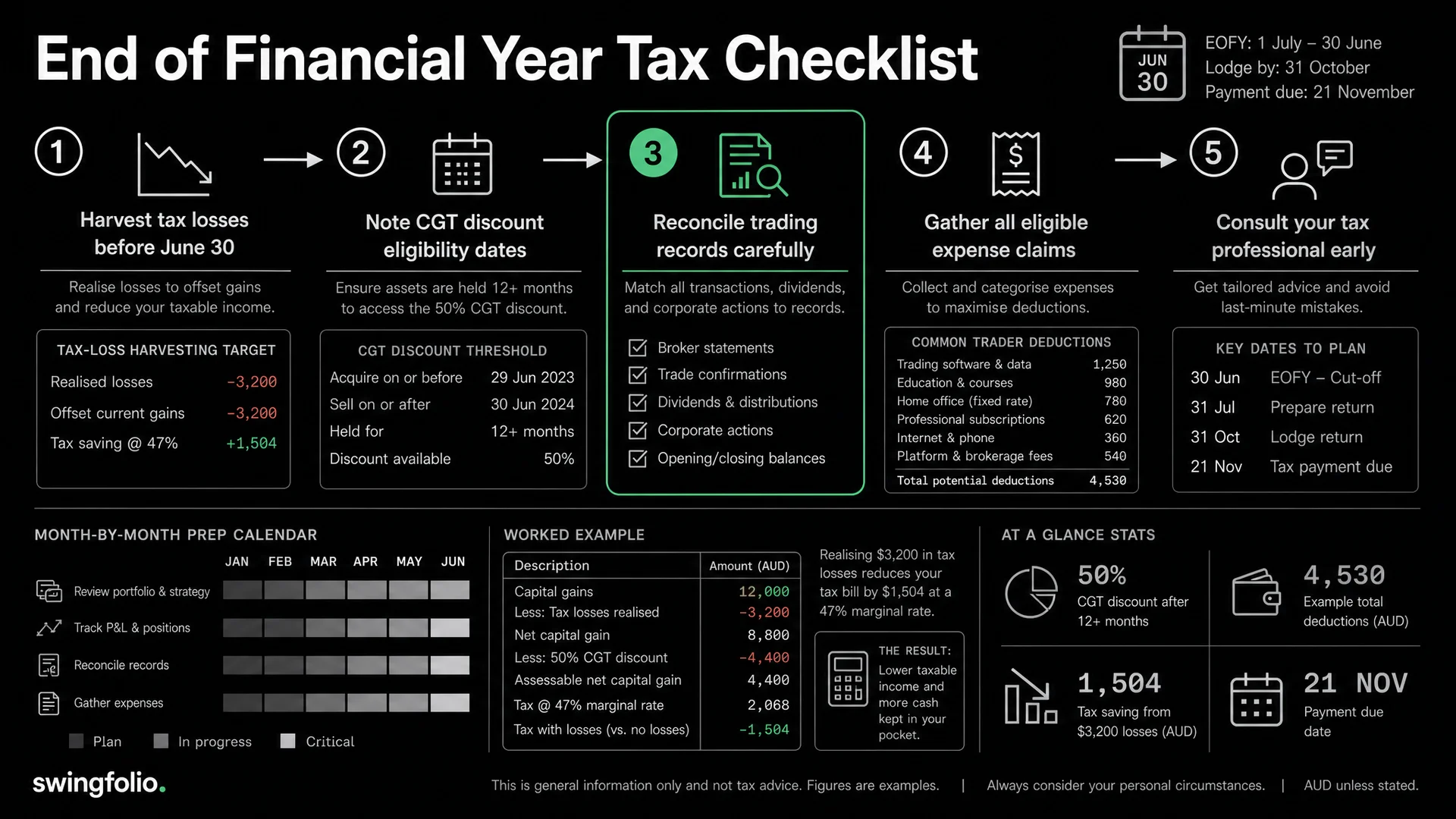
The 2025-26 financial year ended on 30 June 2026. In September 2026, the useful job is to reconcile that completed year, fix missing records and prepare an accountant-ready handover. Planning trades for that year is no longer possible.
This checklist also gives you a reusable April-to-July timeline for 2026-27 and later years. It separates tax work from trading decisions, so a deadline does not become a reason to ignore your strategy.
September 2026: review the completed 2025-26 year
Copy this list into your notes:
- Download annual statements and contract notes from every broker used in 2025-26.
- Reconcile purchases, disposals, transfers, dividends and cash movements.
- Match every disposal to acquisition parcels and include brokerage in the calculation.
- Check corporate actions such as splits, demergers, takeovers and returns of capital.
- Separate unrealised positions from disposals that created a tax event.
- Confirm carried-forward capital losses with the prior return or your tax agent.
- Gather records for expenses that may be deductible under your tax classification.
- Explain any transfer between brokers so it is not mistaken for a disposal.
- Prepare questions about unclear parcels, wash sales, trading-stock treatment or foreign holdings.
Do not recreate the year from an average broker cost if you have shares bought on different dates. The ATO expects records of acquisition dates, cost-base amounts, disposal dates and proceeds. The FIFO, LIFO and parcel-selection guide shows why the chosen parcel can change the result.
A copyable EOFY planning timeline
The dates below are a workflow, not statutory deadlines except for the 30 June year end.
| When | Review | Output |
|---|---|---|
| Monthly | Reconcile trades, fees, dividends and corporate actions | Broker and journal quantities agree |
| Early April | Estimate realised gains, losses and carried-forward losses | Draft year-to-date CGT position |
| Late April | Review open positions and parcel dates | List of genuine trade decisions and tax questions |
| May | Discuss material classification or loss issues with a registered tax agent | Advice recorded before action |
| Early June | Recheck planned disposals, liquidity and unfilled orders | Final decision list based on strategy and tax context |
| 30 June | End of the Australian financial year | Contracted disposals fall into the relevant year |
| July | Download statements and start final reconciliation | Accountant pack in progress |
| August to lodgement | Resolve discrepancies and obtain missing documents | Signed-off handover and return inputs |
Waiting until June creates two risks. Missing records may force rushed calculations, and tax considerations may take over a trade that no longer fits the portfolio. A monthly reconciliation reduces both.
April: calculate the position before considering action
- Total realised capital gains for the year to date.
- Total realised capital losses for the year to date.
- Confirm available carried-forward capital losses.
- Separate discount gains from gains that do not qualify for the discount.
- List unrealised gains and losses, but do not include them in realised CGT totals.
- Flag parcels approaching 12 months using contract dates.
- Check whether tax treatment is on capital or revenue account.
Capital losses offset capital gains, not salary or interest. Losses are applied before the CGT discount. A taxpayer can generally choose the order in which losses reduce gains, so it is often more tax-effective to apply them first against gains that cannot receive the discount. Ask your tax agent to check the full-year calculation.
May: review positions without manufacturing a loss
A loss is not a reason to sell by itself. Start with the investment decision:
- Has the setup failed or the thesis changed?
- Does the position still fit the strategy and risk limit?
- Is there a genuine reason to exit beyond creating a tax result?
- Would a planned repurchase leave the economic exposure substantially unchanged?
The ATO can apply Part IVA to a wash-sale arrangement whose dominant purpose is obtaining a tax benefit. Australia has no universal safe waiting period. Read the detailed wash-sale rules for Australian traders before planning a sell-and-buy-back sequence.
For a loss that also fits a genuine exit decision, calculate the tax effect rather than treating the loss as a cash refund. A $4,000 capital loss reduces eligible capital gains by $4,000. Its tax value depends on the remaining gains, discounts and the taxpayer's circumstances.
The tax-loss selling and July rebound guide covers the loss arithmetic, trade-date rule and the limits of the seasonal rebound evidence.
June: use contract dates, not settlement dates
For a normal ASX share sale, the CGT event generally occurs when the sale contract is entered into. That is usually the trade date, even if settlement happens in July. The ATO's share CGT guidance explains that the contract date determines the income year.
Settlement still matters for cash and broker obligations. It does not create a blanket rule that every sale must settle by 30 June to count in that year.
Before placing a late-June order:
- Confirm the intended parcel and available quantity.
- Check that the order can reasonably fill in the market.
- Record the investment reason and tax context separately.
- Check for earnings, dividends or other events during the holding decision.
- Keep the contract note showing the execution date.
An unfilled order is not a disposal. Avoid assuming a market outcome on the final trading day.
Deductions depend on whether you are an investor or trader
The tax meaning of share trader is narrower than someone who trades often. An investor generally deals with shares on capital account. A person carrying on a share-trading business may treat shares as trading stock and claim business deductions under different rules.
Do not use one generic deductions list for both. Gather the evidence, then ask your registered tax agent which treatment applies.
Potential records include:
- brokerage and transaction costs, which may form part of a cost base rather than an immediate deduction
- subscriptions, data and research costs
- equipment purchase dates, cost and business-use records
- home-office hours and expense records
- interest and evidence of how borrowed funds were used
- tax-agent fees and relevant education expenses
Eligibility, timing and apportionment vary. The Australian trader tax-deductions guide explains the investor and business boundaries in more detail.
Build the accountant handover pack
Give your tax agent a reconciled set of records and a list of unresolved questions.
Disposals and CGT
- Disposal date, security and quantity.
- Matched acquisition parcel and acquisition date.
- Proceeds, cost base and transaction costs.
- Capital gain or loss.
- Discount eligibility and calculation.
- Current-year and carried-forward loss schedule.
Income and corporate actions
- Dividend statements and franking credits.
- Managed-fund or ETF annual tax statements.
- Demergers, splits, takeovers, returns of capital and DRP acquisitions.
- Foreign income and tax records where relevant.
Classification and expenses
- Prior advice or returns supporting investor or trader treatment.
- Trading-stock opening and closing records if the business treatment applies.
- Expense summary with receipts and private-use apportionment.
- Home-office method and supporting records.
Reconciliation
- Broker holdings agree with the parcel register at 30 June.
- Cash movements agree with purchases, sales, income and fees.
- Transfers between brokers retain their original acquisition history.
- Questions and missing documents are listed rather than guessed.
Swingfolio can keep trade dates, partial exits, fees and notes in one portfolio view for review. It does not decide your tax classification or lodge a return. CSV import is available during an active trial, and you review imported trades before Save.
Bring your EOFY trade and fee records into Swingfolio before accountant review: Start the 30-day trial.
This article is general information and not tax advice.