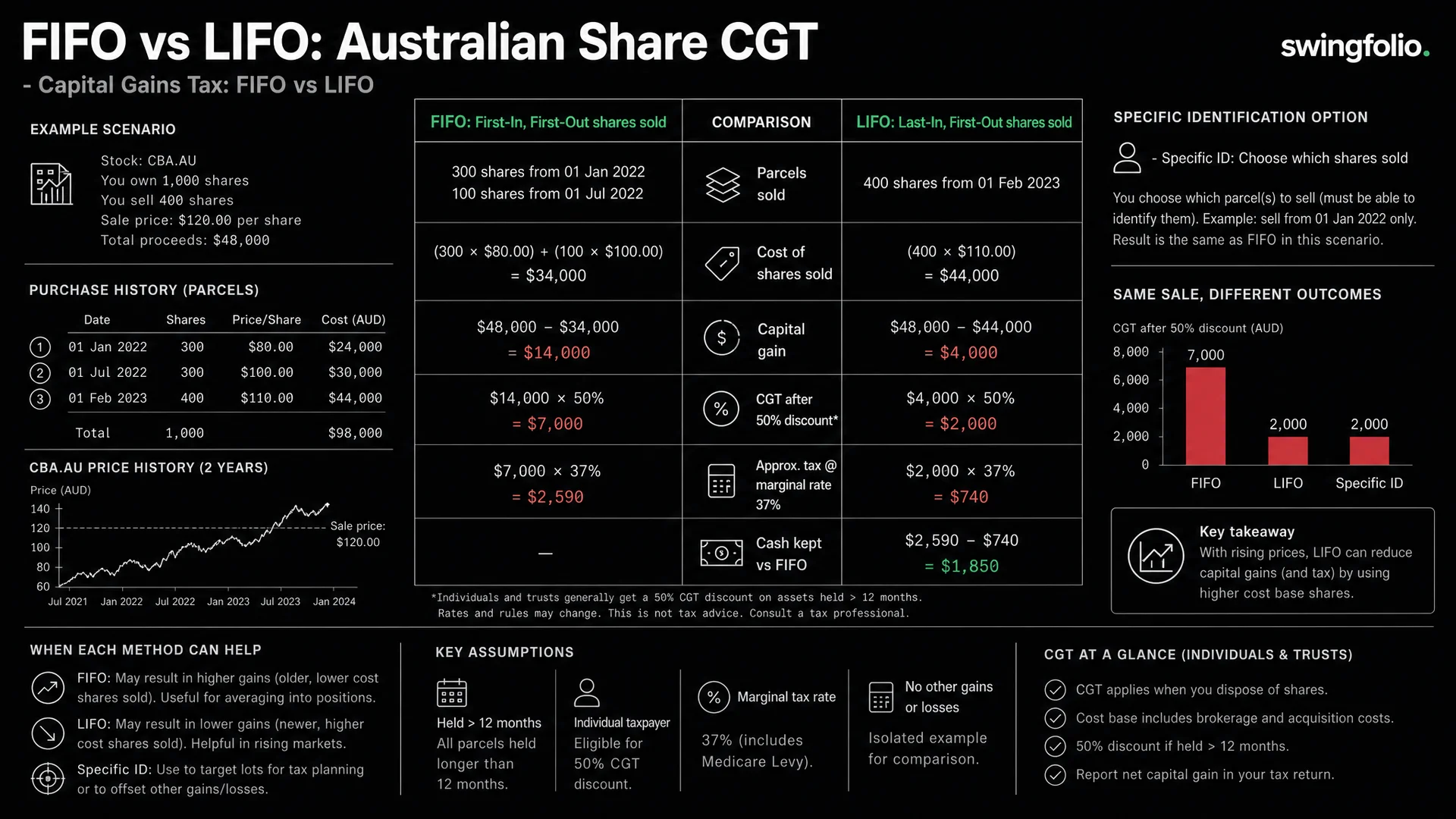
FIFO and LIFO are ways to match a share sale to earlier purchase parcels. For an Australian investor with identical shares bought on different dates, that choice can change the capital gain, discount eligibility and the parcels left for later.
The ATO's Determination TD 33 accepts FIFO as a reasonable basis when identical shares cannot otherwise be distinguished. It also accepts a taxpayer's selection of the shares disposed of when adequate records support that selection. The determination does not say that LIFO is a separate statutory method or that a broker's default decides the tax answer.
FIFO, LIFO and specific parcel selection
- FIFO, first in first out: match the sale to the oldest available parcel.
- LIFO, last in first out: match the sale to the newest available parcel. In practice, this is a form of specific selection that must be supported by records.
- Specific parcel selection: nominate the exact parcel or combination of parcels sold.
Average cost is generally not an acceptable shortcut for shares acquired on different days. Keep each parcel's acquisition date, quantity, price and incidental costs.
Full worked comparison using the same holdings
Assume an Australian resident individual holds three parcels in the fictional company ORB.AU. Brokerage is omitted to keep the parcel comparison visible. The investor sells 300 shares on 20 March 2026 for $38 each, producing $11,400 in capital proceeds.
| Parcel | Acquisition date | Units | Price per share | Cost base |
|---|---|---|---|---|
| 1 | 1 February 2025 | 300 | $34.50 | $10,350 |
| 2 | 15 May 2025 | 300 | $31.00 | $9,300 |
| 3 | 10 September 2025 | 300 | $36.80 | $11,040 |
For illustration, assume a 37% marginal tax rate, ignore Medicare levy and offsets, and assume the investor is eligible for the 50% CGT discount on a parcel held for at least 12 months. Actual tax depends on the taxpayer's circumstances and other capital gains and losses.
| Selection | Parcel sold | Proceeds | Cost base | Capital gain | Discounted gain | Illustrative tax at 37% |
|---|---|---|---|---|---|---|
| FIFO | Parcel 1 | $11,400 | $10,350 | $1,050 | $525 | $194.25 |
| LIFO | Parcel 3 | $11,400 | $11,040 | $360 | $360 | $133.20 |
| Specific selection | Parcel 2 | $11,400 | $9,300 | $2,100 | $2,100 | $777.00 |
The arithmetic is:
- FIFO: $11,400 minus $10,350 equals a $1,050 gain. Parcel 1 was held for more than 12 months, so the assumed 50% discount leaves $525. At 37%, the illustrative tax is $194.25.
- LIFO: $11,400 minus $11,040 equals a $360 gain. Parcel 3 was held for less than 12 months, so no discount applies. At 37%, the illustrative tax is $133.20.
- Parcel 2: $11,400 minus $9,300 equals a $2,100 gain. It was held for less than 12 months. At 37%, the illustrative tax is $777.
Here, the newest parcel produces the lowest current gain. FIFO still benefits from the discount, but its discounted taxable gain is larger than the LIFO gain. Specific selection provides the choice; it does not mean selecting Parcel 2 or always choosing the highest cost.
When FIFO can produce a lower taxable gain
Change only Parcel 1's purchase price to $36.00. Its cost base becomes $10,800 and the capital gain becomes $600. After the assumed 50% discount, $300 remains taxable. That is lower than the $360 taxable gain from Parcel 3.
This is why "highest cost wins" is incomplete. A parcel's acquisition date can matter as much as its cost base. Selling the oldest parcel can also preserve a newer parcel until it passes the discount date, although market risk may outweigh that possible tax benefit.
Add capital losses before comparing the final tax result
Capital losses are applied before the CGT discount. A taxpayer can generally choose which gains to reduce, so applying losses first to gains that do not qualify for a discount can preserve more of the discount.
Suppose the investor has two other results for the year:
- a $4,000 gain on a short-held parcel
- a $2,000 capital loss
Applying the $2,000 loss to the short-held gain leaves $2,000 taxable. The discounted FIFO gain from the worked example then adds $525, for $2,525 before other CGT concessions or adjustments. Applying that loss to a discount gain instead can waste part of the discount's effect.
Parcel selection should therefore be reviewed with the year's other gains, losses and carried-forward losses. The EOFY tax checklist for Australian traders gives you a copyable review timeline, while the capital gains tracking guide explains the records behind a CGT summary.
Investor parcel choice is different from trading stock
This article's worked table assumes the shares are held on capital account by an investor. A person carrying on a share-trading business may hold shares as trading stock and return gains or losses on revenue account. FIFO, specific CGT parcel selection and the 50% CGT discount do not transfer unchanged into that framework.
The labels "active trader" and "swing trader" do not decide tax classification. The ATO considers the nature, scale, repetition, organisation and commercial character of the activity. Get advice on your facts before using a CGT parcel method for business trading stock.
What records support a parcel selection?
Keep evidence that lets another person reproduce the result:
- contract notes for every acquisition and disposal
- acquisition date, quantity, price and brokerage for each parcel
- disposal date, quantity, price and selling costs
- corporate actions such as splits, demergers and returns of capital
- a dated record of which parcels were matched to the sale
- the calculation showing any losses and discounts applied
The ATO says CGT asset records are generally kept for five years after disposal. Some records need to be retained longer because they establish a cost base years before the asset is sold.
If one sale draws units from more than one parcel, show the split. For example, a 450-share sale could use all 300 shares from Parcel 3 and 150 shares from Parcel 1. Allocate proceeds and selling costs across those units, then calculate each parcel separately because their acquisition dates differ.
A repeatable selection workflow
Before finalising a tax calculation:
- Reconcile all holdings across brokers.
- List every available parcel and its adjusted cost base.
- Calculate the gain or loss on each possible parcel selection.
- Mark discount eligibility using the actual contract dates.
- Review current-year and carried-forward capital losses.
- Record the selected parcel matching and retain the evidence.
- Ask a registered tax agent to review material or uncertain choices.
Swingfolio can keep trade dates, prices, fees and partial exits together so you can prepare a clearer accountant handover. It does not choose a tax method or certify a CGT return. CSV import is available during an active trial, and you review imported trades before Save.
Keep trade dates, fees and partial exits together in Swingfolio for your accountant: Start the 30-day trial.
This article is general information and not tax advice.