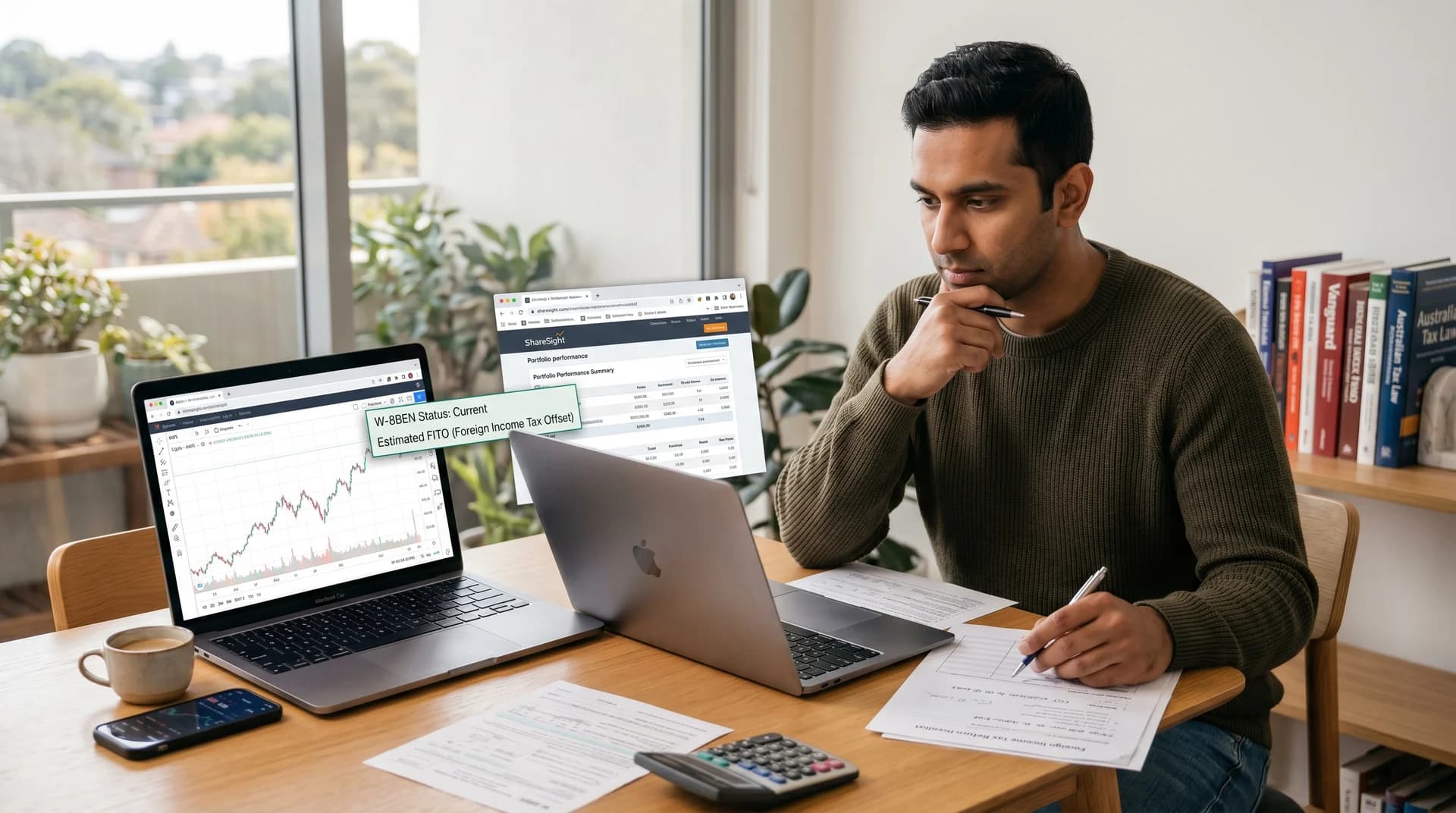
Australian residents generally include worldwide income and capital gains in their Australian tax return. For foreign shares, that means recording the investment in Australian dollars even when every broker screen shows US dollars, pounds or euros.
This guide covers individuals who are Australian tax residents and hold foreign shares as investments. Different rules can apply to share traders carrying on a business, temporary residents, companies, trusts, SMSFs and people with US tax obligations.
Start with a parcel-level record. The Australian shares CGT tracking guide explains the same core workflow, while this article adds currency, withholding tax and foreign-cash records.
Convert each tax event to Australian dollars
Calculate a foreign share's Australian dollar cost base using the exchange rate that applies when you acquire it. Calculate the Australian dollar capital proceeds using the rate that applies when you dispose of it. Include eligible transaction costs in the same way.
The ATO foreign exchange rates guidance explains acceptable translation methods. A published average rate may be reasonable for some recurring income, but it may not suit a one-off share purchase or sale when rates moved sharply. Use one defensible method and keep its source.
Worked AUD cost and proceeds example
Assume an Australian resident buys 100 shares in fictional LUMA.US for US$40 each. The exchange rate is US$0.64 for A$1 on the acquisition date. Purchase brokerage is US$8.
- shares: US$4,000 divided by 0.64 = A$6,250
- brokerage: US$8 divided by 0.64 = A$12.50
- AUD cost base: A$6,262.50
The investor later sells the parcel for US$46 per share when the exchange rate is US$0.61 for A$1. Sale brokerage is US$8.
- gross proceeds: US$4,600 divided by 0.61 = A$7,540.98
- brokerage: US$8 divided by 0.61 = A$13.11
- net AUD proceeds: A$7,527.87
- capital gain before other adjustments: A$1,265.37
The share price rose 15% in US dollars, but the AUD gain also reflects the currency movement. Save both rates and their dates. Do not convert the US dollar gain once at the sale-date rate because that loses the acquisition-date effect.
If an eligible individual owns the parcel for at least 12 months, the CGT discount may apply after capital losses and other CGT steps. The 2026-27 Budget reforms change the treatment of many capital gains from 1 July 2027, so see the dated Budget CGT guide for assets held across that start date.
Report foreign dividends gross
Record the gross foreign dividend before withholding tax, converted to AUD. Also record the foreign tax withheld and the net cash received.
Suppose fictional LUMA.US pays a US$500 dividend when US$0.65 equals A$1. The payer withholds US$75 and deposits US$425.
- gross foreign income: US$500 divided by 0.65 = A$769.23
- foreign tax withheld: US$75 divided by 0.65 = A$115.38
- net cash received: US$425 divided by 0.65 = A$653.85
The tax return starts with the A$769.23 gross income, not the A$653.85 deposit. Whether the A$115.38 supports a foreign income tax offset depends on the FITO rules and the investor's full position.
Check the foreign income tax offset limit
A foreign income tax offset can reduce Australian tax when qualifying foreign tax was paid on income included in Australian assessable income. It is an offset, not a refund of every foreign amount withheld.
The ATO FITO guidance provides a shortcut when the total foreign income tax claimed is $1,000 or less. Above $1,000, the taxpayer generally needs to calculate the FITO limit. Even below that threshold, the foreign tax must meet the eligibility rules.
Keep the dividend statement, proof of withholding and AUD conversion together. If a foreign country withheld more than the treaty rate, ask whether the excess must be recovered overseas rather than claimed in Australia.
US dividends and Form W-8BEN
For a qualifying Australian resident beneficial owner, the Australia-US treaty generally limits US withholding on portfolio dividends to 15%. A broker commonly uses a valid Form W-8BEN to document foreign status and treaty eligibility. Without valid documentation, the payer may withhold at the US statutory rate.
Form W-8BEN generally remains in effect until the end of the third calendar year after it is signed, unless a change in circumstances makes it incorrect. Check the broker's renewal notice and the IRS instructions for Form W-8BEN.
The form does not calculate Australian CGT or remove the need to declare foreign dividends in Australia.
Foreign cash can create another recordkeeping task
Selling shares into a foreign-currency cash balance and spending or converting that cash later can create a separate forex event. Division 775 contains the foreign exchange rules.
The $250,000 balance election can let an eligible taxpayer disregard certain gains and losses on qualifying foreign-currency transaction or credit-card accounts. It is an election with account and balance conditions. It is not an automatic rule that puts every small brokerage cash balance under CGT.
Ask your tax agent whether the broker cash facility is a qualifying forex account and whether an election exists. Preserve each deposit, withdrawal, conversion and fee until that treatment is settled.
Foreign share tax checklist
For each purchase, keep:
- trade date, settlement date, ticker, exchange and quantity
- foreign price, brokerage and total amount
- AUD exchange rate, rate source and conversion
- parcel identifier and later cost-base adjustments
For each sale, keep the same details plus the acquisition parcel selected and the AUD gain or loss calculation.
For income and cash, keep:
- gross dividends, foreign tax withheld and net receipts
- exchange rates used for each income amount
- W-8BEN submission and expiry records for US holdings
- foreign cash ledger, conversions and account statements
- corporate actions and tax vouchers from the issuer or broker
Keep tax records for the period the ATO requires. CGT records often need to remain available throughout ownership and for years after the later CGT event, which can be longer than five years from purchase.
Common errors to catch before lodgment
- converting only the final profit instead of cost and proceeds separately
- using the net dividend deposit as foreign income
- claiming foreign withholding without checking FITO eligibility or the limit
- losing the rate source used for a transaction
- ignoring cash left in the foreign-currency facility
- combining multiple purchase parcels into one unsupported average
- assuming a broker tax summary applies Australian rules to your circumstances
Foreign share tax FAQs
Can I use the exchange rate on my broker statement?
Use it when it represents the actual conversion and suits the tax translation rule for that event. Keep the statement and method. If the broker shows an indicative rate, use a defensible source for the transaction date.
What if dividends are reinvested?
Record the gross dividend and withholding first. Then record the reinvestment as a new share acquisition with its own date, quantity, foreign amount and AUD cost base.
Do I report a foreign share gain if the money stays overseas?
A share disposal can create an Australian tax event even when the proceeds remain in foreign currency. The retained cash may then create separate forex records.
Organise the handover with Swingfolio
Swingfolio can keep trade dates, quantities, prices, fees and notes in one history. During an active trial, you can import CSV trades and review them before saving. Record the foreign amounts and keep your broker statements, exchange-rate evidence and tax workpapers beside the export.
Start the 30-day trial and turn foreign trade activity into a file your tax agent can trace.
This article is general information and not tax advice.