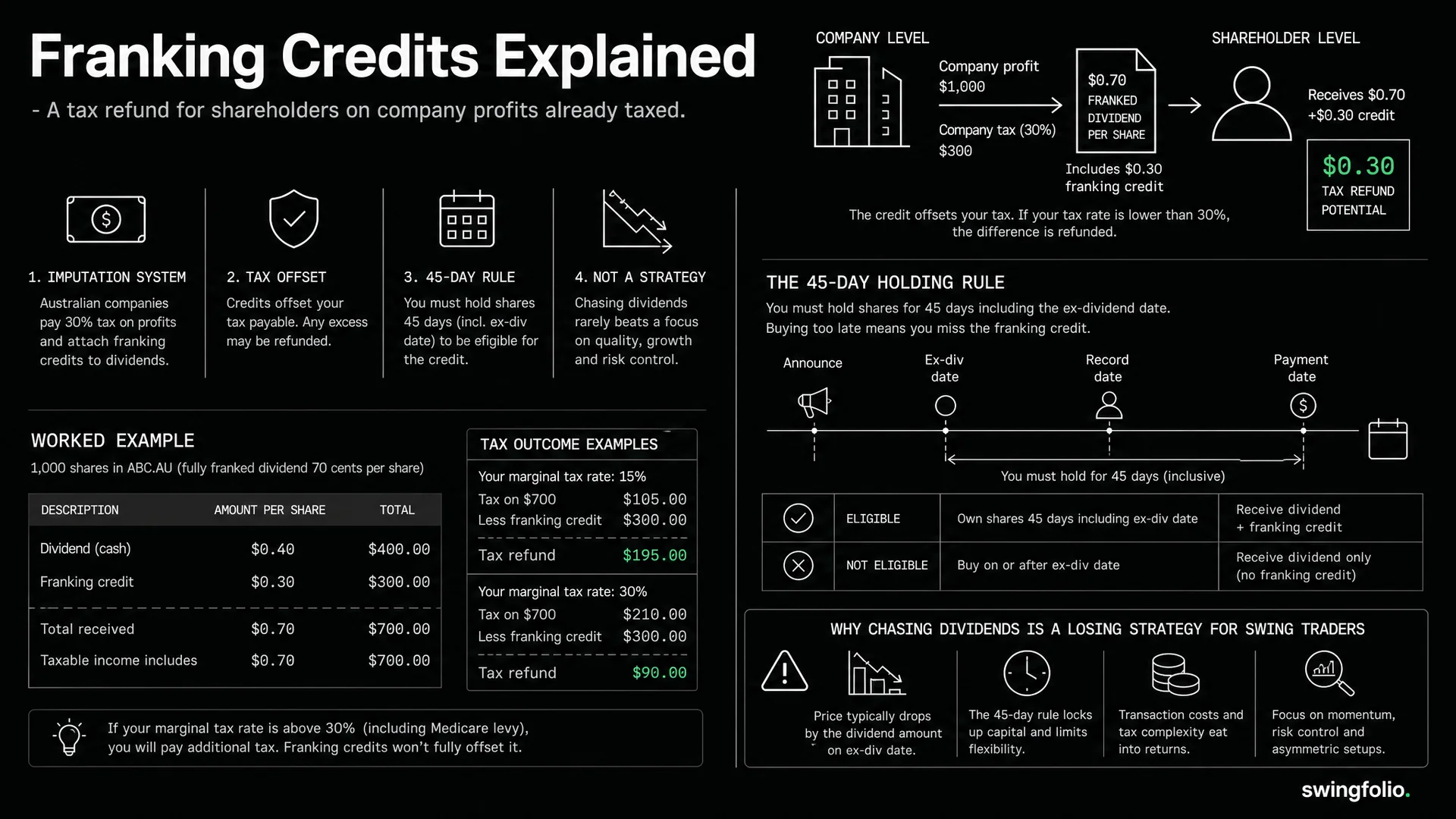
A franking credit represents Australian company tax linked to a franked dividend. An eligible Australian resident shareholder generally includes the cash dividend and attached credit in assessable income, then claims the credit as a tax offset.
For active traders, the key issue is eligibility. Receiving a dividend statement with a credit does not always mean you can claim it. Holding-period, related-payment and dividend-washing rules can matter around short trades.
How franking credits work
Suppose a company taxed at 30% distributes $70 of after-tax profit as a fully franked dividend. The attached credit is $30, so the shareholder's grossed-up dividend income is $100.
- Cash dividend: $70
- Franking credit: $30
- Assessable franked amount: $100
- Illustrative tax at a 37% marginal rate: $37
- Less eligible franking tax offset: $30
- Illustrative remaining tax: $7
This simplified example excludes Medicare levy and the rest of the return. Whether an excess offset is refundable depends on eligibility and the taxpayer's circumstances, so never assume a cash refund from the dividend alone.
For a $1,000 fully franked cash dividend at a 30% franking rate, the credit is $1,000 x 30 / 70 = $428.57. Grossed-up income is $1,428.57. Use the amount on the dividend statement for tax records.
Fully, partly and unfranked dividends
- Fully franked: the whole dividend carries franking credits at the stated corporate tax rate.
- Partly franked: only part of the dividend carries a credit.
- Unfranked: no franking credit is attached.
The company tax rate used for franking can differ between companies and years. Your statement shows the franked amount, unfranked amount and attached credit.
The 45-day holding-period rule
The ATO's holding-period rule generally requires ordinary shares to be held at risk for at least 45 days, excluding purchase and sale days. Certain preference shares use a longer period. Material hedging can affect whether a day counts.
The rule does not simply mean holding until 45 days after the ex-dividend date. Multiple parcels, options, related payments or trust holdings can require extra calculation.
A short swing may receive the cash dividend but fail the holding-period test for its credit. Record the payment and flag the credit for review instead of claiming it automatically.
A simple holding-period calendar
Assume fictional ordinary shares are bought on 1 August and sold on 20 September. The purchase day and sale day do not count. The days from 2 August through 19 September provide 49 calendar days before considering whether the shares remained at risk.
Now assume the same shares are sold on 10 September. Only 39 days sit between the excluded purchase and sale days. The ordinary 45-day test is not met on that simple timeline. The exemption and other rules still need separate review.
You do not need to hold the shares for 45 days before the ex-dividend date. Qualifying days can fall within the rule's relevant period around the entitlement, subject to the detailed conditions.
Small-shareholder exemption
The ATO says the holding-period rule generally does not apply under the small-shareholder exemption when an individual's total franking tax offset entitlement for the income year is below $5,000. The threshold concerns credits, not cash dividends, and includes relevant direct and indirect entitlements.
This exemption has limits. It does not override the related-payments rule, and it is not available to every entity. A trader with long-term holdings, fund distributions and short-term trades should total all relevant credits before relying on it.
Read the ATO's holding-period and small-shareholder guidance, or ask a registered tax agent when transactions are near the boundary.
How the ex-dividend date affects a trade
On the ex-dividend date, a buyer no longer receives the declared dividend. The market price may adjust for that transfer of value, but its actual move also reflects news, supply and demand. Do not assume an exact fall.
If your swing spans the date:
- include the dividend in total-return analysis
- keep the dividend separate from sale proceeds in tax records
- review whether a price-based stop still matches the strategy
- do not widen a stop after the fact to avoid an ex-date move
Buying solely to collect a dividend does not create free return. Price risk, trading costs and tax still apply, and the credit may be unavailable.
Fictional active-trader example
Assume a fictional WATTLE.AU trade buys 1,000 shares at $10.20. During the hold, the trader becomes entitled to a $0.12 fully franked cash dividend, or $120.
The statement shows a $51.43 credit at a 30% franking rate. If eligible, tax records include $171.43 of grossed-up dividend income and a $51.43 offset. The share trade result is calculated separately under the tax treatment that applies.
If the trader sells after only 18 qualifying days, the credit requires review under the holding-period and exemption rules. A useful journal note is: "Received $120 cash; $51.43 credit shown; eligibility pending."
Partly franked dividend example
Assume another fictional dividend pays $1,000 cash and its statement shows $600 franked, $400 unfranked and a $257.14 credit. The assessable dividend components are not replaced by the credit.
If eligible, the record shows:
- franked cash amount: $600
- unfranked cash amount: $400
- franking credit: $257.14
- total assessable amount from those items: $1,257.14
- potential franking tax offset: $257.14
Use the statement's figures. "60% franked" alone is not enough when the issuer's franking rate and exact credit are available.
Related payments and reduced risk
The small-shareholder exemption relates to the holding-period rule. It does not excuse a failure of the related-payments rule. An arrangement that passes the dividend or its value to someone else can require a different qualifying period.
Days may also fail the at-risk test when options or other positions materially remove exposure to price changes. Traders using puts, calls, short positions or linked transactions should give the full arrangement to their tax adviser, not just the share purchase dates.
Dividend record checklist
Keep:
- company and security name
- payment and ex-dividend dates
- quantity entitled to the dividend
- franked and unfranked cash amounts
- franking credit on the statement
- TFN withholding, if any
- purchase and sale dates
- hedges or related-payment arrangements
- managed-fund annual tax statements
- evidence for any exemption relied upon
Reconcile statements to bank cash and annual broker or registry summaries. The issuer statement and complete transaction history support the final treatment.
The capital gains reporting guide covers disposals, losses and CGT calculations. Dividend income and credits need their own reconciliation even when the same shares were sold.
Franking credit questions for traders
Do I lose the cash dividend if I fail the 45-day rule?
The holding-period rule concerns entitlement to the franking tax offset. The cash dividend you received still needs to be recorded and reported under the rules that apply to you.
Does every credit below $5,000 qualify?
No. The small-shareholder threshold is based on the individual's total annual franking tax offset entitlement, and other integrity rules can still apply. Review the whole year rather than one payment.
Can I add the credit to trade profit?
Keep price profit, cash dividends and tax offsets as separate lines. You can combine them later for total-return analysis, but a franking credit is not sale proceeds or guaranteed cash.
What if I trade and invest in different portfolios?
Separate portfolios can help your review, but the annual tax tests can still consider entitlements across holdings. Include long-term investments, fund distributions and short trades in the same eligibility check where required.
Keep dividends in the trading plan
Check ex-dividend and payment dates before entry. Decide how the strategy treats an expected adjustment, and record why you hold through it. Judge the trade on total return and your circumstances rather than dividend yield alone.
Swingfolio helps keep trades, fees and notes together, giving your accountant a clearer history. Start the 30-day trial and build the record while each decision is fresh.
This article is general information and not tax advice.