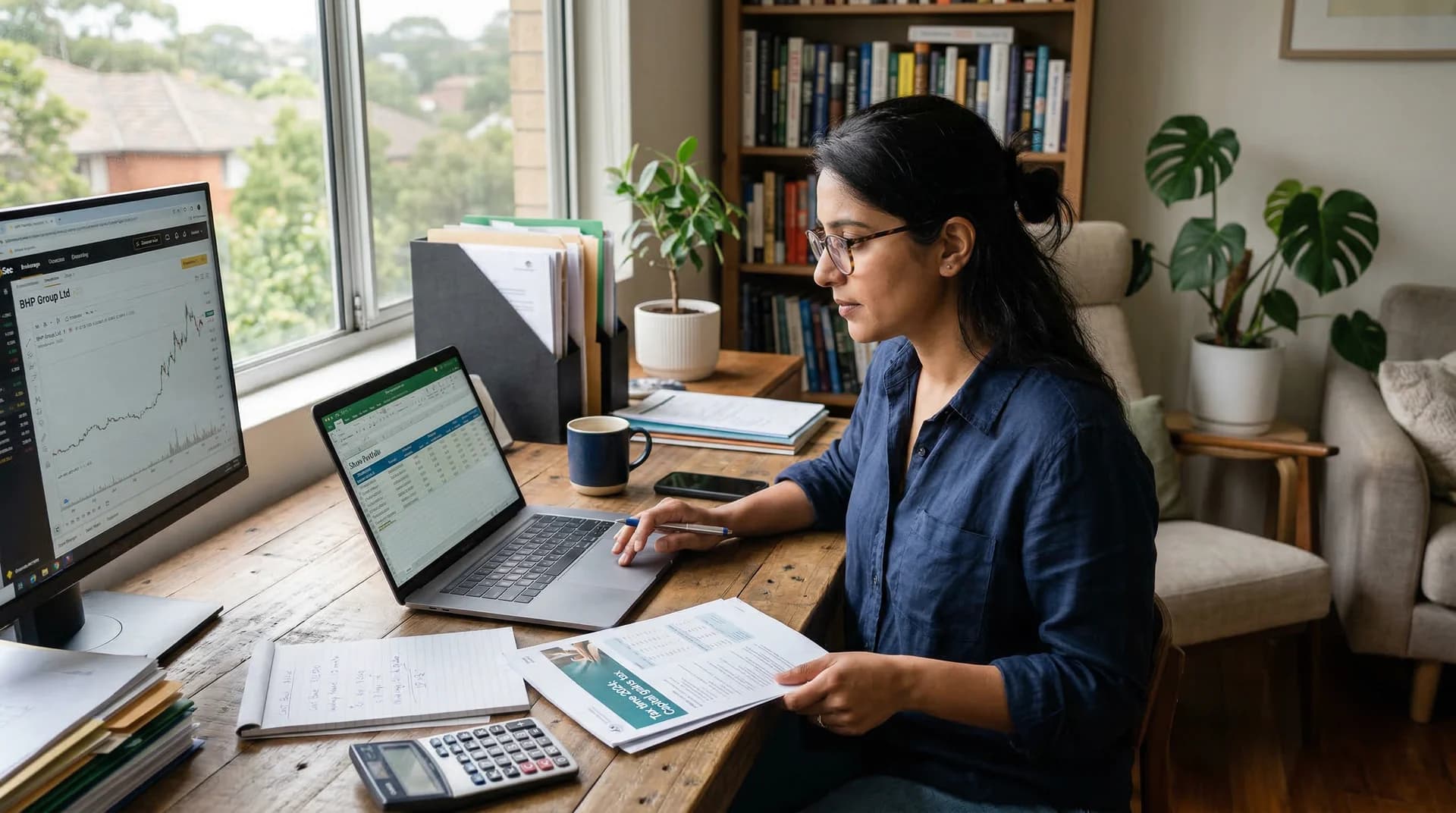
Selling shares can create a capital gain or loss. If you wait until tax time to match purchases with sales, missing contract notes and brokerage can make the calculation difficult. Record each parcel when you buy it, then update it when you sell.
How capital gains tax works on shares in Australia
The ATO explains that capital gains tax is part of income tax, rather than a separate tax. A CGT event usually happens when you dispose of an asset, including shares. Your tax return includes reportable capital gains and losses.
For shares held on capital account:
- Work out the capital proceeds from the disposal.
- Work out the parcel's cost base or reduced cost base.
- Calculate the capital gain or loss.
- Apply current-year and carried-forward capital losses before any CGT discount.
- Include the resulting net capital gain in your assessable income.
A capital loss can reduce capital gains in the same year or a later year. It cannot reduce salary or other ordinary income. If you carry a loss forward, keep the records until the relevant review period ends after you have used the loss.
These rules differ if you carry on a business of share trading. The ATO treats shares in that business as trading stock and treats profits as ordinary income. Activity alone does not settle your status. The ATO considers your purpose, repetition, volume and whether you conduct the activity in a business-like way. Get tax advice if your classification is uncertain.
Track each share parcel
Each purchase creates a parcel with its own acquisition date, quantity and costs. Record:
- the security and exchange
- acquisition and disposal dates
- quantities bought and sold
- purchase and sale prices
- brokerage and other relevant transaction costs
- corporate actions, including splits, mergers and demergers
- dividend reinvestment purchases
- the source and date of any currency conversion
Keep contract notes and statements with the calculation. The ATO's CGT record guidance says records must identify the event, its date, the parties and how it affects the gain or loss. In many cases, you must keep them for at least five years after the CGT event. Some records need to be kept longer.
Calculate the cost base
The first element of a share parcel's cost base is what you paid. Incidental costs can include brokerage on acquisition and disposal. Other events can change the cost base, so check the ATO treatment for dividend reinvestment plans and corporate actions rather than relying on an average portfolio price.
Consider this hypothetical example. You buy 1,000 units in SAMPLE.AU at $10 and pay $19.95 brokerage. Fourteen months later, you sell them for $15,000 and pay another $19.95 brokerage.
- Purchase amount: 1,000 x $10 = $10,000
- Cost base in this example: $10,000 + $19.95 + $19.95 = $10,039.90
- Capital gain before losses and any discount: $15,000 - $10,039.90 = $4,960.10
The example assumes both brokerage amounts form part of the cost base and no other adjustment applies. Your facts may produce a different cost base.
Check the CGT discount date
Australian resident individuals may qualify for the 50% CGT discount when they acquired the asset at least 12 months before the CGT event. Companies cannot use the CGT discount. Eligibility also depends on the asset and taxpayer.
The date test excludes both the acquisition day and the disposal day. For shares acquired on 15 January 2025, the first eligible disposal date is 16 January 2026. A sale on 15 January 2026 is too early.
Apply capital losses before the discount. Assume the full $4,960.10 gain in the hypothetical example remains after applying losses. Also assume the taxpayer qualifies for the 50% discount:
- Discount: $4,960.10 x 50% = $2,480.05
- Discounted capital gain: $4,960.10 - $2,480.05 = $2,480.05
This calculation does not estimate the tax payable. The person's other income, deductions and circumstances affect that result.
Match sales to the right parcels
If you buy the same shares on different dates, identify which shares you sold. The ATO's share examples treat each share as a separate CGT asset and require records for separate parcels. Your records must support the parcel selection. Do not assume that an average portfolio cost supplies the tax cost base.
Partial exits also need parcel-level records. If you buy 1,000 units, sell 400 and later sell 600, record each disposal date, quantity, proceeds and allocated cost.
Worked partial-sale example
Suppose you buy 1,000 SAMPLE.AU units at $10 and pay $20 brokerage. The purchase parcel costs $10,020, or $10.02 per unit for this example. You later sell 400 units at $13 and pay $15 sale brokerage.
- Gross proceeds: 400 x $13 = $5,200
- Allocated purchase cost: 400 x $10.02 = $4,008
- Sale brokerage: $15
- Example capital gain: $5,200 - $4,008 - $15 = $1,177
The remaining 600 units retain $6,012 of the original parcel cost in this simplified example. Keep the calculation with both disposal and holding records. Corporate actions or other adjustments can change the result.
Handle dividends and corporate actions
A cash dividend is not another purchase parcel. A dividend reinvestment plan is different because the reinvested amount buys new shares. Record each reinvestment date, quantity and cost as a separate parcel.
Share splits change the number of units and the cost per unit without creating the same result as a purchase. Demergers, takeovers, returns of capital and bonus issues can also alter your records. Keep the issuer statement and use the ATO instructions for that event.
Track foreign shares in Australian dollars
For an international trade, keep the foreign currency values and the Australian dollar conversion for each relevant transaction. Record the rate, source and date used. Acquisition and disposal happen on different dates, so one exchange rate may not support both sides of the calculation.
Keep foreign brokerage and other costs with the transaction too. Your tax professional can then review the conversion method without reconstructing the original currency amounts.
Use a monthly CGT record routine
Set aside a short monthly review rather than rebuilding a year of activity in July:
- Download the broker statement and contract notes.
- Match every purchase and sale to your parcel register.
- Record brokerage, currency conversion and corporate actions.
- Confirm that units bought minus units sold equal units still held.
- Store the documents by financial year and broker.
- Mark any unresolved parcel or cost question for your accountant.
This routine does not change the tax rules. It keeps missing information small enough to resolve while the transaction is recent.
When you are ready to combine those parcel records into a financial-year summary, use the CGT report checklist for active traders.
Check gains, losses and records before lodging
Reconcile your trade list against broker statements. Check that total quantities bought, sold and still held agree. Then check brokerage, corporate actions, currency conversion and carried-forward losses.
Swingfolio's ATO tax reports bring disposal records, holding periods, gains, losses and discount estimates into one financial-year view. You can review the figures in an Australian Tax Report or MyTax Fields view, then export the tax data to Excel. Compare the export with your contract notes and ask an accountant to check the treatment that applies to you.
For one disposal, use the CGT calculator as an estimate. The portfolio analytics dashboard covers trading performance rather than deciding your tax status. The investor tools provide portfolio tracking for longer-term holdings.
Frequently asked questions
Do I report shares if I made a capital loss?
Include capital gains and capital losses in your tax return. A net capital loss can reduce capital gains in a later year, but it cannot reduce salary or other ordinary income. Keep the supporting records until the relevant review period ends after you use the loss.
Can I average the cost of shares bought at different prices?
Keep each parcel's acquisition details. Your tax calculation needs to identify the shares sold and the costs attached to them. A portfolio's average price does not replace parcel records.
Does every share sale qualify for the 50% CGT discount after one year?
No. The taxpayer, asset and timing must qualify. For an eligible Australian resident individual, the disposal must occur after the 12-month anniversary. Apply capital losses before the discount.
Can I rely on a broker's annual tax report?
Use it as one source, then reconcile it with contract notes, other brokers, corporate actions and carried-forward losses. A broker may not have the complete history of parcels held elsewhere.
What if I transferred shares between brokers?
A broker transfer does not provide the receiving broker with every part of your tax history. Keep the original acquisition dates, costs and corporate-action records, then reconcile the transferred quantity at both brokers.
What happens if I cannot find the purchase record?
Do not guess the cost. Search broker archives, bank records, issuer statements and registry records. Ask your tax professional how to establish the cost base with the evidence available.
How often should I reconcile CGT records?
Choose a routine you will follow. A monthly check can catch missing trades while statements remain easy to find. Confirm that quantities and cash transactions agree, then store the report with your source records.
Record the next purchase when it happens, keep the contract note with your source records, and track each parcel separately. To organise your trades and prepare the tax views, Start the 30-day trial.
This article is general information and not tax advice.