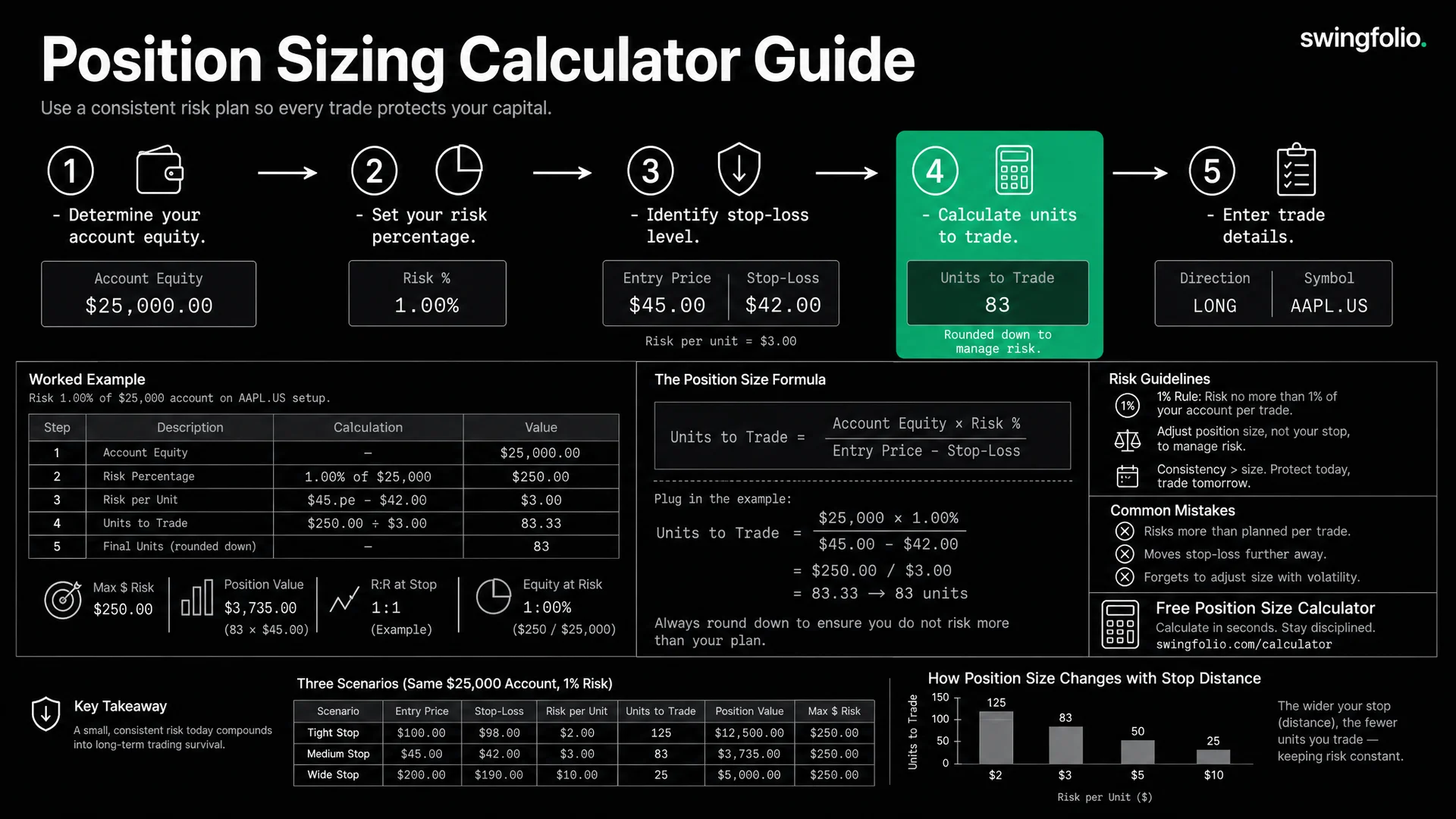
A position size calculator converts your account value, planned risk and stop distance into a number of shares. You decide where the trade idea fails first. The calculator then limits the units so that a stop at that price matches your risk budget.
The formula is:
Position size = (account value x risk percentage) / risk per share
For a long trade, risk per share is entry price minus stop price. For a short trade, it is stop price minus entry price.
How to use the free calculator
Open Swingfolio's position size calculator and enter:
- Entry price
- Stop loss price
- Account value
- Risk percentage
- Direction, long or short
Target price is optional. If you enter one, the calculator also shows potential reward and the planned risk-to-reward ratio.
The results show whole shares, investment amount, risk amount and stop distance. The calculator does not ask for brokerage or available cash, so check both before placing an order.
Three worked position size examples
The examples are hypothetical. The tickers identify real securities, but the prices are invented for teaching.
Example 1: a standard ASX trade
- Account value: $50,000
- Risk percentage: 1%
- Entry for CBA.AU: $130.00
- Stop: $126.00
Risk amount is $50,000 x 1% = $500. Risk per share is $4.00.
Position size = $500 / $4.00 = 125 shares
The position value is 125 x $130.00 = $16,250. The stop risk is 1% of the account, while the purchase uses 32.5% of the account's value. Risk and capital required are different constraints.
Example 2: a smaller account with fees
- Account value: $15,000
- Risk percentage: 1%
- Entry for PLS.AU: $3.20
- Stop: $2.95
Risk amount is $150. Risk per share is $0.25.
Position size before fees = $150 / $0.25 = 600 shares
The position costs $1,920 before brokerage. If estimated round-trip brokerage is $19 and you want all costs inside the $150 budget, market risk has $131 left.
Fee-adjusted size = $131 / $0.25 = 524 shares
Real fills and fees can differ from the estimate. Record actual costs when you review the trade.
Example 3: a wider stop reduces the position
- Account value: $50,000
- Risk percentage: 1%
- Entry for FMG.AU: $18.50
- Stop: $16.00
Risk amount is $500. Risk per share is $2.50.
Position size = $500 / $2.50 = 200 shares
The position value is $3,700, or 7.4% of the account. A wider percentage stop produces a smaller position for the same dollar risk.
Do not tighten a stop only to buy more shares. Place the stop where the setup is invalid, then let that distance determine the unit count.
Risk percentage is a choice, not a universal rule
Many examples use 1% because the arithmetic is easy to follow. It is not a safe percentage for every trader or strategy. Choose risk from tested results, losing streaks, drawdown tolerance and the number of positions you hold together.
Fixed-percentage sizing also compounds. After a loss, the next dollar risk falls with account equity. After a gain, it rises. Use a consistent definition of account value so the calculation does not change according to how you feel about a setup.
Check cash, fees and tradable units
The risk formula can return a position you cannot fund. In Example 1, a tighter stop could produce a share count whose purchase value exceeds the cash available.
Apply these checks after the calculation:
- Round down to a tradable whole unit.
- Confirm the purchase value fits available cash and any allocation limit.
- Reserve estimated entry and exit fees inside the risk budget if that is your rule.
- Allow for slippage and gaps, which can create a loss larger than the planned stop risk.
- For a short trade, check borrowing availability and costs separately.
If cash is the binding constraint, reduce the units. Do not move the stop closer merely to make the calculator return a larger position.
Connect position size to portfolio heat
The calculator sizes one proposed trade. It does not assess the risk already open across the account.
Suppose you have 4% portfolio heat and your plan caps normal heat at 5%. A new trade sized at 1.5% risk would take projected heat to 5.5%. Reduce the size, wait for another position to close or reject the setup.
Use the portfolio heat workflow before every new order. The portfolio heat tracker can keep the open-position view beside your journal.
Connect position size to R-multiples
One R is the initial risk you planned for the trade. If a $50,000 account risks $500, then 1R is $500 before costs.
- A +2R result is a $1,000 gross profit.
- A -0.5R result is a $250 gross loss.
- A stop filled as planned is about -1R before costs.
Consistent sizing makes results easier to compare, but fees, slippage, partial exits and changing account value prevent a perfect conversion from R to account percentage. The R-multiple calculator guide covers those details.
Use the result as a limit
Treat the calculated units as the maximum for the inputs you chose. You can take fewer shares when liquidity, concentration or available cash requires it.
Swingfolio keeps planned entry, stop, target and strategy context with the trade record. That gives you the inputs needed to compare planned risk with the result after the position closes.
Start the 30-day trial to keep each planned entry, stop and size beside the result in Swingfolio.