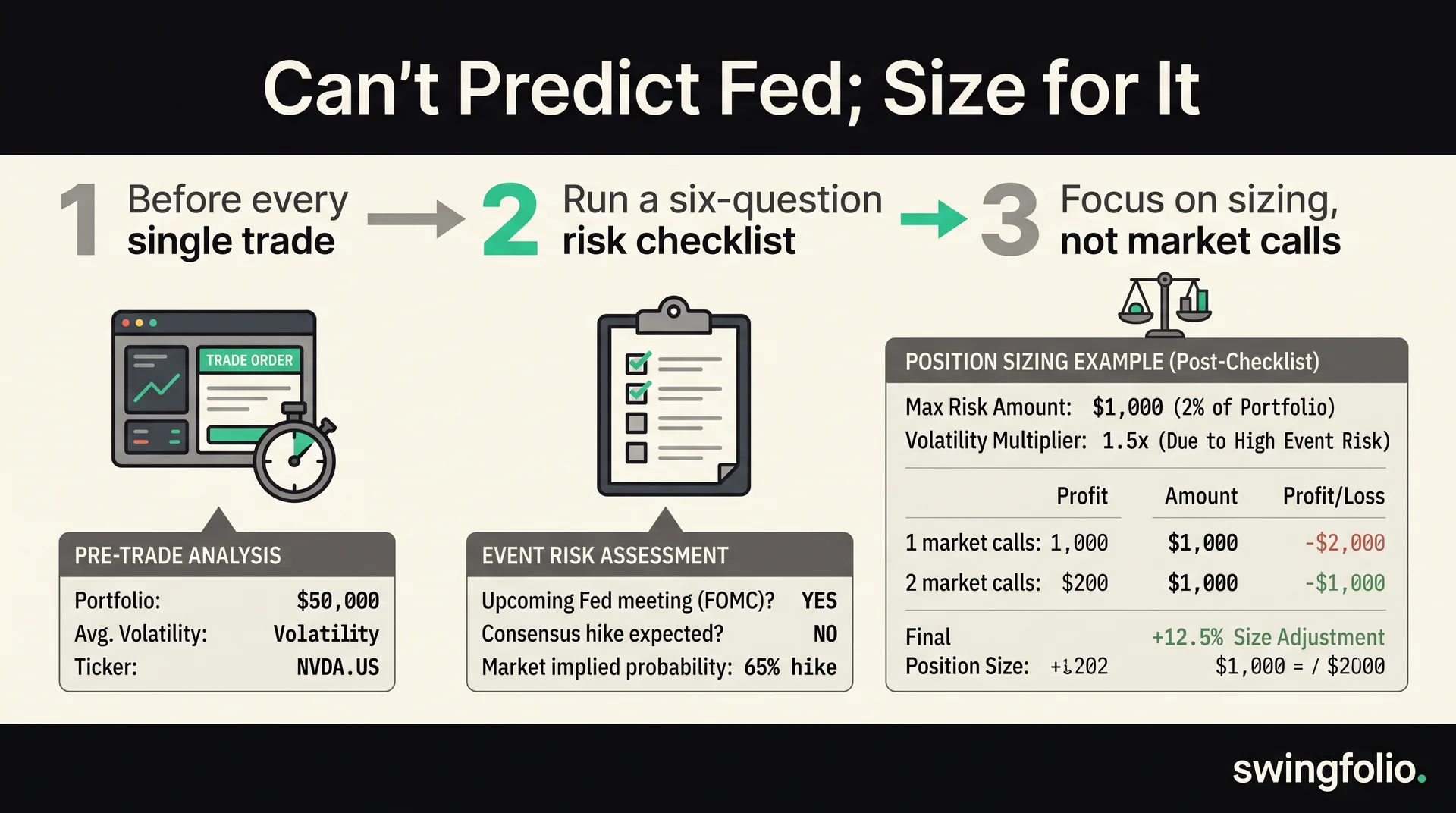
A rate decision, inflation release or jobs report creates two separate unknowns. You do not know the number with certainty, and you do not know how traders will react to it. A strong report can lift prices if the market expected worse. A weak one can cause a sell-off if positioning was built for relief.
Your forecast may still help you form a view. It should not decide how much loss your account can absorb. Before every scheduled event, answer the same six questions.
The six-question macro event checklist
1. Which open position loses the most if the event goes against me?
Rank positions by dollars at risk, then consider gap exposure. A small share count in a volatile stock can carry more event risk than a larger holding in a slower one.
2. Where is every stop, and could a normal event move cross it?
Write down the planned stop and its distance from the latest price. A stop can control an ordinary exit, but a gap can fill beyond its trigger. If the event's plausible range makes the stop meaningless, reduce the position rather than pretending the order guarantees the loss.
3. Do I want full size, reduced size or no position into the release?
Choose before the announcement. Full size, half size and flat are risk decisions, not forecasts. Use the volatility-based position sizing formula to translate your dollar limit and stop distance into shares.
4. How concentrated am I in the sector or factor this event hits?
Three banks can respond to one rate surprise. Several technology positions can respond to the same bond-yield move. Add the risks together before treating them as separate trades.
5. How much cash do I want available after the event?
Cash gives you room to respond without selling another position under pressure. Set the amount before the release, including any unsettled trades or orders that could fill.
6. What will I record after it is over?
Record the position size, plan, actual reaction, exit and any slippage. The note lets you compare your decision with the result without rewriting your forecast after the fact.
Turn the answers into a sizing decision
Use a short pre-event sequence:
- List the event time and every exposed position.
- Calculate planned loss at each stop and the combined total.
- Add a gap scenario that is wider than the stop.
- Compare both totals with your account and sector limits.
- Reduce, close or keep each position.
- Write the conditions for adding size back after the release.
The gap scenario is not a prediction. It tests whether the account can tolerate a worse fill than the neat number in the trade plan.
Hypothetical example: forecast right, trade wrong
Assume a trader expects a central bank to leave rates unchanged. They hold two rate-sensitive positions with $300 planned stop risk each. Both stops sit 3% below the market.
The bank does leave rates unchanged, so the forecast is correct. Its statement is more restrictive than traders expected, and both positions open 6% lower. Each $10,000 position loses a hypothetical $600. Combined loss is $1,200 rather than the planned $600.
The lesson is not that the forecast lacked value. The position decision ignored the second unknown: the market reaction and resulting execution price. Reducing both positions by half would have reduced the hypothetical loss to $600 without requiring a different economic view.
Decide when to restore size
Removing risk before an event needs an after-event rule. Otherwise, temporary caution becomes an unplanned market-timing decision.
You might wait for the first hour to pass, for price to reclaim a level, or for the next daily close. Write that condition before the release. If it never occurs, you have a defined reason for staying smaller.
Frequently asked questions
Should I close every position before a Fed or RBA decision?
No single answer fits every strategy. Compare the combined event loss you can tolerate with your positions, stop distances and gap exposure, then choose full size, reduced size or no position.
Does a stop-loss protect me from an overnight event?
A stop triggers an order. It does not guarantee a fill at the stop price when the market gaps or liquidity disappears.
Is an economic forecast useless for trading?
No. It can inform a scenario, but it should remain separate from the maximum loss and position size you choose before the event.
Start the 30-day trial to save the six answers in Swingfolio and compare your next event plan with its outcome.
General information only. Not financial advice. Trading involves significant risk of loss. Past performance is not indicative of future results. Always do your own research and consider seeking advice from a licensed financial advisor.