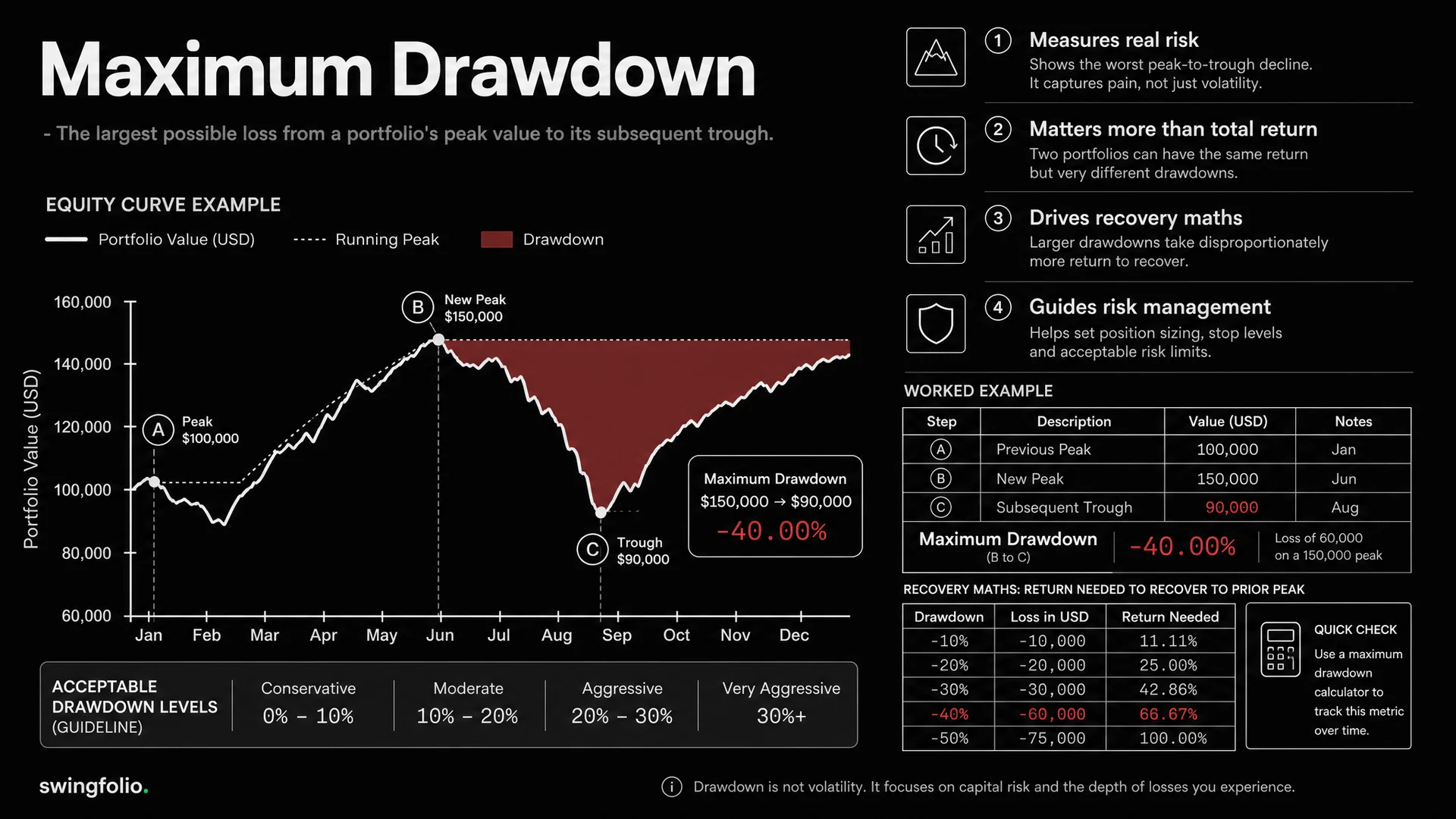
Maximum drawdown is the largest fall from an account's previous peak to the lowest point before a new peak. It tells you how deep the worst decline became, even if the account later recovered.
Return tells you where the account finished. Maximum drawdown tells you what you had to survive on the way there. You need both numbers to judge a trading record.
Maximum drawdown formula
For each point on an equity curve, compare the current value with the highest earlier value:
Drawdown (%) = (Current value - Running peak) / Running peak x 100
The most negative result is maximum drawdown. Some tools display drawdown as a positive loss, such as 20%, while others display it as -20%. The size is the same.
Suppose an account rises from $50,000 to $60,000, falls to $48,000, then recovers to $63,000:
($48,000 - $60,000) / $60,000 x 100 = -20%
The maximum drawdown is 20%. The starting value of $50,000 does not set the peak after the account reaches $60,000.
After you calculate the peak-to-trough percentage from your equity history, enter it in the free drawdown recovery calculator. Add an account size and a hypothetical monthly return to see the dollars lost, gain needed to recover and estimated recovery time at that constant rate. The monthly return is a scenario input, not a forecast.
Worked equity-path example
This fictional sequence shows why you must track the running peak rather than compare every value with the starting balance.
| Checkpoint | Equity | Running peak | Drawdown |
|---|---|---|---|
| Start | $50,000 | $50,000 | 0% |
| Trade 1 | $54,000 | $54,000 | 0% |
| Trade 2 | $51,300 | $54,000 | -5.0% |
| Trade 3 | $56,000 | $56,000 | 0% |
| Trade 4 | $49,280 | $56,000 | -12.0% |
| Trade 5 | $52,640 | $56,000 | -6.0% |
| Trade 6 | $57,120 | $57,120 | 0% |
The largest decline is 12%, from the $56,000 peak to the $49,280 trough. The drawdown ends only when equity exceeds $56,000 at Trade 6. A partial rebound to $52,640 reduces the current drawdown but does not complete the recovery.
Track three dates for a full review: the peak date, the trough date and the recovery date. The depth measures capital damage. The time from peak to recovery measures how long the strategy remained underwater.
Why recovery gets harder as drawdown deepens
A loss and the gain needed to recover are not symmetrical. After a 20% fall, the smaller account must gain 25% to return to its old peak.
| Drawdown | Gain needed to recover |
|---|---|
| 5% | 5.3% |
| 10% | 11.1% |
| 20% | 25.0% |
| 30% | 42.9% |
| 40% | 66.7% |
| 50% | 100.0% |
For example, $100,000 falling 30% leaves $70,000. A $30,000 gain on $70,000 equals 42.9%, so a 30% gain would still leave the account below its old high.
What maximum drawdown can reveal
Compare drawdown with return and with the way you traded during the decline.
- Position sizing: A deep decline may show that each trade or the combined open risk was too large.
- Strategy fit: A trend strategy may struggle in a choppy market. Separate normal strategy conditions from trades that broke the plan.
- Concentration: Positions in the same sector can fall together even when the portfolio holds several tickers.
- Behaviour: Losses beyond the planned stop or attempts to win money back can turn an ordinary losing run into a much larger drawdown.
The number cannot diagnose the cause by itself. Pair it with trade notes, planned risk and portfolio heat. Then ask whether the decline came from expected variance, correlated exposure or broken rules.
Cash flows and sampling can distort the result
Deposits and withdrawals change account value without reflecting trading performance. A $10,000 withdrawal from a $50,000 account can look like a 20% drawdown if the equity series treats it as a loss. Adjust the series for external cash flows or use a performance series that already does so.
Sampling frequency matters too. Month-end balances can miss a sharp mid-month trough. Daily equity catches more movement, while trade-close equity can miss unrealised losses inside an open position. Use the same method when comparing periods or strategies.
Currency conversion can also move a multi-currency portfolio's displayed value. Decide whether you are measuring the account in its base currency and keep that choice consistent.
How much drawdown is acceptable?
No percentage is safe or correct for every trader. A tolerable level depends on strategy variability, concentration, account purpose and the loss that would cause you to abandon the plan.
Instead of adopting a generic threshold, work backwards:
- Choose the largest account decline you could tolerate without changing the strategy in panic.
- Set a smaller action level where you reduce risk and review the record.
- Estimate how a normal losing streak would affect equity at your current risk per trade.
- Include the chance that correlated positions reach their stops together.
If ten full-stop losses would exceed your limit, reduce risk per trade or portfolio heat before the losing run arrives. The risk-reward guide and calculator can help connect planned loss with potential reward.
A practical drawdown review
When equity reaches a new low, answer these questions before changing the strategy:
- Where were the peak and trough, and how deep was the fall?
- How long has the account stayed below its peak?
- Did losses remain close to the initial risk on each trade?
- How much exposure came from one sector, theme or market direction?
- Were the trades valid examples of the strategy?
- Has the result moved outside the strategy's historical range, using the same sampling method?
- What rule will trigger reduced size, a pause or a deeper review?
Avoid changing several rules after a handful of losses. First separate poor execution from a strategy behaving as expected. A trading journal gives the drawdown context that an equity curve alone cannot provide.
Frequently asked questions
Is maximum drawdown the same as a losing streak?
No. A losing streak counts consecutive losing trades. Drawdown measures the fall in account value from its peak. Small losses mixed with small wins can still deepen a drawdown, while one large loss can create the maximum drawdown without a long streak.
Does a new deposit end a drawdown?
It can make the raw balance exceed the old peak, but it does not represent recovery through performance. Adjust for external cash flows before deciding that the account recovered.
Should I calculate realised or total-equity drawdown?
Total equity, including open positions, gives the fuller risk picture. Realised equity can still help if that is the only consistent history available. Label the method and do not compare two series as if they were identical.
Turn the number into a decision
Calculate the decline, identify the peak, trough and recovery, then review what created it. Swingfolio keeps trade plans, results and analytics together so you can connect an equity dip with the positions and decisions behind it. Start the 30-day trial and review your next drawdown while the trades are still fresh.