Sharesight answers important portfolio questions: total return, capital gain, income, currency effects and benchmark performance. Its current Performance Report can group holdings and filter subsets with labels on eligible plans. That makes it useful for judging what a portfolio produced.
Active traders also need to know how a result was produced. A portfolio report may show a strong quarter without revealing whether trades followed their stops, whether one setup carried the result, or how much capital was at risk at the same time.
The useful comparison is therefore portfolio reporting versus trade-decision reporting. Sharesight can remain the portfolio record while a trading journal supplies the missing decision context.
1. R-multiple compares outcomes with planned risk
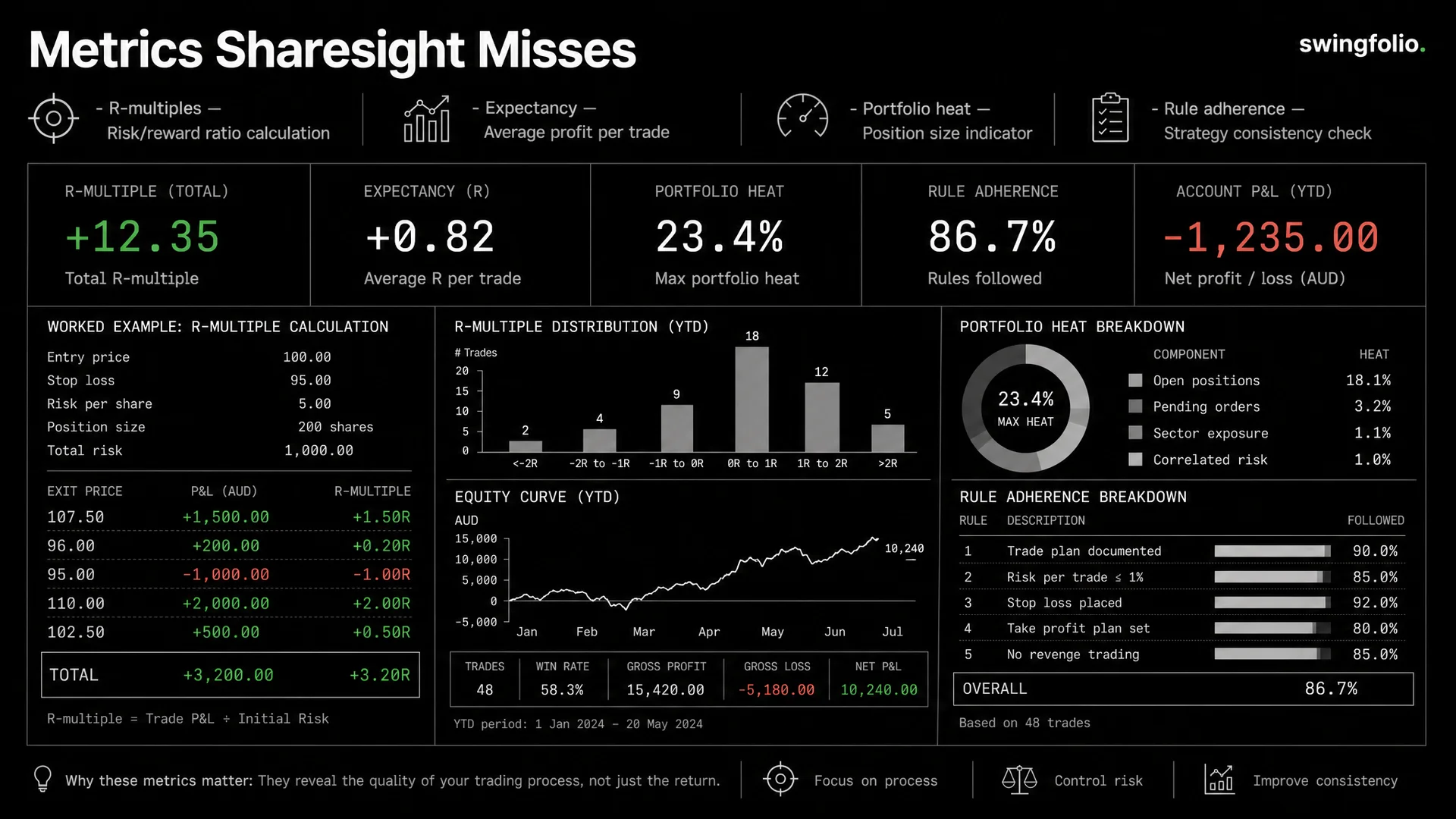
R-multiple expresses a trade's result as a multiple of its initial risk.
A fictional trader buys XYZ.ASX at $20, places an initial stop at $19 and buys 200 shares. Initial risk is $1 x 200, or $200. Selling at $22.50 produces $500 before fees, equal to +2.5R. A full stop loss is -1R.
Dollar profit alone cannot make that comparison. A $500 gain on $200 of planned risk differs from a $500 gain that exposed $2,000. You need entry, initial stop and quantity to calculate R.
Sharesight's report catalogue centres on portfolio performance, allocation, tax and compliance. A journal built around trade plans adds the initial risk needed for an R-multiple review.
2. Expectancy tests the whole payoff pattern
Expectancy combines win rate, average win and average loss:
Expectancy = (Win rate x Average win in R) - (Loss rate x Average loss in R)
Suppose 40 trades include 18 winners averaging +2R and 22 losers averaging -0.8R:
(45% x 2R) - (55% x 0.8R) = +0.46R per trade
The 45% win rate looks modest, but the payoff pattern is positive. A second strategy could win 65% of the time and still lose money if its rare losses are much larger than its wins. Expectancy changes the decision from "raise the win rate" to "protect the payoff distribution."
Read why portfolio return does not measure trading skill for the broader distinction between outcome and process.
3. Portfolio heat shows open risk before it becomes a loss
Portfolio heat adds the planned loss across open positions and divides it by account equity. Four positions risking 1% each create 4% heat if each reaches its stop.
That total still needs context. Four unrelated positions are different from four miners reacting to the same commodity move. Review both heat and concentration rather than treating the percentage as a promise about the worst possible loss. Stops can also fill below their trigger after a gap.
Sharesight reports holdings, allocation and performance. Portfolio heat adds a different decision input: the current stop for every open trade. Use the portfolio heat calculator guide to work through the calculation.
4. Results by strategy show what earned the return
Sharesight supports labels and custom groups for holdings, so you can review selected groups of investments. Those tools classify holdings. A trading journal adds a trade-plan workflow with entry rules, exit rules and R results for each setup.
That difference matters when the same ticker appears in several setups. A breakout in XYZ.ASX and a later mean-reversion trade in XYZ.ASX belong to different decision samples even though a holding label may treat them alike.
For each strategy, compare trade count, win rate, average R and the spread of outcomes. A strategy with ten trades has weak evidence, even if its headline result looks excellent.
5. Holding time by outcome exposes exit habits
Measure how long winning and losing trades remain open. If winners average four days and losers average twelve, inspect the trades before drawing a conclusion. The cause might be a deliberate trend exit, slow stop execution, or hope replacing the original plan.
Sharesight records trade dates in its All Trades Report, so you can inspect durations manually. A trade journal can save time by splitting matched completed trades into winning and losing hold periods.
6. Losses beyond -1R reveal broken risk controls
The largest winner-to-largest-loser comparison gets attention, but the tail of the distribution is more useful. Ask how many losses finished below -1R and why.
A planned stop can still slip during a gap, so a result below -1R does not prove indiscipline. Notes should distinguish market gaps, partial exits, manual overrides and missing stop data. That context tells you whether to change execution, sizing or the strategy itself.
7. Consecutive losses prepare you for normal variance
Count the longest losing sequence and the total R lost during it. Six losses near -1R create a different problem from six losses averaging -1.8R.
Use the historical sequence to set a review trigger, not to predict the maximum future streak. The next run can be longer. Combining streak length with maximum drawdown helps you see both the trade sequence and its account impact.
8. Rule adherence separates the plan from execution
Rule adherence asks whether each trade met the rules you wrote before entry. A checklist might cover the breakout close, volume condition, initial stop, position size and exit trigger.
Then compare outcomes for followed and broken rules. Do not invent a universal adherence target. Your own record should show whether deviations help, hurt or lack enough examples.
This metric requires honest inputs. Ticking a rule after seeing the outcome creates a flattering score and a useless lesson. Trading journal examples show what specific, reviewable notes look like.
Which tool should hold which data?
Use Sharesight when you need its portfolio performance, income, tax and benchmarking reports. Use a trading journal when you need planned risk, setup, rule checks and trade-level review. Some traders will use both because the jobs differ.
If you want to try that workflow, follow the Sharesight export and Swingfolio import checklist. It starts with a small sample so you can compare the records before deciding whether to move or use both tools.
Before choosing, test a small sample of completed trades and ask:
- Can I record the initial stop before the outcome is known?
- Can I compare setups when the same ticker appears in more than one strategy?
- Can I inspect the trades behind an average?
- Can I separate execution mistakes from valid losses?
- Can I export or retain the source records I may need later?
Frequently asked questions
Can Sharesight labels replace strategy tracking?
Labels can filter subsets of holdings in eligible Performance Reports. They can help with broad grouping. Trade-level strategy review needs each completed trade linked to its rules and planned risk, especially when one holding is traded under several setups.
Is win rate enough to compare strategies?
No. Pair win rate with average win, average loss and sample size. A lower-win-rate strategy can outperform if its winners are larger than its losses.
Do I need all eight metrics?
Start with initial risk, R-multiple, strategy and one rule-adherence check. Add metrics when they will change a decision. Collecting fields you never review only creates administration.
Build a decision record beside the portfolio record
Swingfolio links trades with strategies, planned risk and review analytics. It complements the portfolio view by showing the decisions behind each result. Start the 30-day trial and enter a small, completed sample before deciding which metrics deserve a permanent place in your process.
Sharesight is a registered trademark of Sharesight Limited. Feature references are based on Sharesight's public help material reviewed in September 2026.