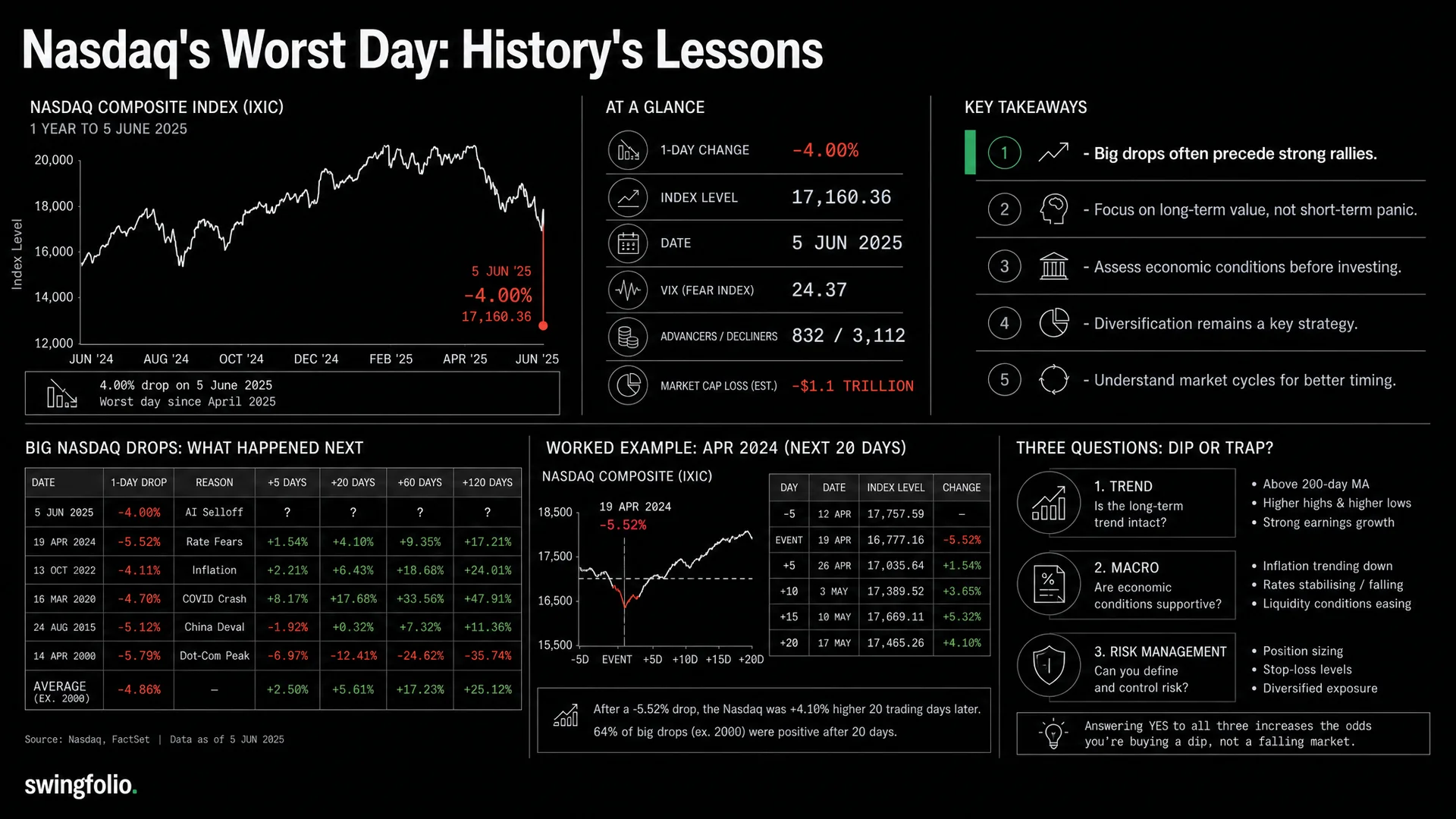
The Nasdaq-100 fell 5% on Friday, 5 June 2026, its largest one-day decline since April 2025, according to Nasdaq's market review. This case study examines that June selloff and the planning lessons it offers.
Nasdaq linked the fall to a sharp shift in rate expectations. May payrolls rose by 172,000, double the 88,000 consensus estimate cited in its market review. Interest-rate markets moved from pricing 15 basis points of tightening to a full 25-basis-point increase during the year. The 10-year Treasury yield ended the week 10 basis points higher at 4.55%.
Broadcom's AI chip revenue forecast, proposed tariffs and geopolitical news added pressure.
What happened four and eight weeks later?
The Nasdaq-100 closed at 28,957.60 on 5 June 2026. Four weeks later, the last available close was 29,329.21 on 2 July, a gain of 1.28%; US markets were closed on 3 July. At eight weeks, the 31 July close of 28,274.20 was 2.36% below the 5 June close.
By 18 September 2026, the index closed at 29,644.17, or 2.37% above the 5 June close. These are our calculations from EODHD daily index closes, using the Nasdaq-100 series NDX.INDX, rather than an ETF proxy. They describe price changes from the selloff close, excluding dividends and trading costs.
The path was an uneven recovery, not a straight rebound. A gain at four weeks did not prevent a lower eight-week close. That is why the scenarios below focus on evidence, sizing and exits rather than treating one bad day as a reliable entry signal.
A large down day gives a range, not a direction
History does not turn a 5% fall into a reliable buy or sell signal. Large declines appear during brief shocks, long bear markets and ordinary corrections. Their shared feature is wider price movement.
After a shock, traders usually face three plausible paths:
- Fast rebound: buyers treat the cause as temporary and recover much of the loss.
- Bounce and retest: the index rallies, returns toward the low and tests whether buyers remain.
- Deeper decline: earnings, credit or policy conditions worsen and each rebound fails below the prior high.
You can plan for all three without assigning a false probability to one session.
Why averages can mislead after extreme days
Studies of large market falls often report positive average returns over the following months. That result can be true and still offer poor guidance for a particular entry.
The sample is small
Five-percent index declines are uncommon. A handful of crisis periods can dominate the result, and several observations from one crisis are not independent. The 2020 pandemic collapse, for example, produced multiple extreme sessions driven by the same shock.
The starting threshold changes the answer
A study of S&P 500 falls greater than 6% does not directly answer what follows a 5% Nasdaq-100 fall. The indexes hold different companies and the thresholds select different days.
Average return hides the path
An index might finish 12 months higher after falling another 20% first. The ending return looks positive, while a leveraged or oversized position may not survive the drawdown.
Record maximum adverse movement as well as the final result. Our guide to maximum drawdown explains why the path changes the trading decision.
Compare two very different historical cases
The dot-com decline and the 2020 pandemic selloff show why the cause matters.
The Nasdaq Composite peaked in March 2000 and fell about 78% by October 2002. Valuations, business failures and a long earnings reset kept pressure on technology shares. An early dip buyer could be right about the internet's future and wrong about the entry price for years.
In 2020, markets fell at exceptional speed as economic activity stopped. Massive policy support and reopening expectations then helped major US indexes recover much faster. The first decline did not reveal the later path. New information and policy changed it.
The June 2026 case began with stronger employment and higher rate expectations rather than an announced financial-system failure. That distinction informed the scenario, but it did not guarantee a short correction.
Four checks separate a rebound from a failing bounce
1. Did the cause improve?
For the June case, traders needed to follow inflation data, labour reports and the Federal Reserve's response. A rally without relief in yields could still be a positioning bounce.
2. Is market participation broadening?
Compare the cap-weighted index with equal-weight measures and the number of stocks above relevant moving averages. If a few large companies lift the index while most constituents remain weak, the rebound has narrow support.
3. Does the low hold on a retest?
A retest gives buyers and sellers another decision point. A higher low with improving participation can support a recovery setup. A close below the shock low on stronger selling can reject it.
This is evidence for a trading plan, not a universal chart law.
4. Are earnings and credit conditions deteriorating?
Watch company guidance, analyst revisions, credit spreads and funding stress. A valuation correction can deepen when expected earnings fall or financing becomes harder. Stable earnings and credit do not guarantee a rebound, but they remove two common sources of persistent bear markets.
A worked risk example
A fictional trader has a $50,000 account and normally risks 1%, or $500, on a position. Before the selloff, a setup used a $2 stop distance, allowing 250 shares before costs and gap risk.
After a 5% index day, the trader widens the technical invalidation distance to $4. Buying the same 250 shares would place $1,000 at risk. To keep planned risk near $500, the position falls to 125 shares.
That calculation still assumes an exit near the stop. Overnight gaps can create a larger loss. The trader can reduce size further, avoid holding through a scheduled event or skip the setup.
Use the risk-reward guide and portfolio heat guide to check position and portfolio risk together.
Build a scenario plan before the next session
| Scenario | Evidence to watch | Possible response |
|---|---|---|
| Fast rebound | Index reclaims the breakdown area with broader participation | Wait for an entry trigger and use reduced size |
| Bounce and retest | Initial rally stalls, then price returns toward the low | Watch whether the low holds before committing risk |
| Deeper decline | New low, weak breadth and worsening earnings or credit evidence | Preserve cash, reduce correlated exposure and reassess |
The response column illustrates a planning process. Your timeframe and strategy determine the action.
Avoid four decisions made under pressure
- Do not turn a long-term holding into a short-term trade because of one red session.
- Do not average down without a maximum position size and invalidation point.
- Do not use a normal-volatility position size when the market range has doubled.
- Do not call a bounce a recovery before defining what would confirm it.
A trading journal template gives these decisions a place before the next headline changes your view.
Frequently asked questions
Does a 5% Nasdaq-100 fall usually rebound?
Historical studies often find positive forward returns after severe declines, but the samples mix different causes and paths. They do not provide a dependable next-day signal.
Should a long-term investor sell after one large fall?
One session provides little information about a multi-year plan. Review whether the investment case, time horizon or required cash has changed.
Should a swing trader buy the first bounce?
Only if the setup defines entry, invalidation and size. Waiting for a reclaim or retest can provide more evidence, although it can also mean missing part of a rebound.
Why track breadth?
Breadth shows how many stocks participate. It helps distinguish an index recovery led by a few large constituents from wider buying.
Use history to widen the plan
The 5 June 2026 selloff showed how quickly strong economic data can become bad news for richly valued shares when rate expectations change. History supports preparing for more volatility after an extreme day. It does not choose between a rebound and a deeper decline.
Define the three scenarios, cut position size when stop distances expand and record the evidence that changes your view. Start the 30-day trial to keep that plan beside the eventual result.
This article is general information and market analysis, not personal financial or investment advice. Market figures and the scenario are dated to 5 June 2026.