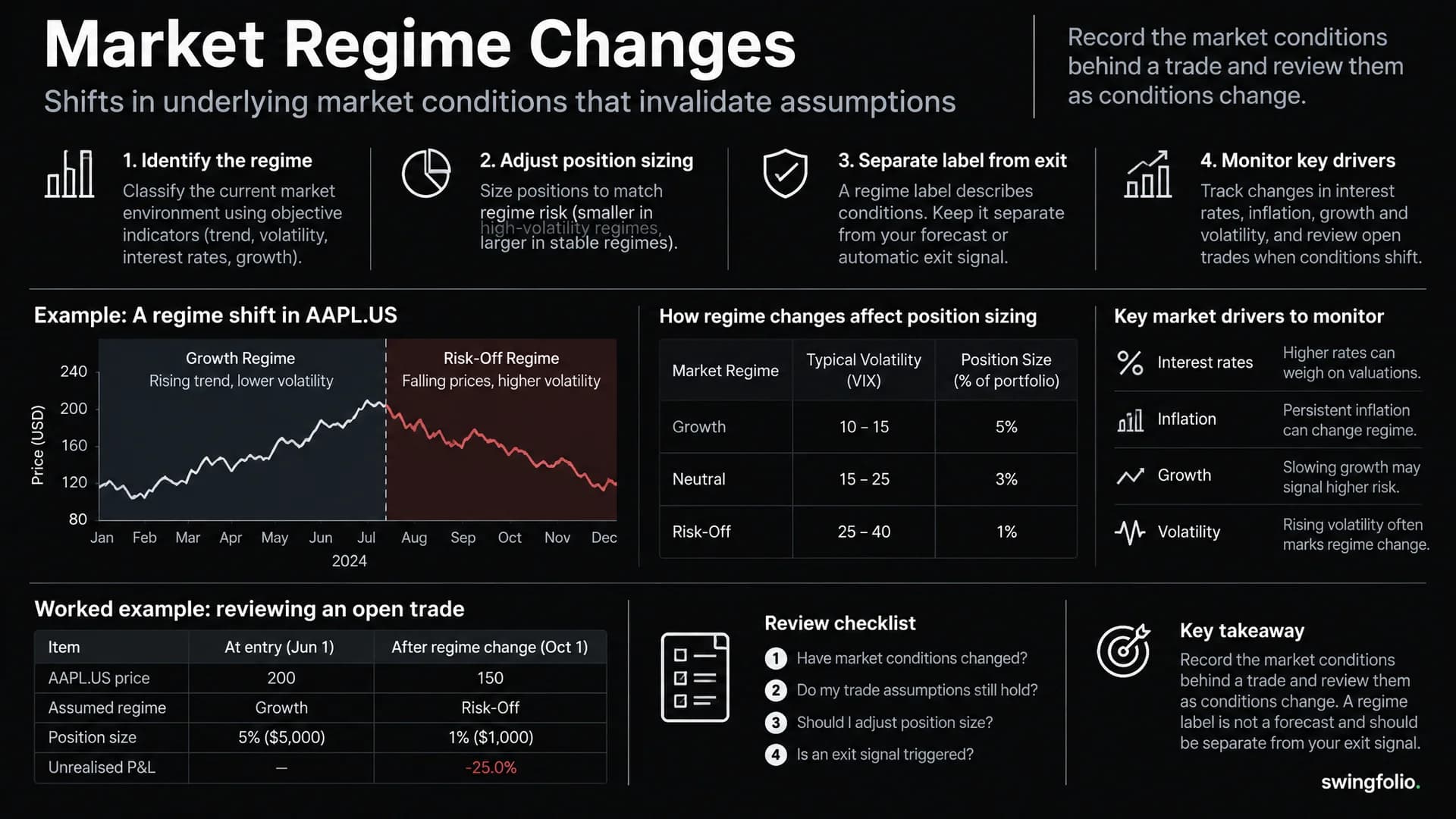
A market regime is a description of prevailing conditions, such as trend direction and volatility. Recording it at entry helps you review whether an open trade still fits the assumptions behind the setup.
The label does not predict the next move. Conditions can change gradually, and two classification methods can assign different labels to the same market.
Write the assumption, not just the label
“Uptrend” is less useful than a dated definition. State the market, timeframe and method used, then explain why the setup depends on it.
For example: “Daily broad-market trend is positive under my moving-average rule. This trade depends on continued follow-through after a pullback.”
That record lets you compare the current conditions with the original premise without rewriting history.
Price risk and regime risk differ
A protective stop defines an intended execution trigger. It does not explain why the setup was attractive, and it does not guarantee the loss will stop at that level.
A regime review asks whether the environment the strategy relies on has changed. It may lead to no action, a closer review or a decision specified in your rules.
Avoid assuming that every change in interest-rate expectations invalidates every equity trade. Companies and strategies have different sensitivities.
A hypothetical open-trade review
| Field | At entry | At review |
|---|---|---|
| Market condition | Positive trend under the written rule | Trend rule no longer positive |
| Company setup | Pullback with defined support | Support still intact |
| Original risk | Recorded at entry | Retained for performance review |
| Action rule | Review if market condition changes | Review now; do not invent a new rule retrospectively |
The table does not imply that the trade must close. It identifies a review trigger that existed before the outcome.
A historical claim that a setup fails “twice as often” in another regime would require a defined sample and calculation. Do not infer that probability from a label alone.
Keep macro assumptions separate from price classifications
A forecast of lower interest rates is an economic expectation. A price-based uptrend classification is a market observation. They can move differently.
If the trade depends on an economic assumption, record its source and date separately. The RBA decision archive provides primary statements for Australian monetary-policy decisions; market expectations require their own dated evidence.
Compare like with like
When analysing closed trades by regime, use the label that was available at entry. Classifying the whole earlier period after seeing what happened introduces hindsight.
Also compare setup, size, costs and rule versions. If all downtrend trades used a new exit rule, a performance difference cannot be attributed to regime alone.
The market-regime journal guide covers the entry record. This article focuses on revisiting positions that remain open.
Using Swingfolio's regime information
Swingfolio can display stored market-regime information with trades. Check the source and any override, and treat an absent label as missing information rather than a neutral condition.
The trade's stored regime is historical context. It is not necessarily a live statement that the market remains in the same state.
Record your review date and decision beside the position. Keep the original entry rationale so you can distinguish a planned response from a new explanation made after a loss.
A short review routine
- Identify the conditions the setup required.
- Compare them with current, dated evidence.
- Check company-specific information and event risk.
- Confirm remaining size, stops and portfolio exposure.
- Follow the action rule or document a justified change.
- Review the outcome later without replacing the original record.
For performance comparisons across changing conditions, see market rotation and trading edge.
Does a regime change mean I should sell?
Not by itself. It is one input into the strategy's review and risk rules.
Can a regime label prove why a trade lost?
No. It describes conditions. Execution, company news, sizing and ordinary variation may also matter.
General information only. Not financial advice.