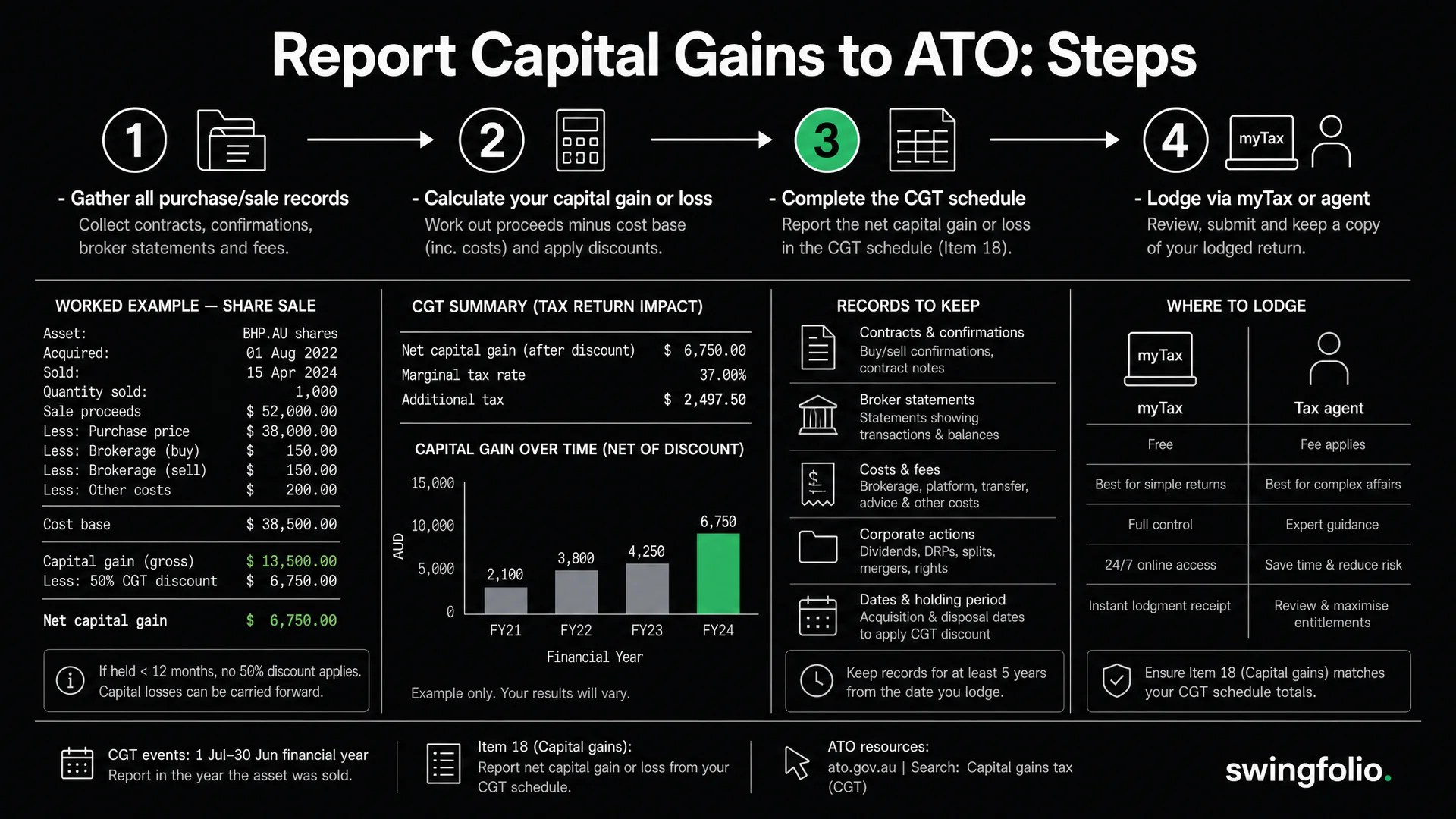
Reporting capital gains starts before you open myTax. First reconcile every disposal, cost base, capital loss and discount-eligible gain for the 2025-26 income year. Then transfer the required totals or give the working papers to your registered tax agent.
This guide is for Australian investors reporting shares on capital account. If your activity may be a share-trading business, ask an adviser which tax treatment applies. For the record-building process, read how to track capital gains on shares.
Step 1: Build a 2025-26 disposal list
List each CGT event from 1 July 2025 to 30 June 2026. For an ordinary market sale, the contract date generally determines the income year, rather than the settlement date.
For every disposal, collect the asset and parcel, acquisition and disposal contract dates, proceeds, purchase price, brokerage, cost-base adjustments, parcel-matching method and possible discount eligibility. Reconcile the list to broker confirmations, cash movements and remaining holdings.
Pre-fill information can help, but check it against your own records. It may not contain the complete cost base, every disposal or your parcel choice.
Step 2: Calculate each gain or loss
For a straightforward share sale, subtract the cost base from capital proceeds. Acquisition and selling costs may affect the calculation. Corporate actions and special rules can also change the result.
Keep short-held gains, discount-method gains and capital losses identifiable. You need those categories to apply losses and discounts in the correct order.
Step 3: Separate total gains from net capital gain
- Total current-year capital gains are gains before capital losses and the CGT discount.
- Net capital gain is the amount remaining after the required calculation steps and is included in assessable income.
- Net capital loss carried forward is an unused capital loss. It does not reduce salary or other ordinary income.
Worked 2025-26 example
Assume an individual investor has an $8,000 short-held gain, a $12,000 discount-eligible gain, a $5,000 current-year capital loss and a $1,000 prior-year net capital loss.
Total current-year capital gains are $20,000. There are $6,000 of losses available. Applying them to the non-discount gain first usually preserves more discount benefit:
- Short-held gain: $8,000 - $6,000 = $2,000
- Discount-method gain: $12,000 x 50% = $6,000
- Net capital gain: $2,000 + $6,000 = $8,000
The return therefore distinguishes $20,000 of total current-year gains from an $8,000 net capital gain. This simplified example assumes all costs and eligibility decisions are correct.
The ATO requires current-year and eligible prior-year capital losses to be applied before the discount. You can choose which gains to reduce. Applying losses to gains without a discount will often produce the smaller net gain.
Step 4: Check 2025-26 discount eligibility
Under the rules applying to the 2025-26 return, an eligible Australian resident individual can generally use a 50% discount for a CGT asset held at least 12 months. Not every asset, entity or gain qualifies.
Keep the acquisition and disposal contracts with the calculation. If eligibility is unclear, flag the parcel for advice instead of silently applying a discount.
Future settings may differ. The 2026-27 federal budget CGT guide covers later changes separately. This article applies the ordinary 2025-26 return rules to its example.
Step 5: Enter the figures in the 2026 return
The current ATO myTax 2026 instructions direct an individual to open Capital gains or losses in the personalised return. Work out the gains manually or with the ATO record-keeping tool, then enter:
- Total current year capital gains: gains before capital losses, CGT discounts and most concessions
- Net capital gain: the amount left after losses, discounts and any applicable concessions
- Net capital loss carried forward to later income years: current-year net loss plus any prior loss still unapplied
- Credit for foreign resident capital gains withholding: only when an amount was withheld from relevant sale proceeds
The 2026 instructions require a CGT schedule in myTax if either total current-year capital gains or total current-year capital losses exceed $10,000. Trust capital-gain amounts count toward the relevant totals. Other triggers include affordable-housing discount reporting and certain earn-out amendments. Use the ATO myTax 2026 capital gains instructions for the complete conditions.
The $10,000 schedule test is not a tax-free threshold. A smaller taxable gain still belongs in the return.
Step 6: Reconcile before lodging
- Disposals: Every sale and other CGT event appears once.
- Parcels: Units sold do not exceed units acquired and remaining holdings make sense.
- Cash: Proceeds and brokerage agree with statements.
- Tax totals: The worksheet adds to total gains, losses used, net gain and carried-forward loss.
Pay special attention to partial sales, DRP parcels, share splits, demergers, returns of capital, inherited assets and foreign-currency transactions. These can make a broker export incomplete as a tax calculation.
What if losses exceed gains?
Suppose a fictional investor has $3,000 of current-year gains and $7,500 of current-year capital losses, with no prior losses. The $3,000 gain is absorbed. The remaining $4,500 is a net capital loss carried forward.
That $4,500 does not reduce wages or dividend income. Keep it for a later year with capital gains, and keep the calculation records. If the next year produces a $6,000 capital gain, the carried-forward loss may reduce it to $1,500 before any eligible discount is applied.
Losses from collectables have separate use restrictions. Losses from personal-use assets are generally disregarded. Keep these categories separate rather than putting every negative disposal into one pool.
Common filing mistakes
Entering the net number as total gains
The total-gains field comes before losses and discounts. In the worked example above, $20,000 is total current-year gains and $8,000 is the net capital gain.
Forgetting small disposals
The schedule threshold does not decide whether a gain is reportable. Reconcile all CGT events, including small sales and partial disposals.
Claiming a discount before applying losses
Apply current-year losses and prior-year net capital losses before the discount. Preserve a worksheet that shows the order.
Treating pre-fill as a finished calculation
Check acquisition costs, sales, parcel matching and corporate actions. A pre-filled disposal may still lack the information needed to calculate the right gain.
Losing the prior-year loss balance
Compare the new calculation with the previous return. A valid carried-forward loss is useful only if it remains supported and is brought into the next calculation.
Capital gains reporting questions
Do I report every trade separately in myTax?
The return asks for totals, and a CGT schedule may ask for categories and further detail. Keep disposal-level working papers behind those totals so the result can be reviewed.
Does a loss reduce my salary income?
No. A net capital loss can reduce capital gains in the same year or a later year, subject to the rules. It does not directly offset salary, interest or dividends.
Which shares did I sell when I bought several parcels?
Your records need a defensible parcel-identification method and enough detail to show which units remain. Do not switch parcels after seeing the tax outcome without checking that the records support the choice.
Accountant handover checklist
Give your accountant:
- disposal-level gain and loss worksheet
- broker confirmations and annual statements
- acquisition evidence for older parcels
- prior return showing carried-forward losses
- dividend and managed-fund tax statements
- corporate-action notices
- foreign-currency method and source rates, if relevant
- notes explaining parcel selection and adjustments
- a list of unresolved questions
The CGT reports guide for active traders explains how to organise larger trade histories.
Keep the evidence
ATO retention periods depend on the record and how it affects later returns. Acquisition records may need to survive throughout ownership and after disposal. Carried-forward loss records may need to remain until after the loss is fully used. Follow the ATO's CGT record-keeping guidance for your situation.
Swingfolio can keep trade dates, prices, fees and partial exits together and produce reports for review. Tax classification and final return decisions still depend on your circumstances. Start the 30-day trial and organise the record before lodgment season.
This article is general information and not tax advice.