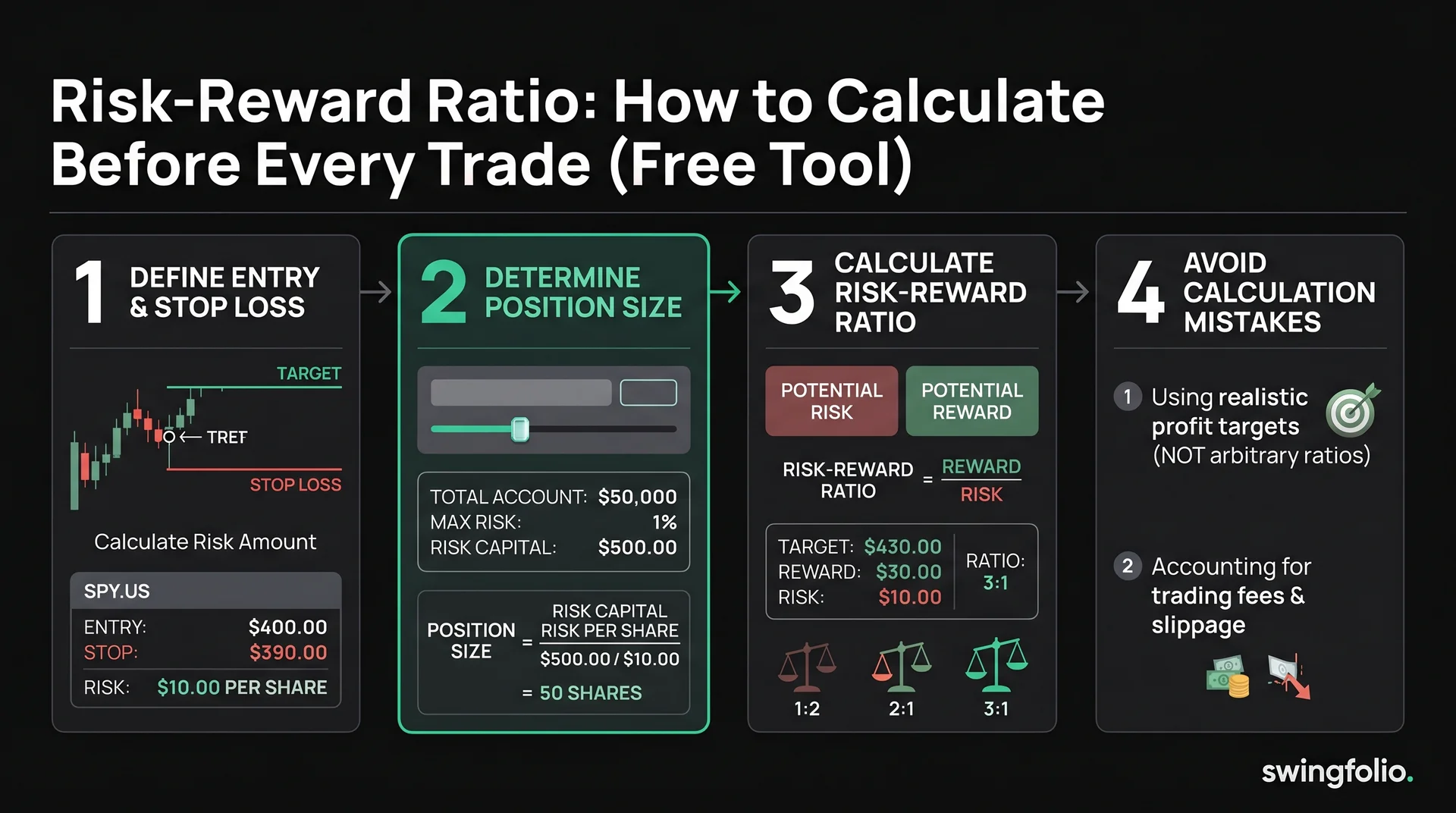
Risk-reward ratio compares the profit you plan to pursue with the loss you accept if the trade fails. Calculate it before entry, while you can still reject a poor trade without money or emotion attached.
The ratio is one part of a risk plan. Use the position size calculator to decide quantity, then use the free risk-reward calculator to test how your average wins and losses interact with win rate.
How to calculate risk-reward ratio
For a planned long trade:
Risk per share = entry - stop
Reward per share = target - entry
Reward-to-risk ratio = reward per share / risk per share
Suppose a fictional KITE.AU setup has an entry at $40, stop at $38 and target at $46.
- Risk per share: $40 - $38 = $2
- Reward per share: $46 - $40 = $6
- Reward-to-risk: $6 / $2 = 3, usually written as 3:1 or 3R of planned reward
For a short trade, risk is stop minus entry and reward is entry minus target. Use absolute positive distances so the comparison remains clear.
Add position size and trading costs
The price ratio stays the same when quantity changes, but your dollars at risk do not. At 150 shares, the fictional long risks $300 and targets $900 before costs. At 400 shares, it risks $800 and targets $2,400.
That distinction matters. A visually attractive 3:1 setup can still be too large for the account. Choose the stop from the chart logic, set a dollar risk limit, and calculate quantity:
Quantity = allowed dollar risk / risk per share
If allowed risk is $500 and risk per share is $2, quantity is 250 shares. The planned target profit is 250 x $6 = $1,500 before brokerage, spread and slippage.
Costs reduce the realised ratio. With $20 total brokerage, the example's loss at the stop becomes $520 and target profit becomes $1,480. That is about 2.85 units of net reward for each unit of net risk. A gap through the stop can increase the loss further, so the initial calculation is a plan, not a guarantee.
Risk-reward and win rate work together
A ratio says nothing about the chance of reaching the target. Expectancy combines your observed win rate with average wins and losses:
Expectancy = (win rate x average win in R) - (loss rate x average loss in R)
If 45% of trades win 2R on average and 55% lose 1R, expectancy is:
(0.45 x 2R) - (0.55 x 1R) = +0.35R per trade
If the same 45% win rate produces only 1.2R winners, expectancy becomes:
(0.45 x 1.2R) - (0.55 x 1R) = -0.01R per trade
This is why a high win rate can coexist with weak results, and a lower win rate can work when winners are larger. Use results from your own completed trades. Planned targets alone do not establish average wins.
The simple breakeven win rate for an average win of 2R and average loss of 1R is 1 / (2 + 1), or 33.3%, before costs. Your required rate rises when losses exceed 1R or winners finish short of target.
Use Swingfolio's calculator with the right inputs
The public calculator models a trading system rather than a single entry, stop and target. It asks for:
- win rate
- average win in R
- average loss in R
- trades per month
- percentage of the account risked per trade
It returns expectancy per trade in R and account percentage, a monthly projection, breakeven win rate and profit factor. The projection applies your inputs mechanically; it is not a forecast. Try several realistic scenarios, including worse slippage or smaller average winners.
For a single proposed trade, calculate entry, stop and target first. Then use the calculator to ask whether trades with that payoff fit the results your strategy has actually produced.
A pre-trade risk-reward routine
- Mark the entry trigger before the trade activates.
- Put the stop where the setup is invalidated.
- Choose a target or exit method supported by the chart and strategy.
- Calculate the price-based ratio.
- Calculate quantity from your dollar risk limit.
- Recalculate at the actual fill if price or quantity changes.
- Record both planned and realised R in your trading journal template.
If the ratio is unattractive, skip the trade. Moving a stop closer solely to manufacture 2:1 changes the risk logic. Moving a target beyond credible resistance changes the probability. A ratio should test the plan, not decorate it.
Common risk-reward mistakes
Using the current price instead of the intended entry
If a breakout entry is $10.50 while the stock is still $10, calculate from $10.50. The untriggered move is not your reward.
Treating 2:1 as a universal rule
There is no ratio that suits every setup. A strategy with frequent modest wins has a different payoff profile from a trend strategy with many small losses and occasional large winners. Compare the ratio with your own journal data.
Ignoring partial exits
Selling half at 1R and half at 3R produces a 2R gross average if both exits fill. Record the weighted result rather than calling the entire trade 3R.
Confusing planned ratio with realised R
A 3:1 plan can finish at +0.5R, -1R or worse after a gap. Keep both values. The gap between them often reveals early exits, inconsistent stop management or unrealistic targets.
Forgetting correlated portfolio risk
Several individually sensible trades can create too much combined exposure. Check portfolio heat before adding another position.
Turn the calculation into evidence
Record the planned ratio, actual fill, initial risk and final R for every trade. Review results by strategy. You may find that one setup regularly reaches 2R while another often reverses near 1R. That evidence is more useful than a borrowed minimum ratio.
Risk-reward questions
Is 1:2 the same as 2:1?
Writers use both conventions. State which side is reward. This article writes a 2R potential reward for 1R risk as reward-to-risk of 2:1.
Should I move the target when the ratio is too low?
Only when your strategy and market structure support the new target. A larger number does not make an unlikely target more credible.
When should I recalculate?
Recalculate when the actual entry, quantity, stop, target or expected costs change. Keep the original plan too, so the journal shows why realised R differed.
Swingfolio keeps plans, trade outcomes and performance review together, helping you compare intended payoff with what you captured. Start the 30-day trial and build a risk-reward record from your own trades.