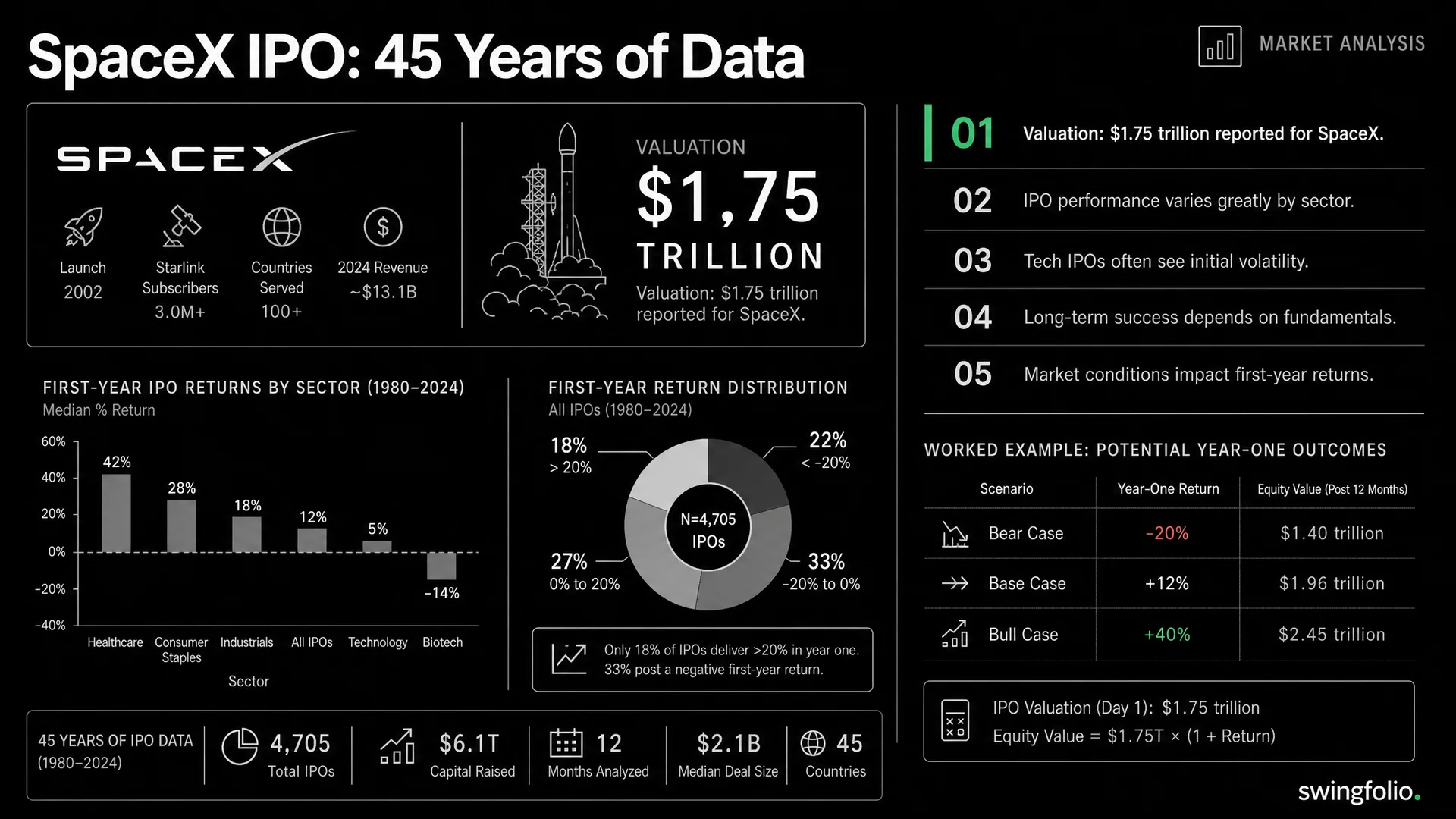
SpaceX completed the largest IPO on record in June 2026. That fact made the launch historic. It did not make the stock's first year predictable.
The company priced 555,555,555 Class A shares at $135 on 11 June. SPCX.NASDAQ began trading the next day, opened at $150 and closed its first session at $160.95. After the underwriters exercised their overallotment option, the deal raised $85.7 billion.
The more useful question now is narrower: what does long-run IPO evidence say about the price a public-market buyer pays after listing?
Three prices tell three different stories
IPO returns depend on the starting line.
- Offer price: $135 was available to investors who received an allocation.
- First trade: $150 was the first price in public trading.
- First close: $160.95 was the end-of-day reference often used in IPO studies.
A buyer allocated shares at $135 gained 19.2% by the first close. A buyer who entered at the close started 19.2% above the offer price. If the stock later returned to $135, the allocated buyer would be flat before costs while the closing buyer would be down about 16.1%.
That distinction is central to IPO research. The widely reported "first-day pop" measures the gain from the offer to the close. Retail traders who buy after trading starts usually cannot capture all of it.
What 45 years of IPO evidence shows
Jay Ritter's University of Florida IPO dataset covers 9,254 qualifying US offerings from 1980 through 2024. Table 20 measures returns from the first closing market price, not the offer, and includes dividends. Returns run through 31 December 2025.
| IPO cohort | Average first-year return | Difference from size-matched companies |
|---|---|---|
| 1980 to 1989 | 3.4% | -3.6 percentage points |
| 1990 to 1999 | 14.9% | -0.9 percentage points |
| 2000 to 2009 | -11.3% | -19.7 percentage points |
| 2010 to 2024 | -0.8% | -9.4 percentage points |
| 1980 to 2024 | 5.6% | -5.8 percentage points |
The cohort spread is the lesson. The 1990s average was positive and close to matched companies. The 2000s average lost money and lagged badly. The full-period 5.6% raw return sounds encouraging until compared with 11.4% for size-matched companies.
IPOs often rise on day one
US IPOs have historically produced a positive average offer-to-close return. Underwriters, issuers and investors debate whether that reflects deliberate underpricing, uncertainty or the need to attract demand. Whatever the cause, most of that measured return belongs to investors who received stock at the offer price.
SpaceX followed that pattern. The company's pricing release confirms the $135 offer. Nasdaq's listing review records the $150 open and $160.95 close. The 19.2% rise was real, but it was not a 19.2% gain for someone who bought near the close.
First-year results vary widely
The average hides a large spread between winners and losers. Some newly listed companies multiply in value. Others fall below the offer within months. Market conditions, profitability, valuation and the price a buyer pays all affect the result.
This is why a historical average is a base rate, not a forecast for SpaceX. The company is much larger than a typical IPO and combines launch, satellite connectivity and AI businesses. Few historical offerings make a close comparison.
Raw return and market-relative return answer different questions
Suppose an IPO rises 8% during a year in which a broad index rises 15%. The shareholder made money, but accepting single-company risk returned 7 percentage points less than the index.
For a trading journal, record both:
| Measure | Question it answers |
|---|---|
| Position return | Did this trade make or lose money? |
| Benchmark return | What did a broad alternative return over the same dates? |
| Relative return | Did the trade compensate you for choosing this stock? |
Our guide to why portfolio returns do not measure trading skill explains why one profitable trade is not enough to judge a process.
Large issuers are different, but not safe
Research often finds that larger, profitable issuers fare better than small, speculative companies. Size can mean established revenue, customers and access to capital. It does not remove valuation risk or prevent a large drawdown.
SpaceX entered public markets with enormous scale. Its filings also require investors to value several capital-intensive businesses together. The long-run data points in both directions, so it cannot settle the case.
Ending return can hide a severe drawdown
Ritter's cohort table reports returns at the one-year point. It does not tell you the deepest loss each holder endured along the way. A stock can fall 40%, recover and finish the year up 5%. The ending result looks calm, while the path may force a leveraged trader out.
Track maximum adverse excursion for each trade and maximum drawdown for the account. Compare them with the planned risk. Historical IPO averages cannot tell you whether your position size can survive the route to the average.
Seven large IPOs: first-year returns and drawdowns
Arm, Airbnb and Snowflake finished their first year above the first public close. Each still suffered a substantial decline along the way. Rivian and Robinhood show how far a popular listing can fall before its first anniversary.
The table uses daily closes from Swingfolio's stored price history for Arm, Rivian and Robinhood, and direct EODHD history for the other four companies. Issuer filings establish the first-trading dates. Return runs from the first public close to the close on or immediately before the calendar anniversary. Drawdown is the largest fall from a closing peak to a later closing trough within that same window.
| Company and first trading date | First-close to one-year return | Worst drawdown inside year one | Sources |
|---|---|---|---|
| Arm, 2023 IPO/relisting (ARM.NASDAQ), 14 September 2023 | +131.8% | -42.6% | Swingfolio stored daily closes; IPO date filing |
| Rivian (RIVN.NASDAQ), 10 November 2021 | -67.3% | -88.0% | Swingfolio stored daily closes; IPO date filing |
| Robinhood (HOOD.NASDAQ), 29 July 2021 | -74.0% | -90.2% | Swingfolio stored daily closes; IPO date filing |
| Airbnb (ABNB.NASDAQ), 10 December 2020 | +24.7% | -39.2% | EODHD ABNB.US daily closes; issuer filing |
| Snowflake (SNOW.NYSE), 16 September 2020 | +27.4% | -51.7% | EODHD SNOW.US daily closes; issuer filing |
| Uber (UBER.NYSE), 10 May 2019 | -21.1% | -68.0% | EODHD UBER.US daily closes; issuer filing |
| DoorDash (DASH.US), 9 December 2020 | -13.0% | -47.5% | EODHD DASH.US daily closes; issuer filing |
These are our calculations from 252 or 253 daily observations per company, retrieved on 19 September 2026. Arm's endpoint is 13 September 2024 and Uber's is 8 May 2020 because their anniversaries fell on weekends. The other endpoints fall on the anniversary date.
EODHD's historical-data documentation describes its adjusted-close series. Adjusted and raw closes match throughout these seven windows, so adjustments do not change the results shown. Returns exclude brokerage and currency conversion; closing-price drawdown can miss a deeper intraday low.
This selected group illustrates dispersion, not the average IPO or a forecast for SpaceX. Arm's 131.8% gain did not spare a holder a 42.6% closing drawdown. Snowflake's positive first-year return coexisted with a decline of more than half from its earlier peak. Your position size must survive the path, not just look sensible against the eventual return.
SpaceX's dual-class voting control
SpaceX's final IPO prospectus gives Class A shares one vote each and Class B shares ten votes each. It reported Elon Musk holding about 84.4% of combined voting power after the offering, making SpaceX a Nasdaq controlled company. Public shareholders therefore have limited influence over decisions controlled by that voting majority, a governance consideration separate from the stock's price or growth prospects.
A worked first-year comparison
Consider three fictional investor scenarios using actual historical SPCX.NASDAQ prices. Ignore brokerage and currency conversion so the price effect stays clear.
| Investor | Entry price | Shares | Cost |
|---|---|---|---|
| Offer allocation | $135.00 | 20 | $2,700 |
| Opening buyer | $150.00 | 20 | $3,000 |
| First-close buyer | $160.95 | 20 | $3,219 |
If the stock is $175 one year later, their gains are $800, $500 and $281 respectively. The same company and exit date produce returns of 29.6%, 16.7% and 8.7% because the entries differ.
Now add an Australian dollar that strengthens against the US dollar. An Australian investor's local-currency return can be lower again. The stock chart alone does not capture that currency effect.
The first-year calendar matters
An IPO's first year contains events that can change both information and share supply:
- Quarterly results replace roadshow forecasts with public-company reporting.
- Analysts and investors revise their estimates as new operating data arrives.
- Lock-up releases can let some pre-IPO holders sell, subject to the actual prospectus terms.
- Index eligibility or inclusion can create demand, but the timing and weight depend on index rules.
Do not assume a standard 180-day unlock. SpaceX's filed documents contain several categories and conditions. Use the final prospectus and later SEC filings for the dates and shares that apply. Our SpaceX lock-up supply guide shows how to separate eligible shares from actual selling.
The first two earnings reports may teach a trader more than the first two hours of price action. They show whether revenue, spending and cash use match the story investors bought.
A practical plan for trading a new listing
You do not need to predict the first-year winner before entering. You need a trade that survives being wrong.
Write down:
- the setup and the evidence that confirms it
- your entry and invalidation price
- position size based on the dollars at risk
- the event dates that could create a gap
- the benchmark you will use in review
- whether the result came from the plan or from the IPO's volatility
Use the risk-reward guide before entry, then compare the plan with the outcome in a trading journal. A 15% overnight gap can pass straight through a stop, so size must account for more than an orderly exit at the stop price.
Questions traders ask about IPO history
Does a first-day pop predict a strong first year?
No. It shows that demand exceeded available supply at the offer price. The next year depends on the entry price, company results, valuation and the wider market.
Is the offer price the right benchmark for my return?
Only if you bought at the offer. Use your own executed price to measure your result. Keep the offer and first close as market context.
Should I wait for a lock-up expiry?
Treat a disclosed release as an event to investigate, not an automatic sell signal. Check which holders can sell, how many shares become eligible and whether the market already expects the supply.
Does history say SpaceX will underperform?
No. History describes a distribution across many IPOs. SpaceX can land anywhere inside or outside that distribution.
History improves the question, not the prediction
SpaceX's completed IPO gives traders firm reference points: a $135 offer, a $150 opening trade and a $160.95 first close. Long-run evidence explains why those starting prices matter and why average IPO returns cannot decide the outcome of one unusual company.
If you trade SPCX.NASDAQ, measure the return from your entry, compare it with a benchmark and plan around disclosed events. Start the 30-day trial to record the thesis, risk and review in one journal.
This article is general information and market analysis, not personal financial or investment advice. SpaceX transaction figures are dated to June 2026. Check current company filings before acting.