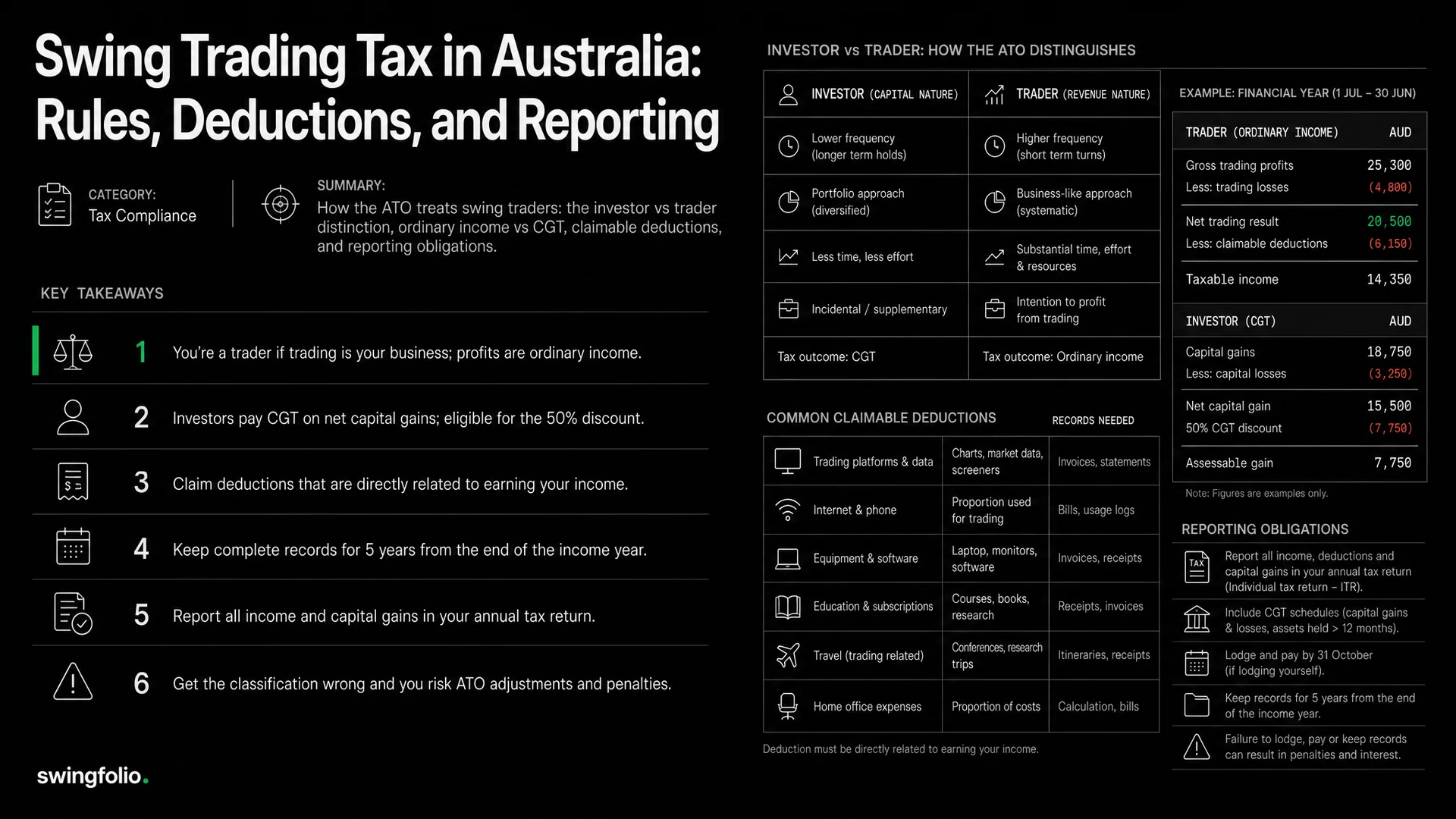
Australian tax treatment for swing trading starts with one question: are your shares investments, or are you carrying on a business of share trading?
The answer changes how you report sales, losses and expenses. Your holding period or number of trades cannot decide it alone. The ATO considers the nature, repetition, volume and organisation of the activity, the capital involved and whether you operate in a business-like way.
This guide uses the rules relevant to the 2025-26 income year. Parliament has enacted CGT changes for gains accruing from 1 July 2027, so keep the year attached to every example.
Investor and share trader treatment
An investor generally holds shares on capital account. A person carrying on a share trading business generally holds shares as trading stock and earns ordinary income from buying and selling them.
| Issue | Investor | Share trading business |
|---|---|---|
| Profit on sale | Capital gain | Ordinary business income |
| Loss on sale | Capital loss | Revenue or trading-stock loss, subject to business loss rules |
| Long-held shares | May qualify for the 2025-26 CGT discount rules | No general CGT discount on trading-stock profit |
| Expenses | Rules depend on whether an expense relates to assessable income or the asset's cost base | Business deductions may apply where the expense has the required income connection |
| Records | Parcel, cost base, proceeds and CGT records | Trading-stock, income, expense and business records |
Tax labels follow the facts. You cannot elect to be an investor for profitable positions and a business for losing positions after the trades occur.
How the ATO assesses a share trading business
No minimum trade count or dollar threshold makes someone a share trader. The ATO and courts consider the whole pattern.
Evidence that may support a business includes:
- repeated, regular buying and selling aimed at earning income from turnover
- a documented method for research, entries, exits and risk
- records and accounts organised like a business
- enough scale and capital for the activity being claimed
- actual conduct that matches the stated plan
A profit-making intention helps, but the ATO says it is not sufficient on its own. A salaried worker can run a share trading business, and a person with a large portfolio can remain an investor. Time spent, volume and capital have meaning only in context.
Two fictional profiles
Leah makes eight purchases during 2025-26, mainly for dividends and long-term growth. She sells two positions after company news changes her view. Those facts lean toward investment.
Noah trades throughout most weeks using documented setups, records each decision, reconciles broker data and operates with repeated turnover. Those facts may support a business, but no single detail settles the classification.
If the result remains uncertain and consequential, an ATO private ruling or advice based on your full records can provide more certainty.
Investor workflow for a 2025-26 sale
An investor works through each disposal:
- Identify the shares sold and their acquisition date.
- Calculate capital proceeds in Australian dollars.
- Calculate the cost base, including eligible incidental costs.
- Work out the capital gain or capital loss.
- Combine gains and apply current and carried-forward capital losses.
- Apply the CGT discount to any eligible remaining gain.
- Report the resulting net capital gain and retain the calculation.
For the detailed loss ordering and 12-month test, read the 50% CGT discount for active traders. The ATO reporting walkthrough covers the return process.
Worked investor example
In 2025-26, fictional investor Mia sells one parcel for $18,400. Its cost base, including brokerage, is $15,900, so the capital gain is $2,500. She also has a $700 capital loss from another position.
Mia subtracts the loss first, leaving $1,800. If the gain passes the holding-period and other eligibility rules, she applies the 50% discount and includes a $900 net capital gain. If it does not qualify, the remaining gain stays $1,800.
The example isolates the CGT sequence. Mia's final tax depends on her full return.
Share trading business workflow
A share trading business accounts for sales as business income and deals with opening stock, purchases, closing stock and expenses under the applicable rules. This is an accounting workflow, not a list of CGT events with a discount added later.
A fictional simplified record might show:
- sales proceeds: $92,000
- opening stock plus purchases: $83,000
- closing stock adjustment and deductible expenses: determined from the business records
The taxable result cannot be calculated correctly from the $9,000 difference alone. Stock on hand, valuation method, expenses, private-use adjustments and any loss rules can change it.
Business losses do not automatically reduce salary. The non-commercial loss rules can defer an individual's business loss unless a test, exception or Commissioner's discretion applies.
Which costs need attention?
For an investor, brokerage on acquiring or disposing of shares commonly forms part of the cost base or reduced cost base. A recurring service used to manage income-producing investments may have different treatment. Expenses connected to private use are not deductible.
For a share trading business, eligible costs may include broker fees, relevant market data, accounting services and the business-use portion of equipment or home-working costs. Timing and depreciation rules can apply. Apportion mixed private and business use.
Do not copy a deduction list without checking the connection between the cost and your assessable income. Keep the invoice, payment record, business-use calculation and reason for the claim.
Foreign shares add currency records
Australian residents generally report relevant foreign share transactions in Australian dollars. Keep the foreign-currency amounts, dates and exchange-rate source used for each tax calculation.
A US-dollar trading profit can become a different Australian-dollar result because the exchange rate changes between purchase and sale. Dividends and foreign tax withheld require their own records. A broker's US-dollar profit column is not the completed Australian tax calculation.
Can you be an investor and a trader?
One person can hold some shares as long-term investments and other shares as trading stock if the facts support two distinct activities. Separation makes the treatment easier to evidence.
Use different broker accounts where practical. Keep written purposes, strategies and records for each pool. Avoid moving parcels between labels after the market outcome is known.
Records that make tax time easier
Keep:
- broker contract notes and account statements
- parcel acquisition and disposal dates
- quantities, prices, fees and corporate actions
- Australian-dollar conversions for foreign trades
- dividend statements and foreign tax records
- trading plans and journals if business status is relevant
- invoices and private-use apportionment for claimed costs
- prior-year capital loss schedules
- reconciliations between broker, journal and tax totals
ATO retention periods vary with the record and transaction. A five-year rule often applies, but CGT asset records may need to be kept throughout ownership and for years after the event. Do not discard an old purchase record merely because five years have passed since purchase.
A clean year-end reconciliation
Use this process before lodging:
- Export the full financial-year broker history.
- Check opening holdings against the prior year's closing holdings.
- Match every buy, sell, fee, dividend and corporate action.
- Confirm open parcels and closed-parcel links.
- Convert foreign transactions consistently.
- Separate investment and business records where applicable.
- Compare your totals with broker tax reports and investigate differences.
- Save the source files and final calculation together.
Swingfolio's CSV import is available on an active trial. Review imported rows before Save and reconcile them with your broker statements. Swingfolio helps organise trading records; it does not determine tax status or produce a certified tax return.
The wash sale rules guide covers loss transactions that deserve extra care. If you receive Australian dividends, read the franking credits guide.
What changes from July 2027?
The Treasury Laws Amendment (Tax Reform No. 1) Act 2026 changes the treatment of relevant capital gains accruing from 1 July 2027. It replaces the flat 50% discount for most post-reform accruals with indexation and a minimum-tax framework. Transitional rules split pre-reform and post-reform gains for assets held across the boundary.
That reform does not rewrite a 2025-26 investor example. It also does not create a CGT discount for trading-stock profit. See the 2026-27 Budget CGT guide before planning around the new rules.
Frequently asked questions
Does frequent trading make me a share trader?
Frequency is one factor. The ATO assesses the purpose, repetition, organisation, capital and actual conduct together.
Can an investor deduct a trading software subscription?
The treatment depends on how the service relates to assessable income, whether it has private use and whether another tax rule applies. Keep records and assess the actual use.
Can I claim a loss against my salary?
An investor cannot use a capital loss against salary. A business loss follows the business and non-commercial loss rules, so it may be deductible or deferred.
Does holding a share for 12 months make me an investor?
No. The holding period can affect an investor's CGT discount eligibility, but it does not decide whether your overall activity is a share trading business.
Classify first, calculate second
The same sale can lead to different reporting depending on whether the shares were an investment asset or trading stock. Document the purpose and activity while you trade, then reconcile every parcel and fee at year-end.
Start the 30-day trial to organise your trades and review your records before tax time.
This article is general information and not tax advice.