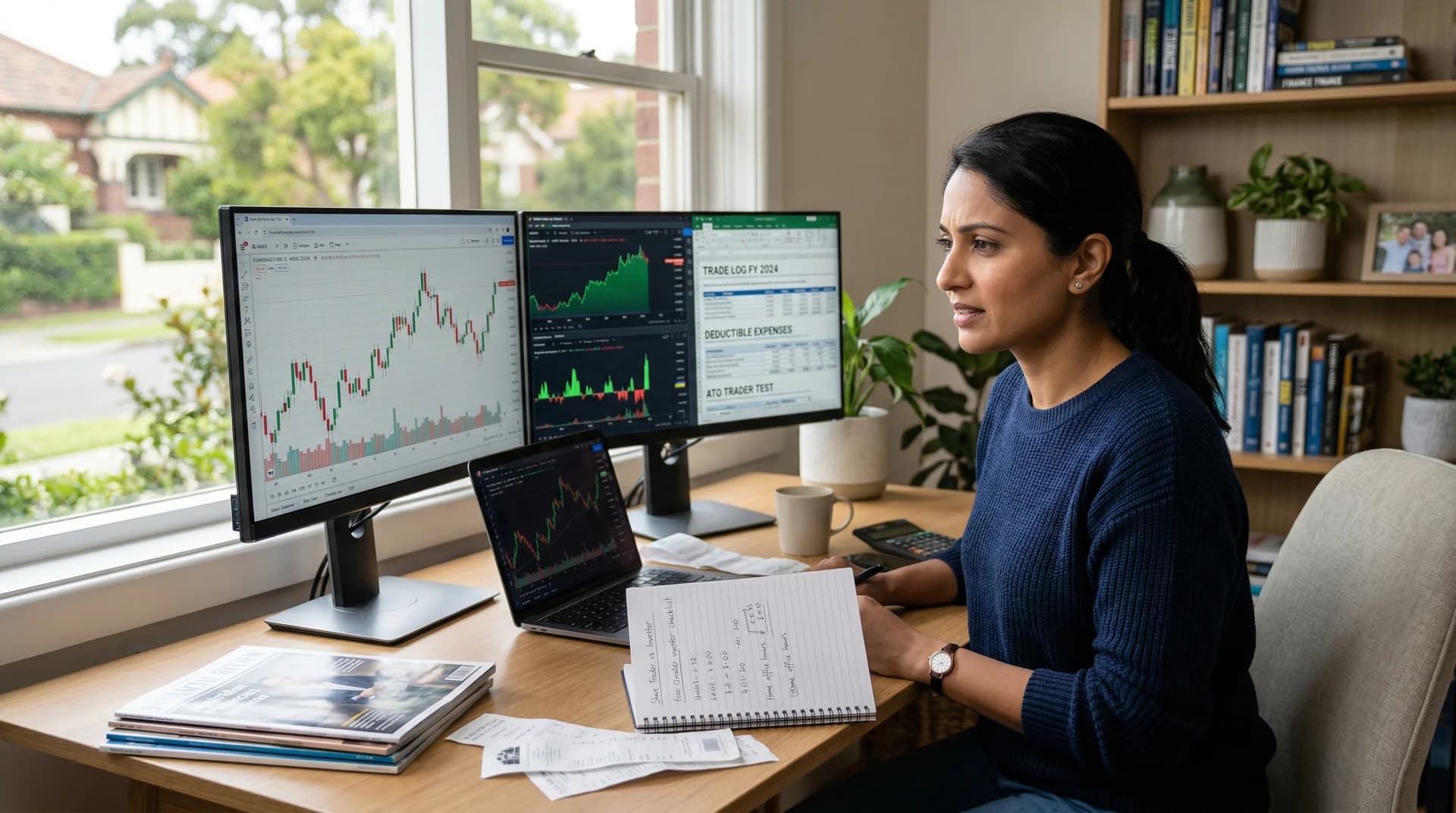
Trading shares often does not make you a share-trading business for tax purposes. Your classification changes how profits, losses and expenses are treated, so settle that question before copying a deduction list into your return.
Share investor or share-trading business?
The ATO distinguishes share investing from carrying on a business of share trading. An investor generally holds shares as capital assets. A share trader holds them as trading stock in a business.
For an investor, disposal gains and losses usually fall under the CGT rules. Brokerage and similar acquisition or disposal costs may affect the cost base rather than form an immediate deduction. An eligible taxpayer may use the CGT discount for qualifying assets.
For a share-trading business, proceeds form assessable income and purchase costs relate to trading stock. Ordinary business deduction rules can apply to expenses incurred in earning that income. Because the profit is ordinary income rather than a capital gain, the CGT discount does not apply to it.
How the ATO assesses the activity
The ATO does not publish a trade-count or turnover threshold that makes someone a share trader. It considers the activity as a whole, including:
- whether you seek profit through a business activity
- the repetition, volume and regularity of transactions
- whether you organise the activity in a business-like way
- the amount of capital involved
- your records and operating methods
No single factor decides the result. There is no automatic trade-count, turnover or weekly-hours threshold that makes someone a share trader.
You can hold some shares as investments and others as trading stock, but your records and conduct need to support the distinction. Separate accounts can help with evidence; they do not decide the tax treatment by themselves.
Expenses a share-trading business may deduct
A business can generally deduct an expense to the extent it is incurred in gaining assessable income or carrying on the business. Capital, private and domestic amounts have separate rules or exclusions. Apply that test to each expense rather than assuming its name makes it deductible.
Possible categories include:
- market data, charting, journaling and research services used in the business
- accounting or legal work connected with the business or its tax affairs
- interest on money borrowed for an income-producing business use
- home-based business running costs
- decline in value or other treatment for computers and equipment
- education that has the required connection with the existing income-earning activity
- brokerage and transaction costs under the trading-stock treatment
Apportion an expense when it has business and private uses. For example, if an eligible $600 annual service is used 75% for the business, the business portion is $600 x 75% = $450. The tax treatment still depends on the deduction rules that apply. Keep the invoice, payment record, calculation and evidence of the business-use percentage.
Home and equipment costs need the right rule
The ATO publishes separate guidance for employees working from home and for home-based businesses. Use the guidance that matches how you operate.
The ATO's home-based business expense guidance explains running and occupancy expenses for people who operate a business from home. Eligible people can use the 70 cents per hour fixed rate from 1 July 2024 under its conditions and record requirements. The rate covers specified running costs, so those costs cannot also be claimed separately through that method.
Equipment treatment depends on the taxpayer, asset, use and tax provisions that apply. Check the ATO guidance for the year and entity before claiming the full cost or decline in value. A $300 price does not create an automatic deduction in every case.
For any home-based claim, record the hours or costs required by the chosen method as you incur them. Keep evidence of extra running costs and separate equipment records. A calendar reconstructed at year end may not satisfy the record rule that applies.
Education, advice and borrowing costs
Education needs a sufficient connection to the income-earning activity. A course that starts a new activity or qualifies you for a different one may fail that test. Keep the course outline and evidence of how it relates to the business you already carry on.
Professional fees also need to be classified by what the adviser did. Some tax-related fees may be deductible under a specific rule, while capital or private advice can receive different treatment.
For interest, trace the borrowed money to its use. A loan label or the presence of dividends does not settle deductibility. Mixed use requires a supported apportionment, and later redraws can change the tracing calculation.
Organise deduction records through the year
Create a folder for each income year with sections for software, equipment, education, advice, borrowing and home expenses. Save the invoice and proof of payment together. Add a short note when the business connection is not obvious.
Maintain a deduction register with:
- supplier and purchase date
- description and amount
- business-use percentage
- category and proposed tax treatment
- location of the supporting record
- question to confirm with your accountant
Reconcile subscriptions against bank or card statements. For shared equipment, retain the usage calculation. For borrowing costs, keep loan statements and a record of how each drawdown was used.
Questions to ask your accountant
Bring specific facts rather than asking whether "active trading" makes everything deductible:
- Do my activities amount to a share-trading business for this income year?
- Which shares are trading stock and which remain capital investments?
- Does this expense have the required connection to assessable income?
- Is any part private, capital or related to starting a new activity?
- Which home-expense method applies to my circumstances?
- How should I treat equipment and software under the rules for my entity?
- Do the non-commercial loss rules affect when I can use a business loss?
That last question matters because carrying on a business does not by itself mean every loss can reduce salary in the same year. Separate loss rules can defer an amount.
Investors can have deductions too
It is wrong to say an investor cannot deduct any software, advice or borrowing cost. Some expenses incurred in earning assessable dividend income may be deductible. Capital, private and acquisition costs are treated differently.
The answer depends on the expense and its connection to assessable income. Do not claim a business expense merely because you trade often, and do not discard a possible investor deduction without checking the relevant rule.
Investors who need to organise parcel costs and disposal records can follow this Australian share capital gains tracking guide.
Keep evidence for every claim
Keep receipts, invoices, loan records, usage calculations and working papers. For a home expense, retain the records required by the chosen method. For an asset, keep its purchase details, business-use calculation and decline-in-value records.
A trading journal can support a chronology of your activity, strategies and trades. It cannot prove business status or deduction eligibility on its own. Swingfolio records trade dates, strategies, fees and notes, and its analytics use the trades you enter. Those records can help you prepare questions for an accountant, but the app does not classify your tax activity.
If the classification remains uncertain, ask a registered tax agent or apply to the ATO for a private ruling about your specific arrangement. A ruling binds the ATO when it applies to you and you rely on it as described; it is not a general approval for other years or facts.
Gather the source record for each proposed deduction and write down its income-producing connection before lodging. To organise the related trade records, Start the 30-day trial.
This article is general information and not tax advice.