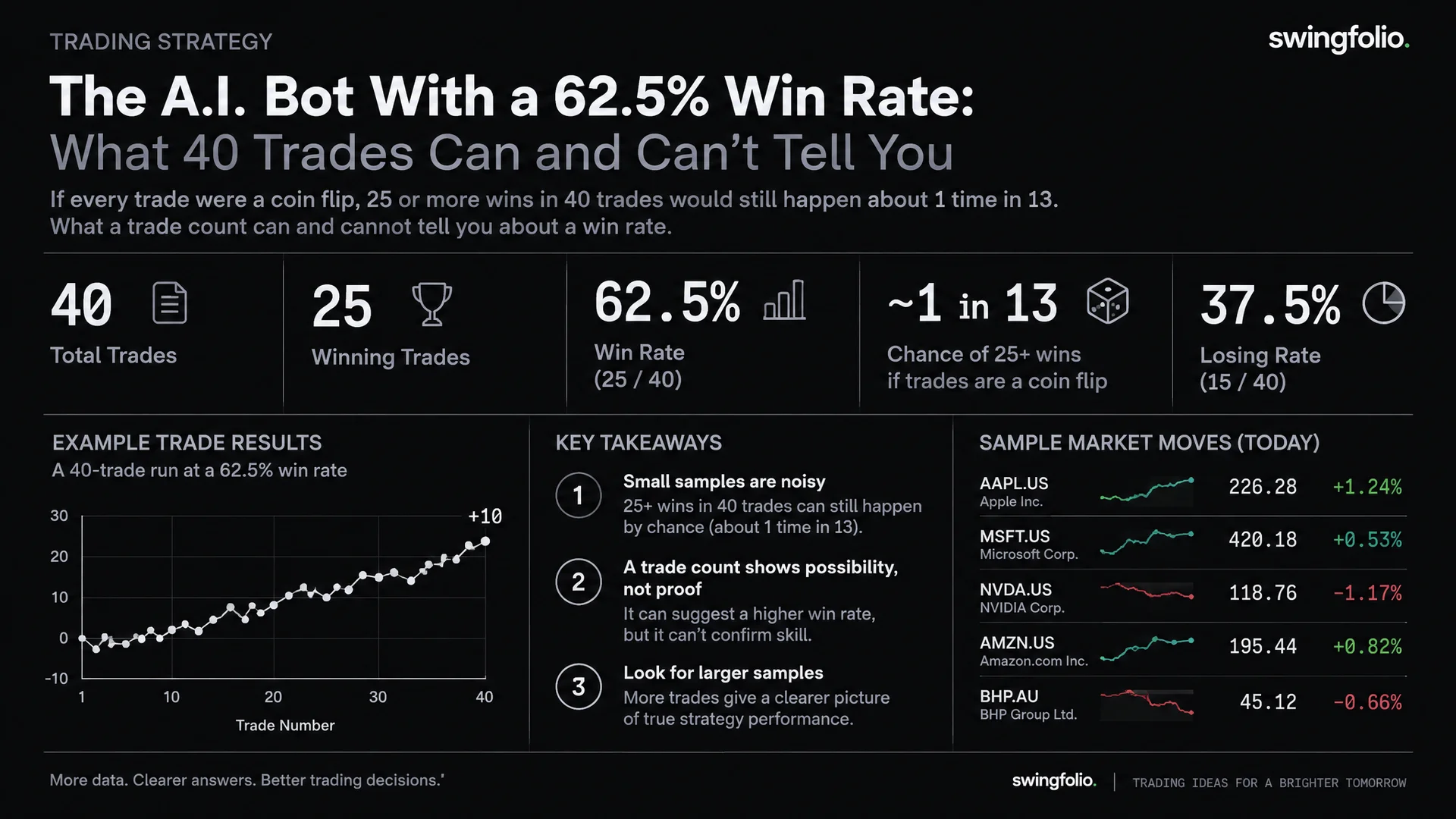
A trading screenshot with a 62.5% win rate over 40 trades looks like evidence. It may be. It may also be a result that chance alone produces fairly often. One number that changes how you read it is not on the screenshot: how many attempts there were that you didn't see.
This post works through the arithmetic, using a coin flip as the model of a trade with no skill in it, and shows where to see the trade count behind your own strategies' win rates in Swingfolio.
The coin-flip baseline
Suppose every trade were a fair coin flip: a 50% chance of a win, each trade independent of the last. Over 40 trades:
| Wins out of 40 | Win rate | Chance of at least this many by luck alone |
|---|---|---|
| 24 | 60% | about 13% |
| 25 | 62.5% | about 7.7%, or 1 in 13 |
| 26 | 65% | about 4.0% |
| 28 | 70% | about 0.8% |
These are binomial probabilities: the share of all possible sequences of 40 flips that have at least that many heads. Under this model, where every trade is independent with a constant 50% chance of a win, a strategy would reach 25 or more wins about one time in thirteen.
The coin is a model, not a claim about markets. Real trades differ in size, cost and dependence on each other. The model only answers one question: how often does a win rate this high appear when nothing but chance is at work?
Twenty bots, one screenshot
Now picture 20 bots, each flipping its own coin, 40 trades each.
- On average, about 1.5 of them finish with 25 or more wins (20 × 7.7%).
- The chance that at least one of them gets there is about 80%, four times in five.
Say only the runs that reached 25 or more wins get posted. You would see win rates of 62.5% or higher, and you would not see the runs that fell short. Nothing about a posted bot was better than the rest. It landed on the right side more often, this time.
A single result, picked from many, can look stronger than it is.
What a trade count can and can't tell you
A win rate means little until you know how many trades it rests on:
- 4 trades: almost nothing. Two wins and two losses, or three and one, are both common by chance.
- 25 or more wins from 40 trades: under the coin-flip model, about one run in thirteen gets there, as the table shows.
- More trades: under the same model, a high win rate becomes less likely to appear by chance alone. A bigger count helps, but it cannot prove skill on its own, because a strategy can stop working, and real trades may not be independent.
Two questions are worth asking of any win rate, including your own:
- How many trades is it based on?
- How many other attempts, strategies or accounts sit behind it that you aren't seeing?
Seeing the count in Swingfolio
Swingfolio's Strategies page lists your strategies (all, active or inactive) with net P&L, average R, Closed trade count and Win rate side by side, for the period, portfolios and markets you choose. On the demo account, for example, one strategy shows 50% from 4 closed trades (2 wins) and another 59% from 17 (10 wins), so the count is in view whenever you read the rate.
Two notes on what the columns count:
- Closed counts the closed trades in your selection. Win rate uses the trades whose outcome can be worked out, with break-even trades counted as resolved, so in some cases it rests on fewer trades than the Closed figure.
- You can pick two to four strategies and compare them side by side with the same filters.
Open the Strategies page in Swingfolio and check the closed count next to each win rate before your next trade.
Frequently asked questions
How many trades do I need before I trust a win rate?
There is no single number. Under a simple coin-flip model, a high win rate becomes less likely to appear by chance as the count grows, but a count never proves skill. Compare the win rate with what that model would produce at the same count, as in the table above.
Doesn't a high win rate mean a strategy is profitable?
No. Win rate ignores the size of wins and losses. A strategy can win most trades and still lose money if its total losses exceed its total gains. Look at average R and net P&L alongside it.
Is this saying A.I. trading tools don't work?
No. It says that 25 or more wins from 40 trades, on its own, is something chance produces about one time in thirteen under a simple model, whoever or whatever produced the result. The same arithmetic applies to any strategy, including your own.
All figures are coin-flip arithmetic and a hypothetical example. General information only. Not financial advice.