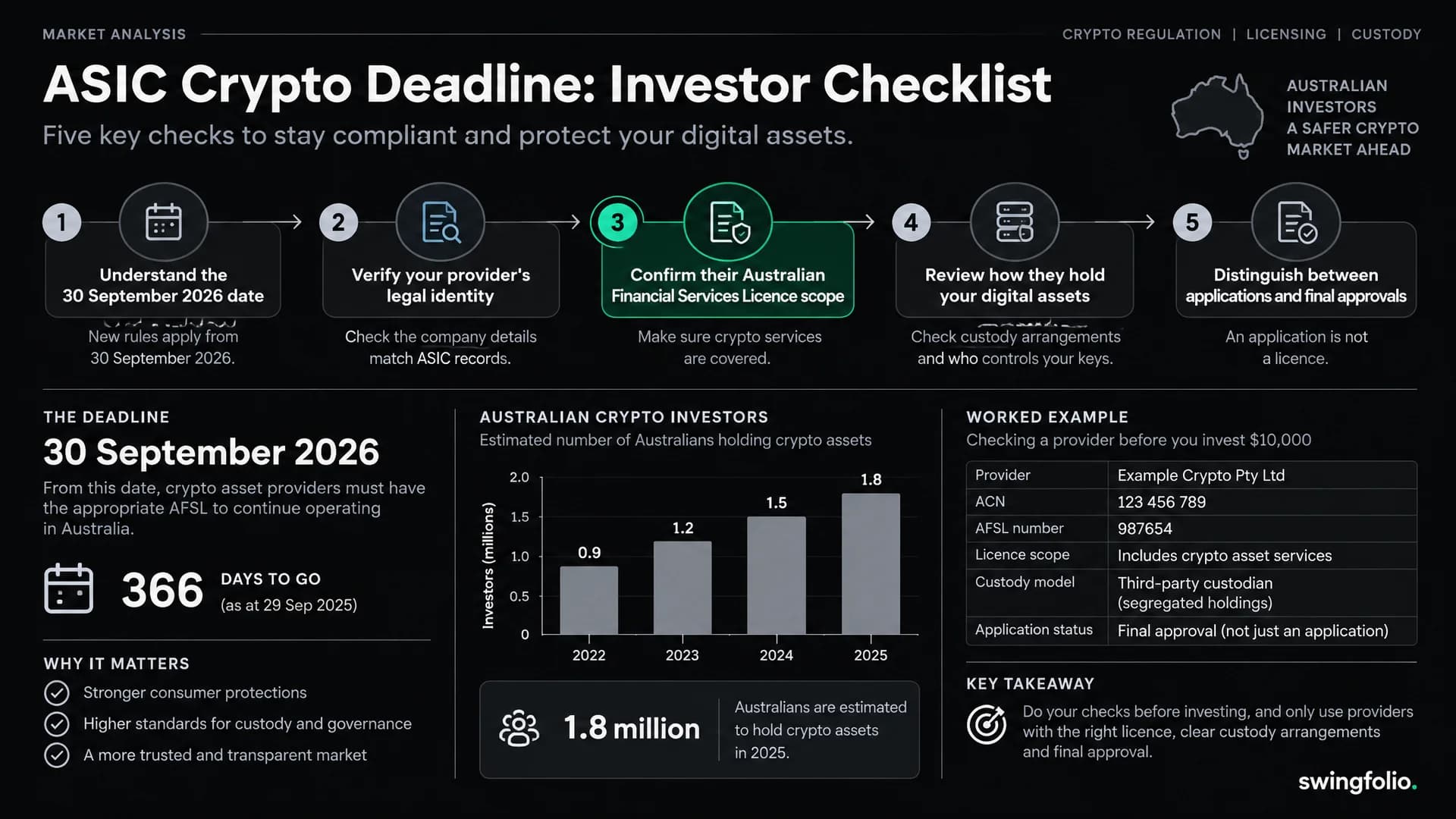
ASIC's 30 September 2026 deadline concerns specified transition steps for covered digital-asset businesses. It does not mean every crypto platform must hold a newly granted licence that day, or that every product on a platform has received ASIC approval.
For an investor, the practical task is to identify the legal provider, understand the service you use and check the claimed authorisation against independent records.
What the deadline covers
ASIC's published extension notice describes arrangements for financial services involving digital assets that are financial products, as well as certain market and clearing-and-settlement activities.
The updated class no-action letter sets the conditions. Relevant steps can include an AFS licence application or variation, specified representative arrangements, or other prescribed actions by the deadline. Market and clearing-and-settlement applicants have their own notification, pre-meeting and application requirements.
For qualifying applicants, protection can continue under the letter until specified events concerning the application. The letter also has exclusions, including crypto lending/earn products and certain derivatives, and an eligibility condition concerning operation by 31 December 2025.
These details matter. “We applied” is incomplete without knowing the entity, activity, applicable pathway and conditions. This summary is not a determination that a particular business qualifies.
Separate four different claims
| Provider's claim | What you still need to establish |
|---|---|
| “We submitted an application” | What was requested and the current application position |
| “We have an AFS licence” | Which legal entity holds it and what it authorises |
| “We are an authorised representative” | The appointing licensee and the activities covered |
| “We are registered with AUSTRAC” | The registration and applicable services; this is a separate regime |
AUSTRAC now uses the term virtual asset service provider, or VASP, in its registration framework. Do not treat anti-money-laundering registration and an AFS licence as interchangeable documents.
A familiar brand can operate through several companies. The terms for your account determine which entity you deal with.
Start with the legal name
Open your account terms and find the contracting entity, registration details and contact information. Then use ASIC's professional registers search to inspect the relevant licence or representative record.
Match the name and number, not only the brand. Check the current status and authorisations relevant to the service.
If the provider relies on a transition arrangement, ask for a written explanation of its basis. An application may not appear as a granted licence, so absence from the licence list alone does not resolve every transition question. Equally, a provider's statement is not independent proof that it meets every condition.
Save the answer and the date you checked it. A useful research note identifies what you verified and what remains unresolved.
Check whether the service changes the exposure
Buying and holding a token, lending it for a return, using leverage and placing assets into a managed arrangement can create different rights and obligations.
Consider a hypothetical platform offering two tabs:
- Spot: buy a token and retain it in the platform's custody.
- Earn: transfer the token into an arrangement promising a variable return.
The same login and balance display do not establish the same contract or protections. Check the product terms, legal counterparty, withdrawal rights and regulatory basis for each service.
If a document refers only to one activity, do not extend its claims to the whole platform.
A licence does not guarantee an investment
ASIC's Moneysmart checking guide explains that licensing does not amount to ASIC endorsing a company, advice or product, and does not remove the possibility of loss.
It also warns about impersonation. A scammer can copy a real company's licence number. Use independently obtained contact details to verify that the business offering the account is connected to the licence holder.
Avoid following a login or payment link merely because a message invokes the approaching deadline. Verify any required action through the provider's established channel.
Ask practical custody questions
Regulatory status is one part of the review. Also ask:
- Who controls the assets and any relevant private keys?
- Are client assets separated from the provider's own assets, and on what legal basis?
- Can the provider lend, pledge or otherwise use them?
- What limits or conditions apply to withdrawals?
- What records would support your claim if the provider failed?
- Which complaints process applies to your account and product?
A balance on a dashboard is not a complete custody explanation. Keep the contract and transaction evidence that show the claim you actually hold.
Do not infer from this checklist that a particular custodial or self-custodial arrangement is suitable for everyone. They involve different operational responsibilities.
Keep records before making account changes
Export transaction histories and retain confirmations, fees, deposits and withdrawals. If you move assets, preserve the sending and receiving records and reconcile quantities.
A transfer can affect the evidence available for later tax and performance work. Avoid deleting the original account records after moving the balance.
For your trading review, use the journal record template to note the provider and reason for the change. The import review guide explains why a successful file upload still needs reconciliation.
Swingfolio's trade records can support your review; a journal entry is not a certification of a provider's licensing or custody arrangements.
Common questions
Must every covered applicant receive a licence by 30 September?
No. The letter specifies transition steps and conditions, including circumstances extending through the application process. Read the relevant pathway.
Does the deadline require investors to sell their crypto?
It is not a blanket instruction to investors to sell. Assess official notices and your provider's actual arrangements before acting on a deadline claim.
Does a licence cover every product offered under a brand?
Not automatically. Check the entity, licence scope and particular service.
Reviewed 27 September 2026. Recheck ASIC's current notices after the deadline or before relying on this guide. General information only, not a legal assessment of any provider.