Author
Tyson P
Founder, Swingfolio
Founder of Swingfolio. Finance guy, Swing trades ASX and US stocks and built the tool to track his own results.
Read how these articles are researched and reviewed in the editorial methodology.
Articles by Tyson P

Am I Overtrading? Review Entries After Wins and Losses
Check for overtrading after winning and losing periods. Compare entry timing, setup quality, position size and costs before drawing a conclusion.
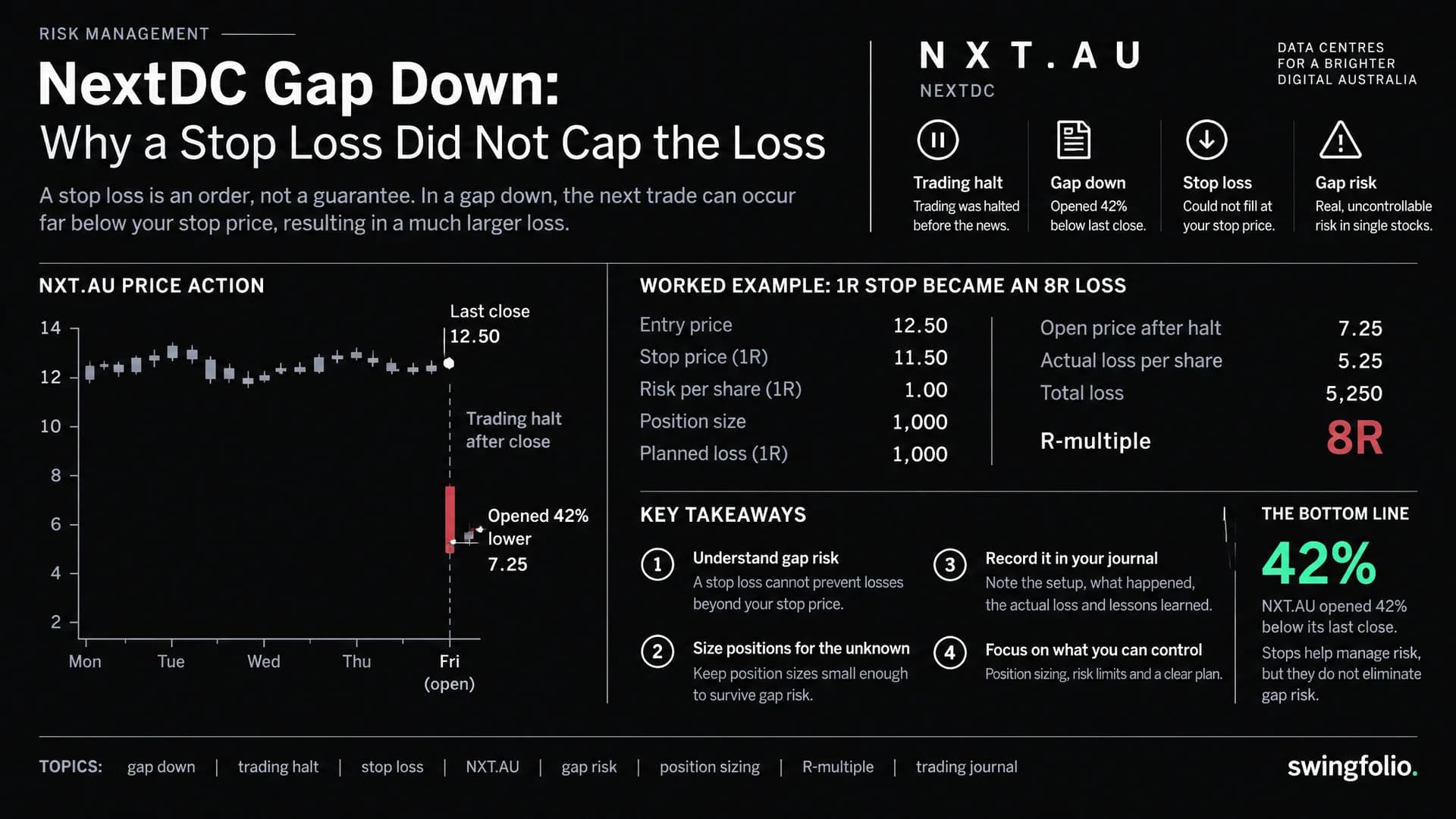
NextDC Gap Down: Why a Stop Loss Did Not Cap the Loss
NEXTDC opened 42% below its last close after a trading halt. A worked example shows how a 1R stop became an 8R loss, and what to record in your journal.

Mastering the Moving Average Crossover Trading Strategy
Learn how to master the Moving Average Crossover trading strategy. This comprehensive guide covers entry rules, risk management, and how to track your progress with SwingFolio.

Nasdaq 23/5 Trading: What Australian Share Traders Need to Know
Nasdaq plans a December 2026 overnight session. See Australian trading times, broker-access checks and a worked example of spread costs before placing orders.
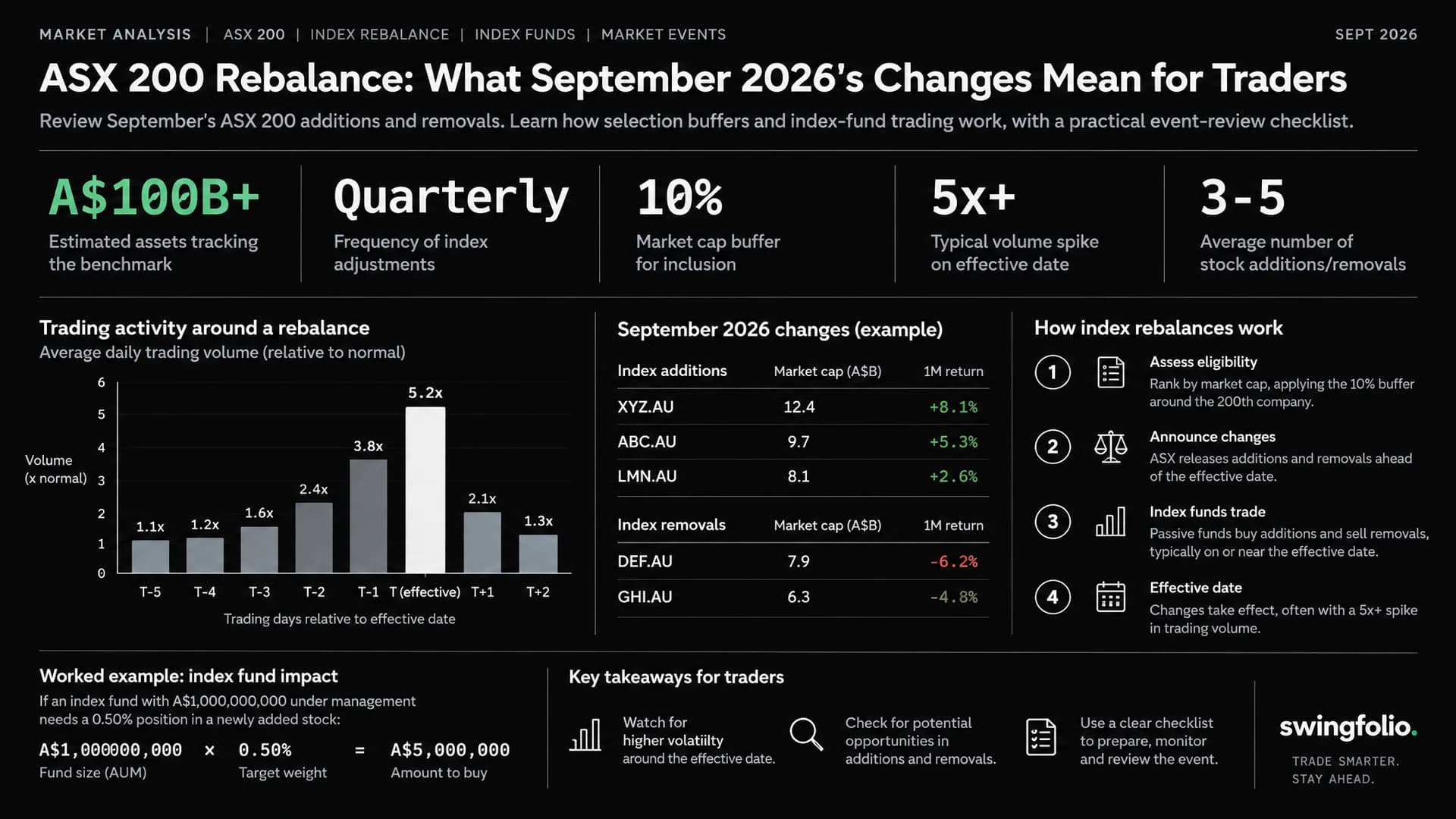
ASX 200 Rebalance: What September 2026's Changes Mean for Traders
Review September's ASX 200 additions and removals. Learn how selection buffers and index-fund trading work, with a practical event-review checklist.

AI Backlog vs Revenue: How to Read Oracle's $664 Billion RPO
Understand Oracle's $664 billion RPO, why backlog differs from revenue, and how capital spending affects cash flow. Includes a worked contract example.
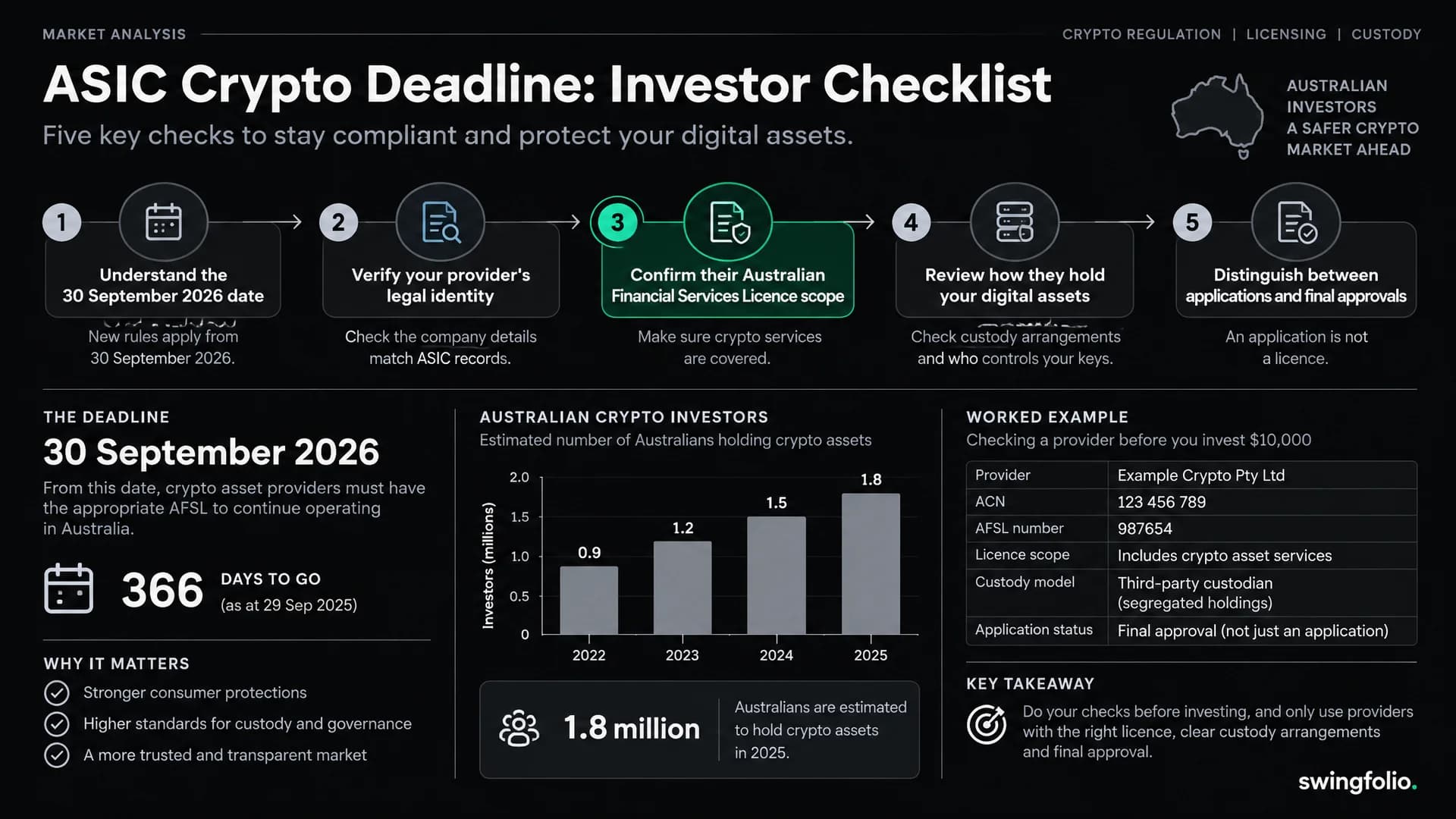
ASIC's 30 September Crypto Deadline: What Australian Investors Should Check
Understand ASIC's 30 September 2026 crypto transition deadline. Check provider identity, licence scope and custody, and distinguish applications from approvals.
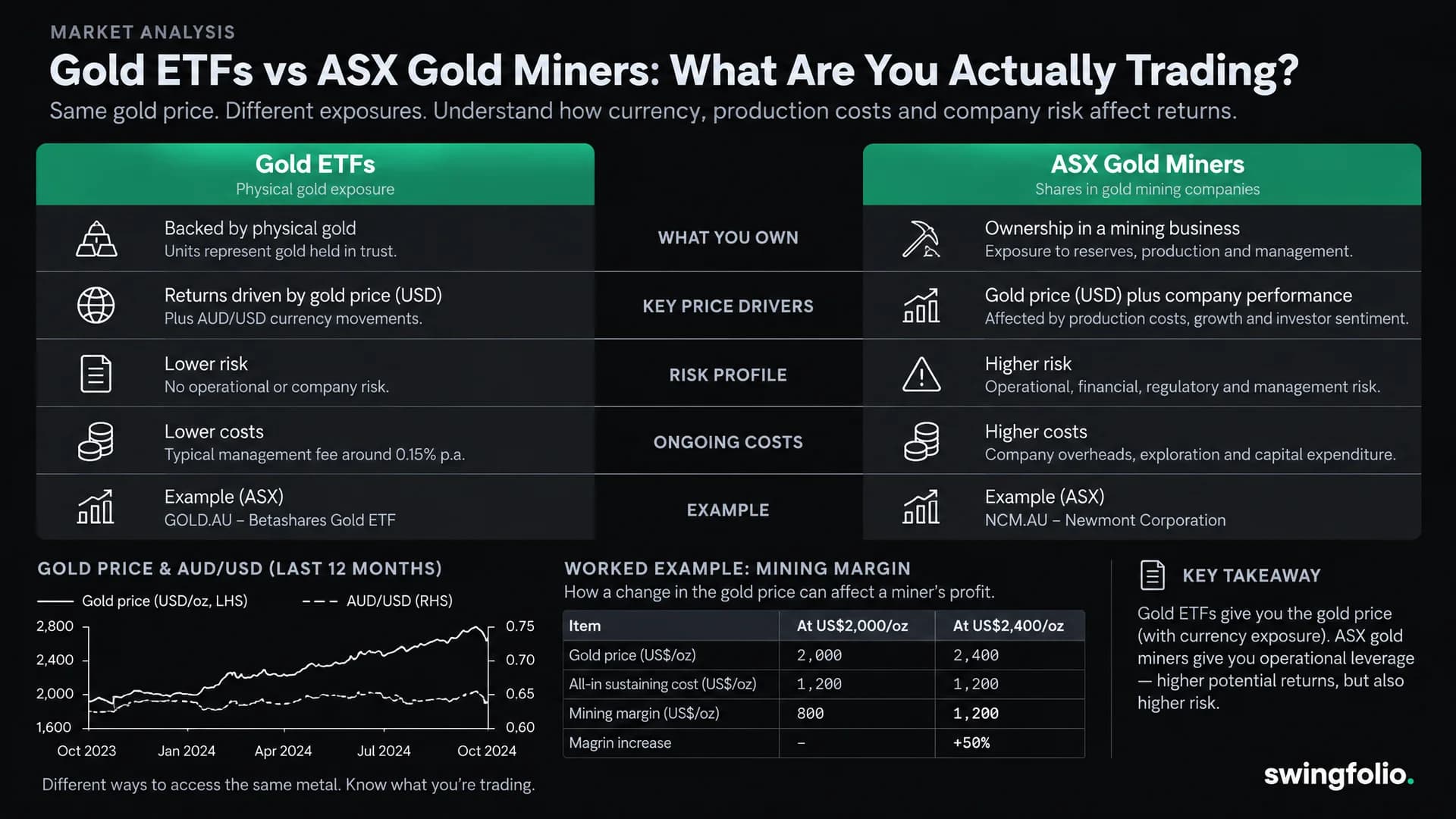
Gold ETFs vs ASX Gold Miners: What Are You Actually Trading?
Compare physical gold ETFs with ASX gold miners. See how currency, production costs and company risk affect returns, with a worked mining-margin example.
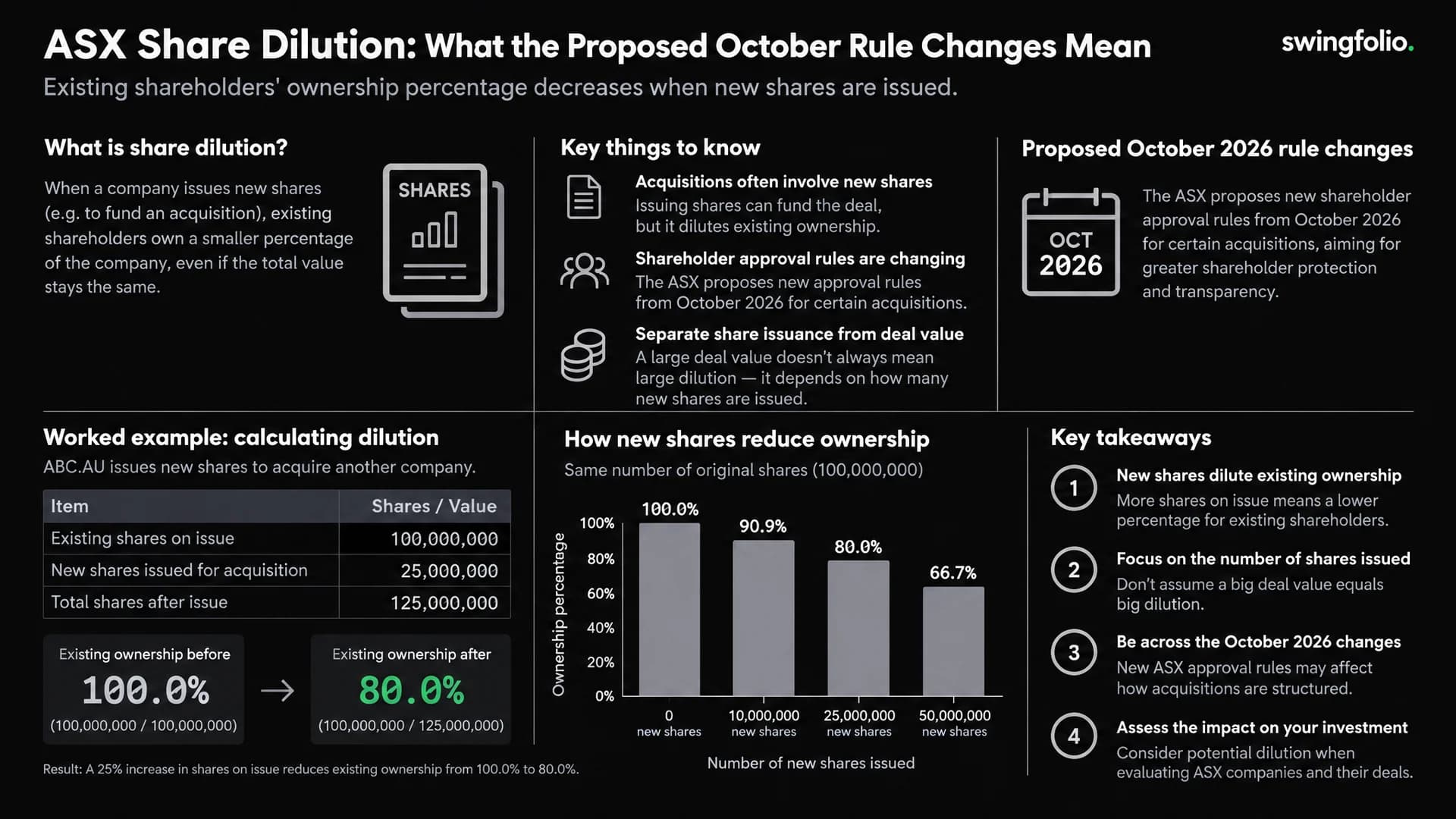
ASX Share Dilution: What the Proposed October Rule Changes Mean
Understand ASX acquisition dilution and the proposed October 2026 approval rules. Calculate ownership changes and separate share issuance from deal value.
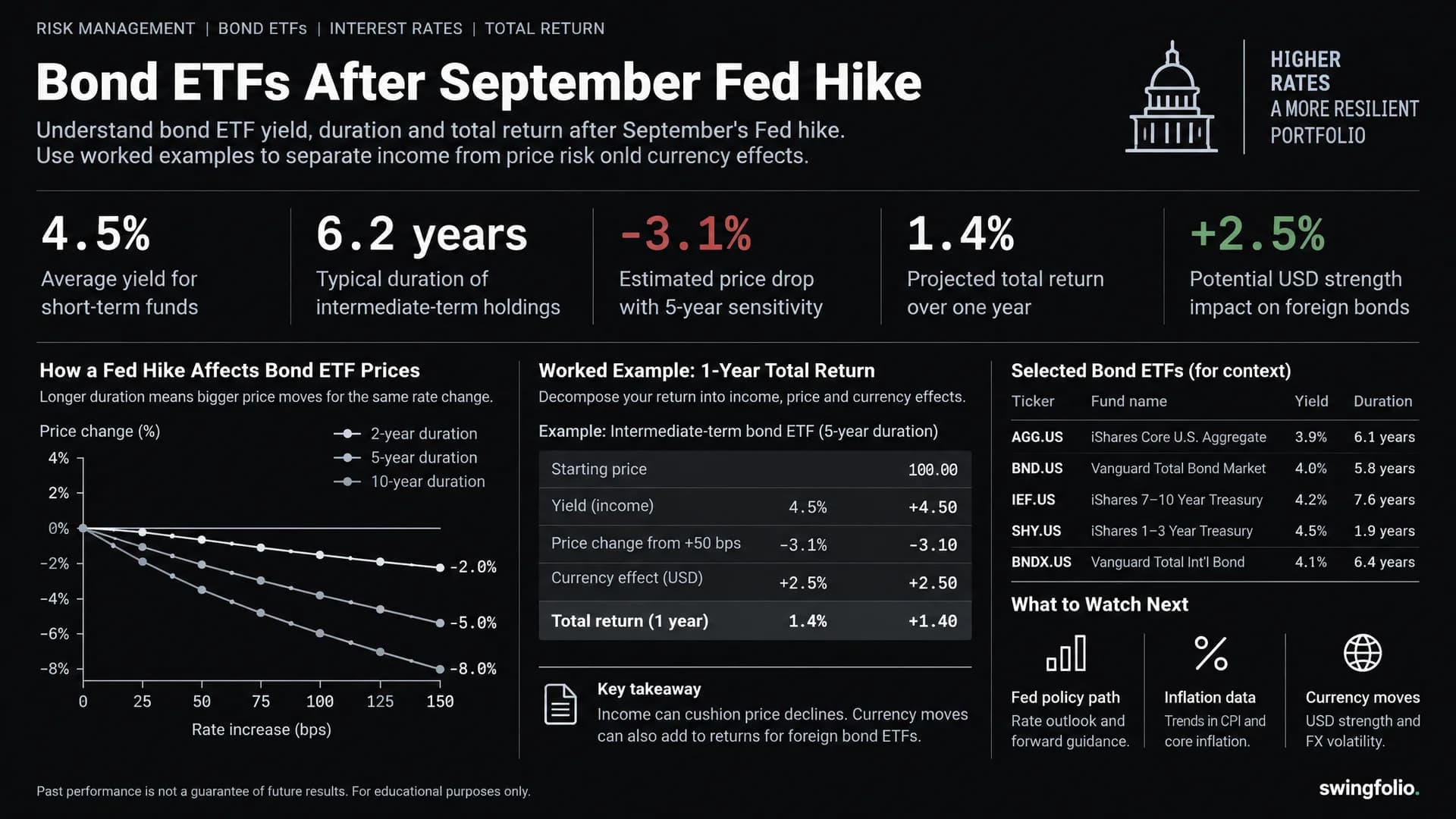
Bond ETFs After the September Fed Hike: Yield, Duration and Price Risk
Understand bond ETF yield, duration and total return after September's Fed hike. Use worked examples to separate income from price risk and currency effects.

Hedged vs Unhedged ETFs: How AUD Moves Change Your Returns
Compare hedged and unhedged ETFs with worked AUD return examples. Understand currency exposure, hedging costs and why an ASX listing does not remove FX risk.

ETF Liquidity Explained: Spreads, NAV and the Cost of a Trade
Understand ETF liquidity beyond daily volume. Calculate bid-ask spreads and premiums to NAV, and check market hours and order size before placing a trade.
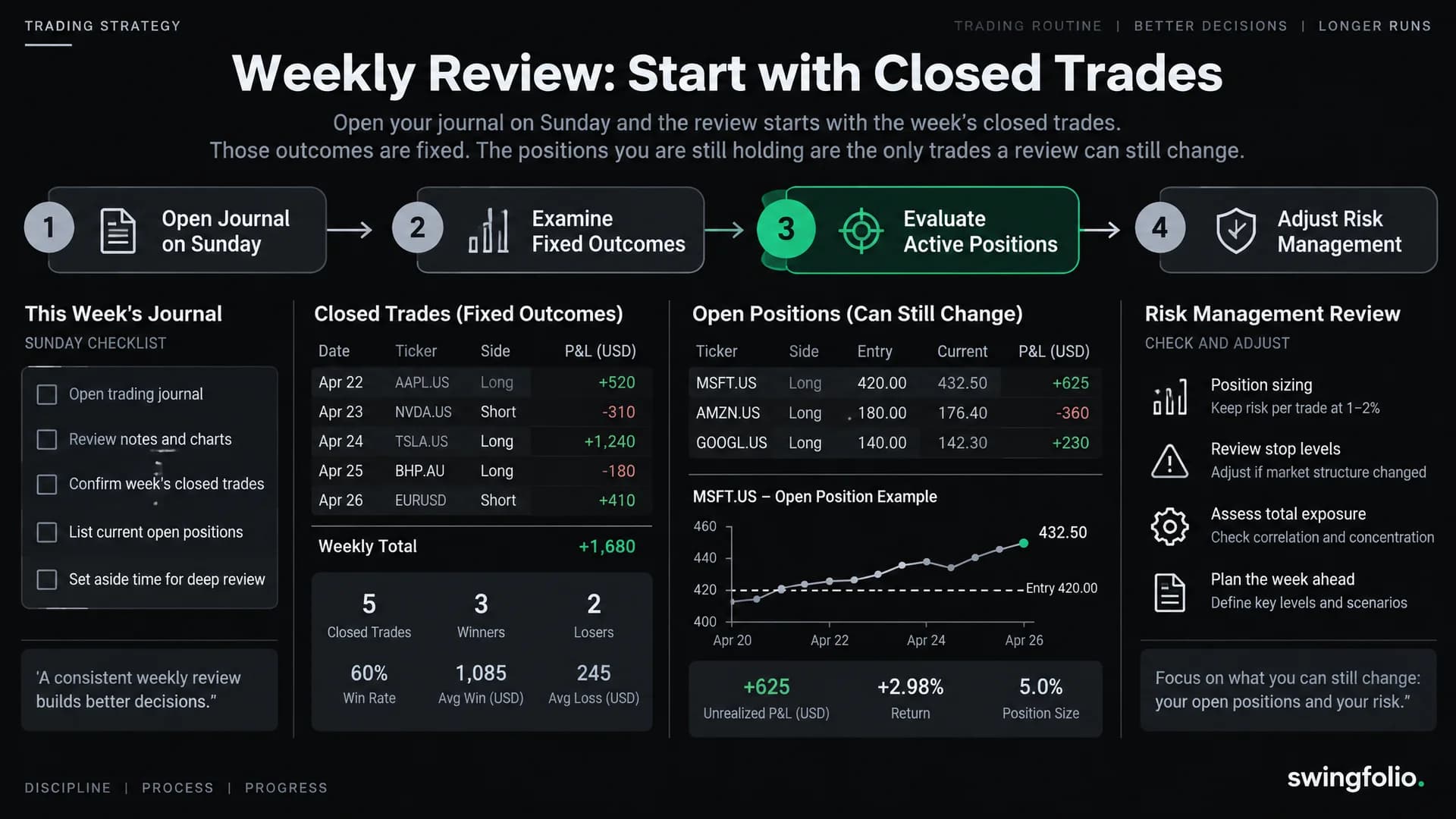
Your weekly review starts with the trades you can no longer change
Open your journal on Sunday and the review starts with the week's closed trades. Those outcomes are fixed. The positions you are still holding are the only trades a review can still change, and the reason people skip them is real.

Breakeven Win Rate After Trading Costs
A fixed fee consumes more R when the stop is tight. Calculate the win rate your strategy needs after commissions, spread and slippage.
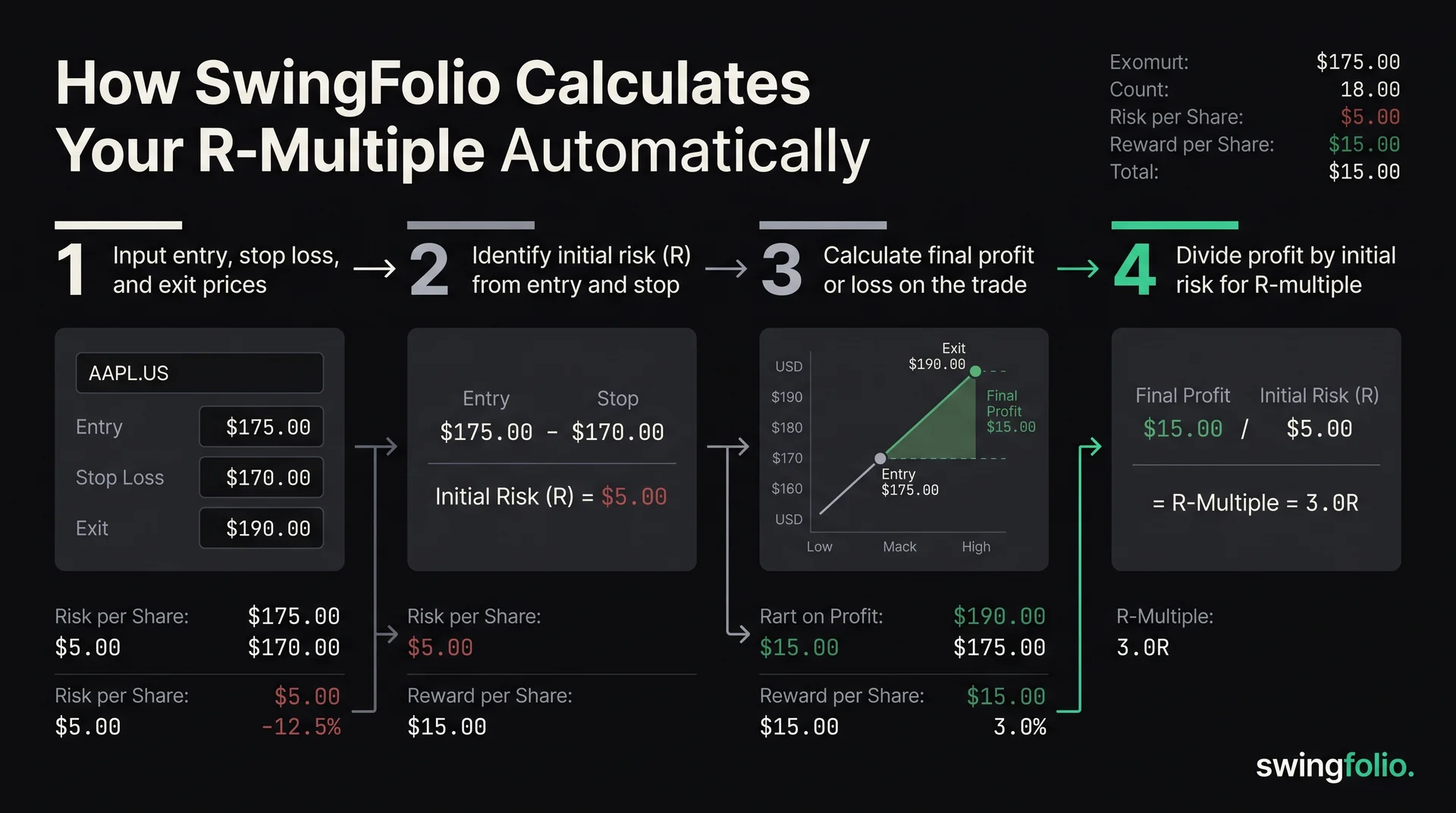
How Swingfolio Calculates R-Multiple
Swingfolio compares each closed trade's price result with its initial planned risk, including weighted partial exits and an MAE review fallback.

Your Trading Journal Needs a Market Regime Column
A practical workflow for recording market regime at entry, splitting setup results by condition and using Swingfolio's benchmark-derived classification.
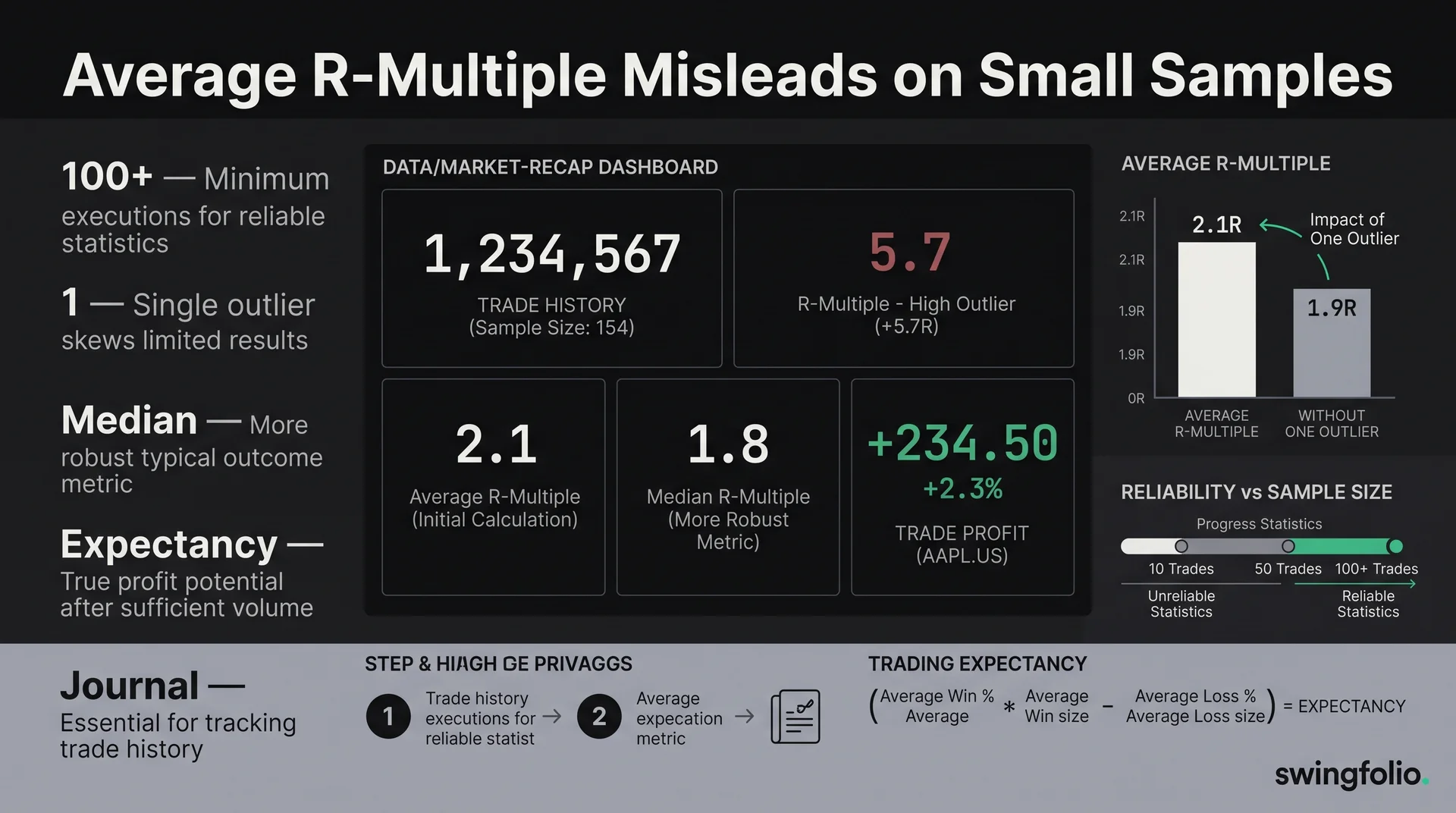
Average R-Multiple: How Sample Size Changes the Answer
A nine-trade record can show positive average R while eight trades lose. Compare raw mean, median and robust mean before judging a setup.

Are You Beating the Index? A Fair Benchmark Test
A green account is not enough to prove active trading added value. Compare it fairly with a relevant benchmark over the same dates and risks.

Market Rotation: Is Your Trading Edge Gone or Conditional?
When leadership changes, the same setup can stall without becoming useless. Diagnose execution, regime fit and strategy evidence before changing rules.
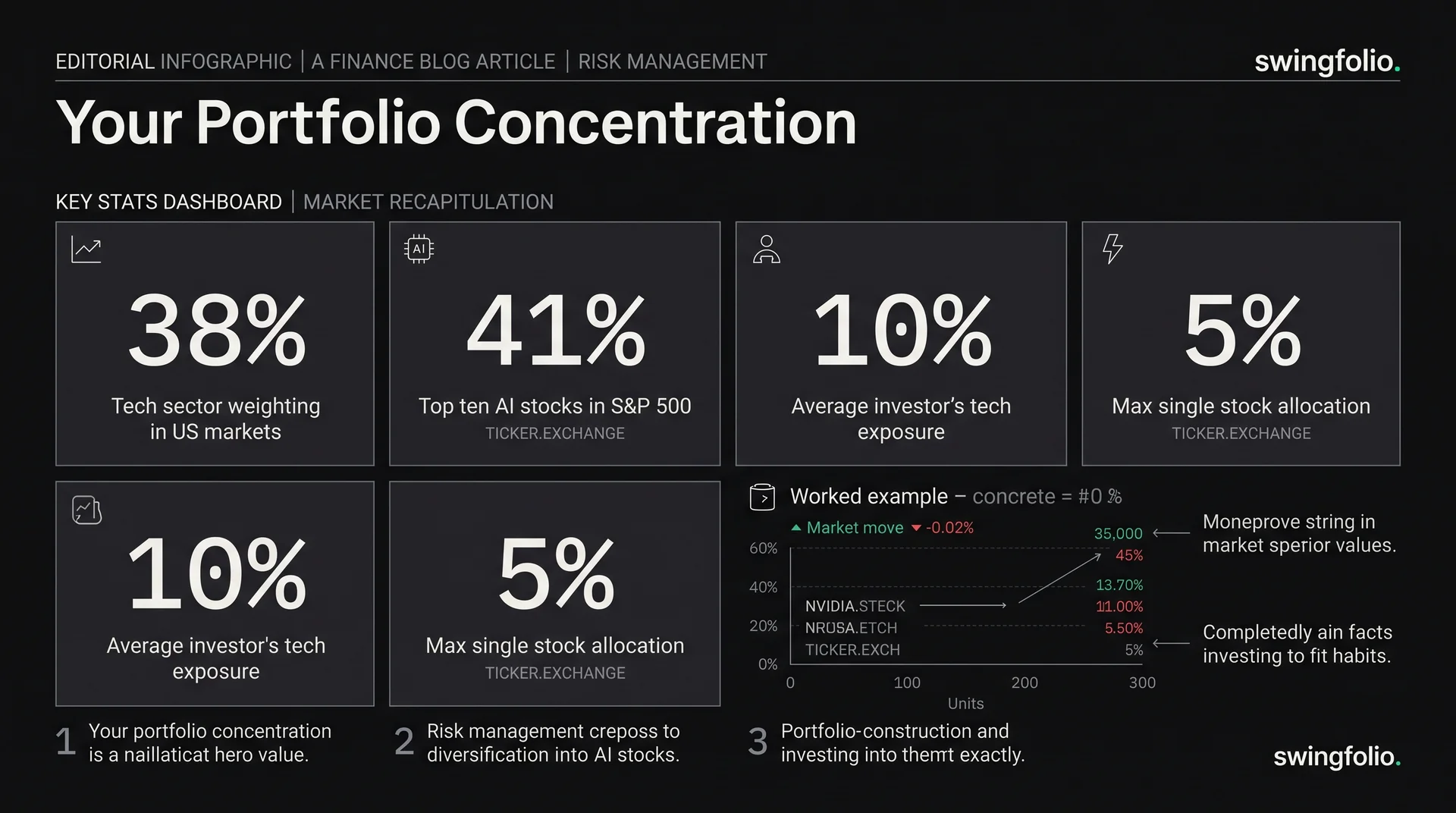
Portfolio Concentration: You Own More Nvidia Than You Think
Several tickers can still create one concentrated bet. Measure direct positions, fund overlap, sectors and themes before the market exposes the connection.

Mid-Year Trading Review: A 30-Minute Worksheet
A copyable 30-minute worksheet for benchmarking the half, ranking setups, reviewing losses, finding one pattern and choosing one action.
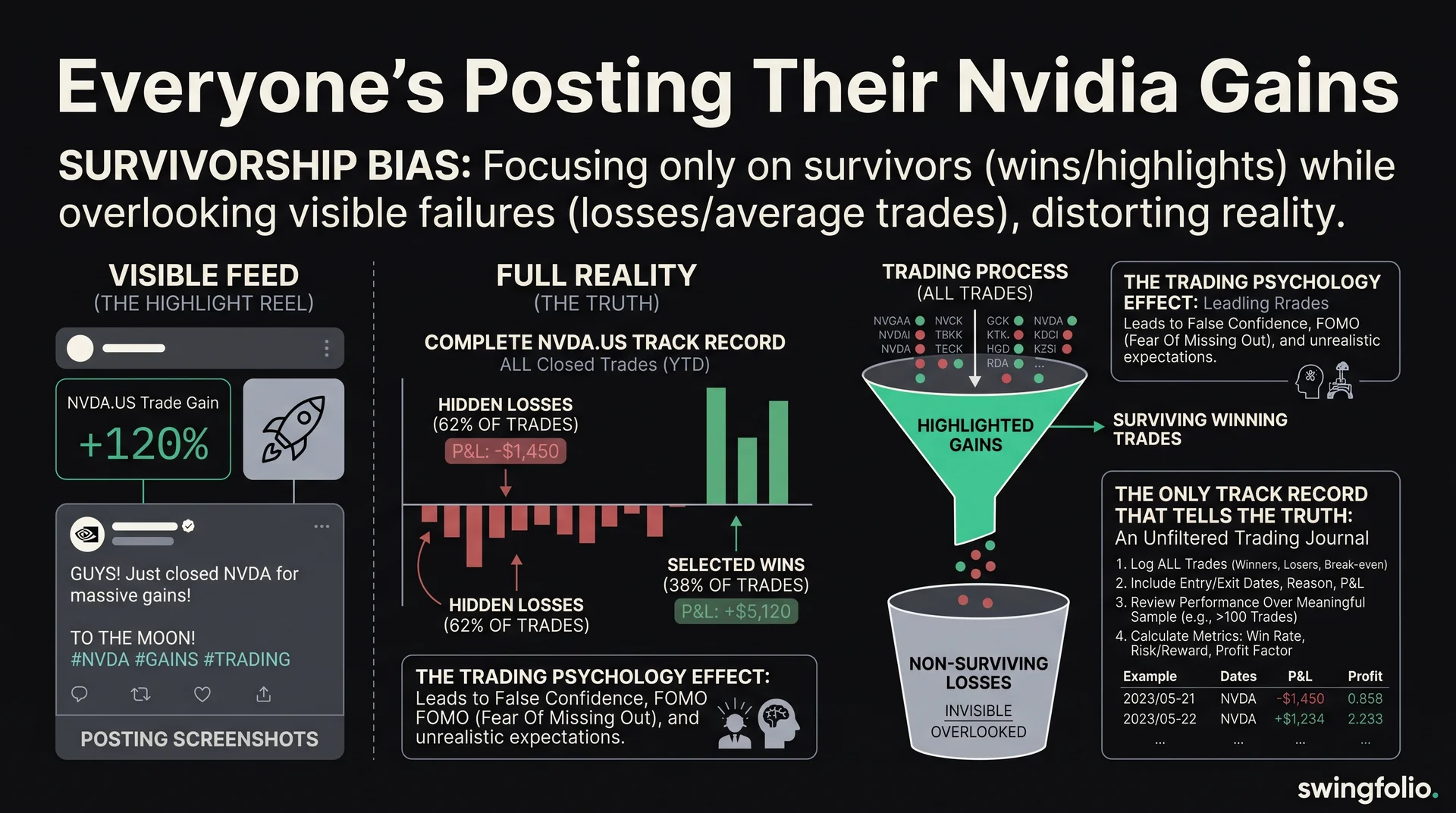
Survivorship Bias in Trading: The Screenshots You See
The Nvidia winner in your feed may be real, but it is not a representative record. Use the missing denominator to judge screenshots and your own results.

When Your Winner Goes Parabolic, Use an Exit Plan
A partial exit can bank some profit while a trailing rule keeps part of a parabolic winner open. Set both rules before the reversal arrives.

Missing the FOMO Trade Is a Risk Decision, Not a Loss
A missed rally costs no capital. This worked sizing example and copyable log stop the feeling of loss from changing your next entry or risk.
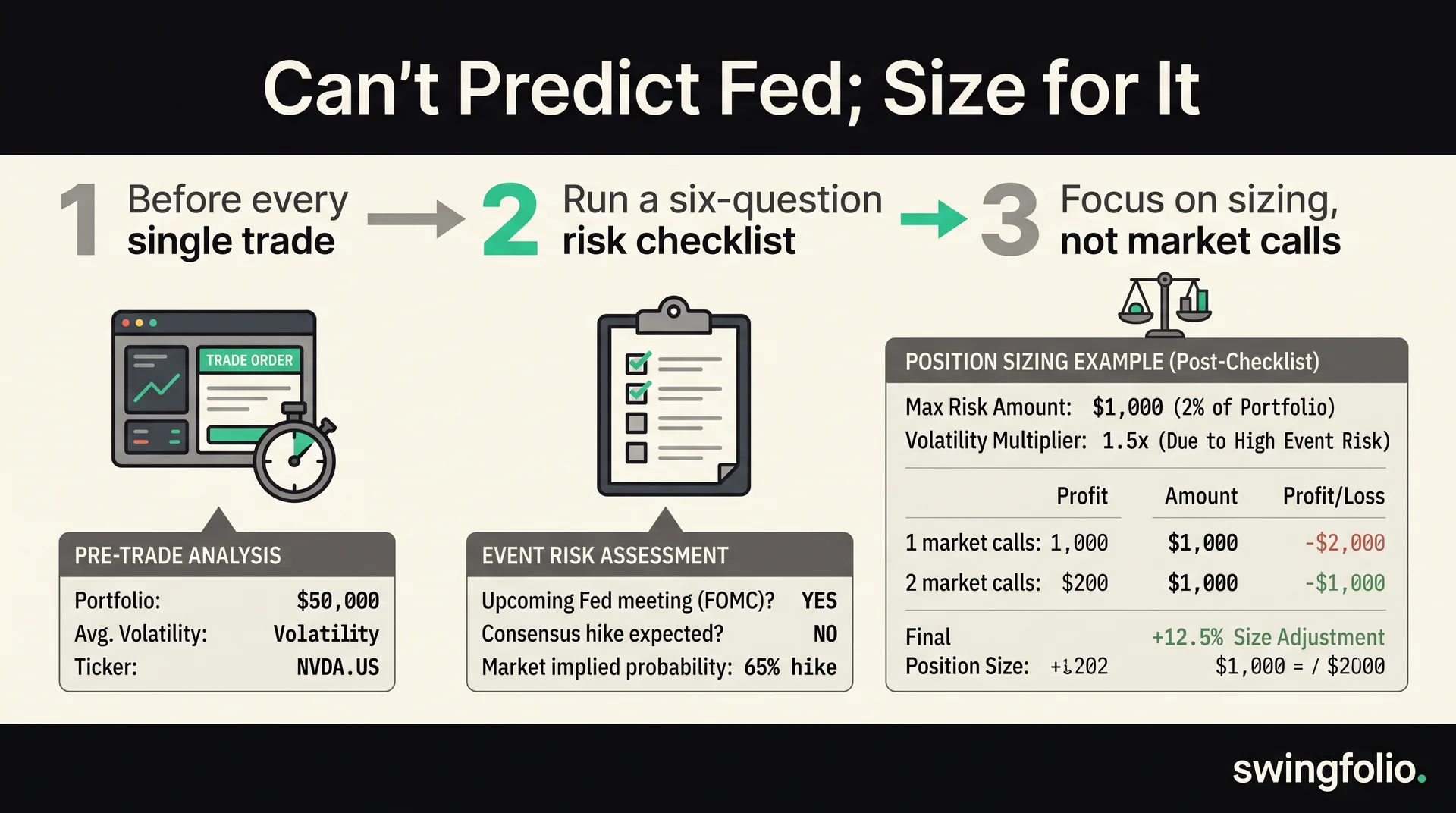
Macro Event Checklist: You Can't Predict the Fed, but You Can Size for It
Run six questions before a scheduled macro release to check size, stops, concentration, cash and the note you will review afterwards.
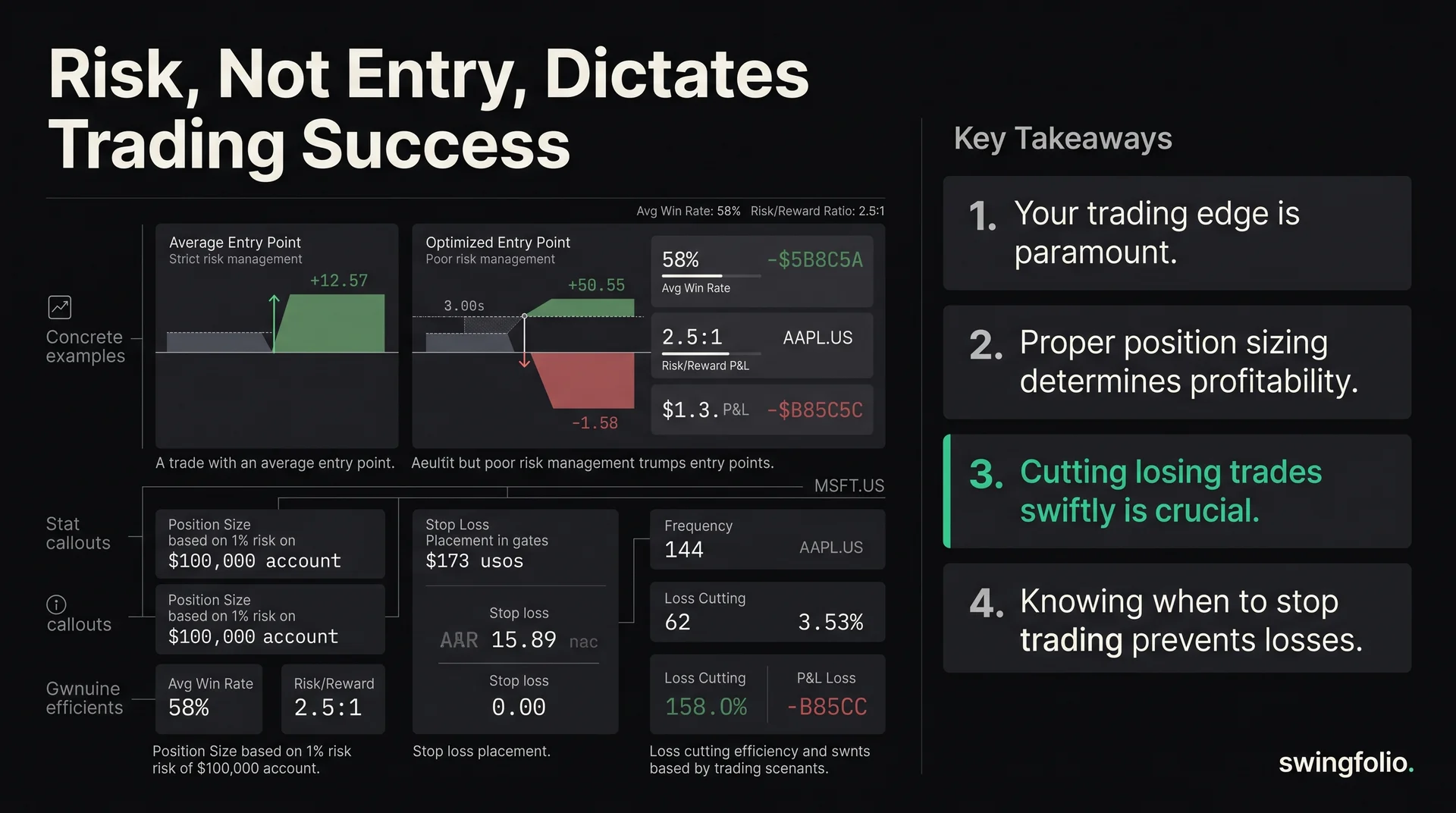
Why You're Not Profitable: Diagnose the Whole Trade
A profitable setup can be ruined by size, costs or execution. Use this worked diagnosis to find which part of the trade is producing the loss.

Backtest vs Live Trading: Test Strategy and Execution
A backtest measures written rules. Practice trading rehearses mechanics. A small live test adds real execution pressure. Use each stage for its proper job.

Day Trading vs Swing Trading: Which Fits Your Life?
A practical comparison of day trading and swing trading through time, attention, costs, overnight risk and the routine each style requires.

Importing Trades Is Not the Same as Reviewing Them
A broker import solves data entry. This four-layer framework turns validated fills into trades you can review for setup, risk, execution and lessons.

Rule Adherence Score: Measure Your Trading Discipline
A repeatable method for scoring trading discipline across five rules, ten worked trades and four combinations of process and outcome.
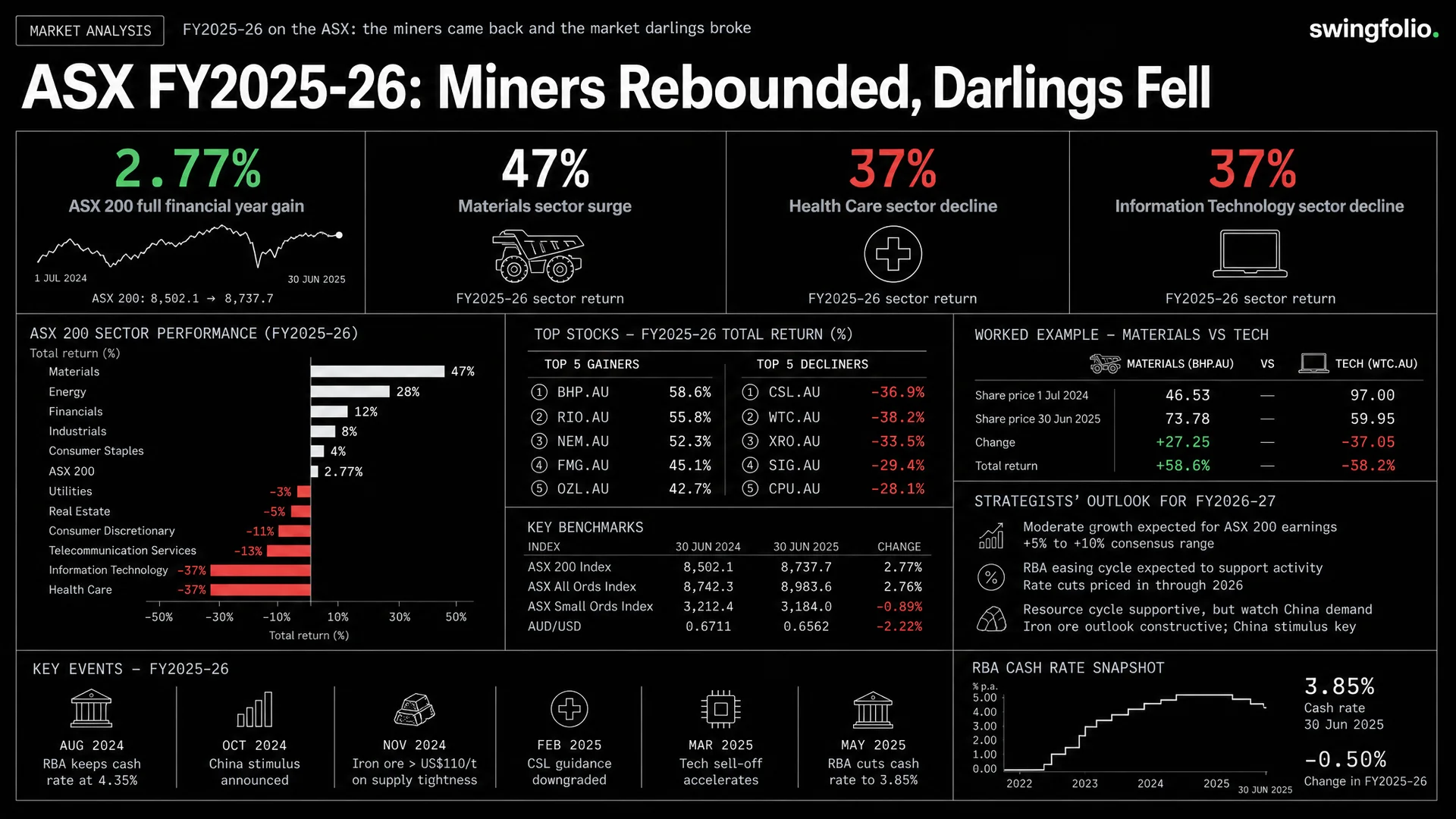
ASX FY2025-26 Review: Miners Rose as Market Darlings Fell
The ASX 200 gained 2.77% in FY2025-26, but miners and former market favourites moved in opposite directions. Here is the sector and stock scorecard.

Position Sizing Strategies for Volatile Markets
Use account risk, stop distance and ATR to size volatile trades, then account for cash capacity, correlated holdings and gaps through a stop.
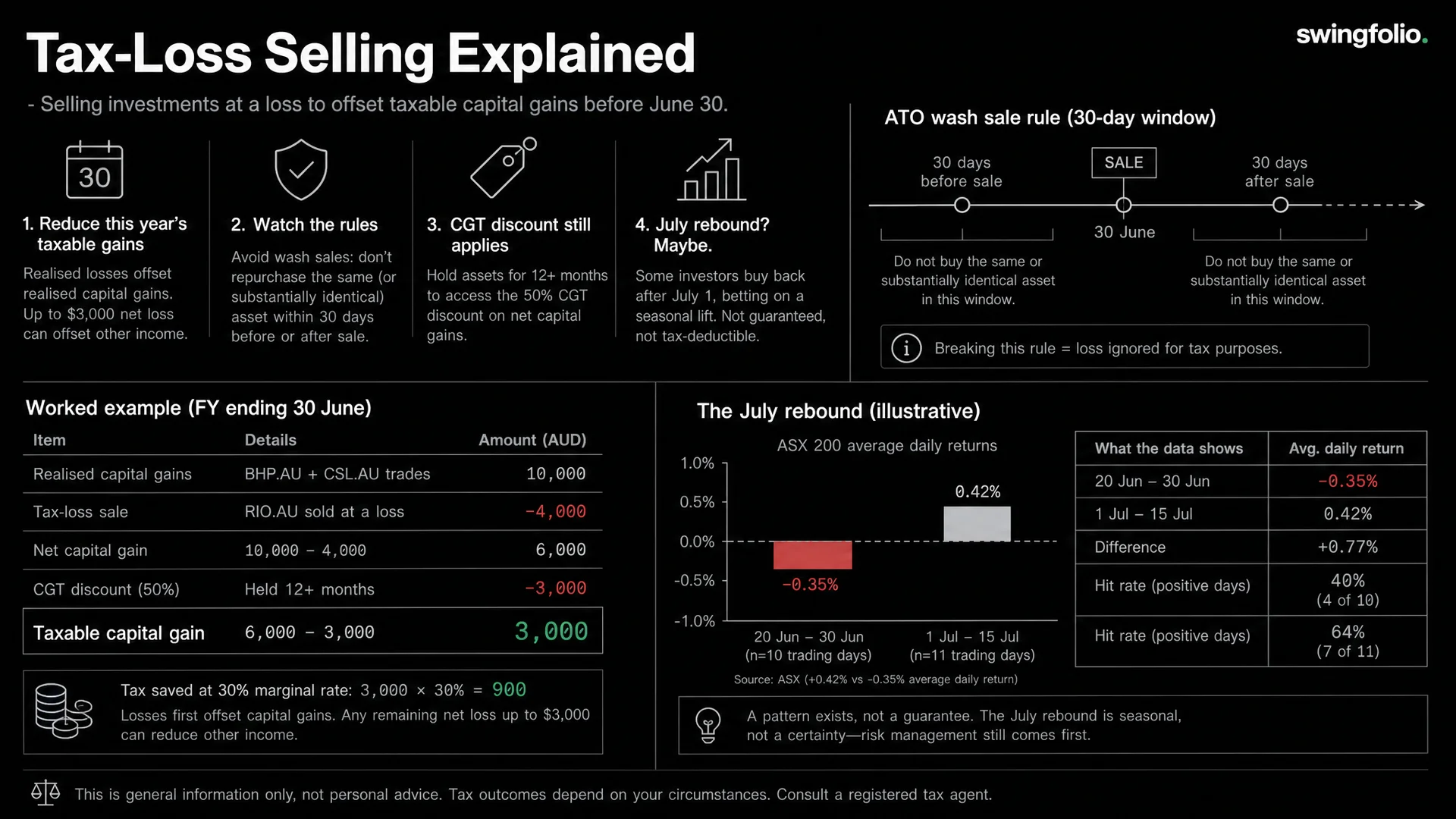
Tax-Loss Selling in Australia and the July Rebound Evidence
Learn how Australian capital losses work, where wash-sale risk starts and what the historical evidence says about a possible July rebound.
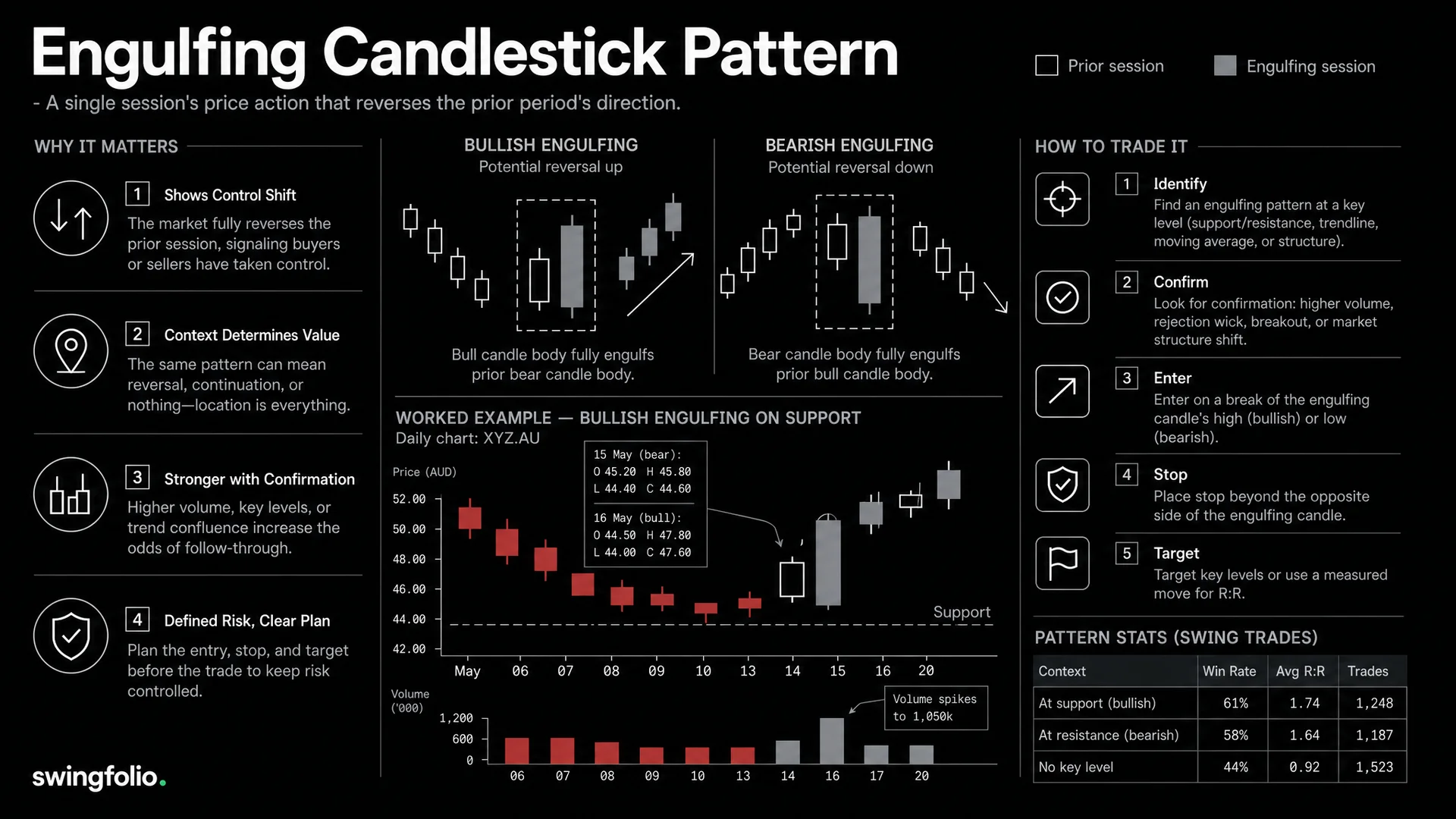
Engulfing Candlestick Patterns for Swing Trading
Learn the body-based definition of bullish and bearish engulfing patterns, the context that matters and two complete swing trade scenarios.
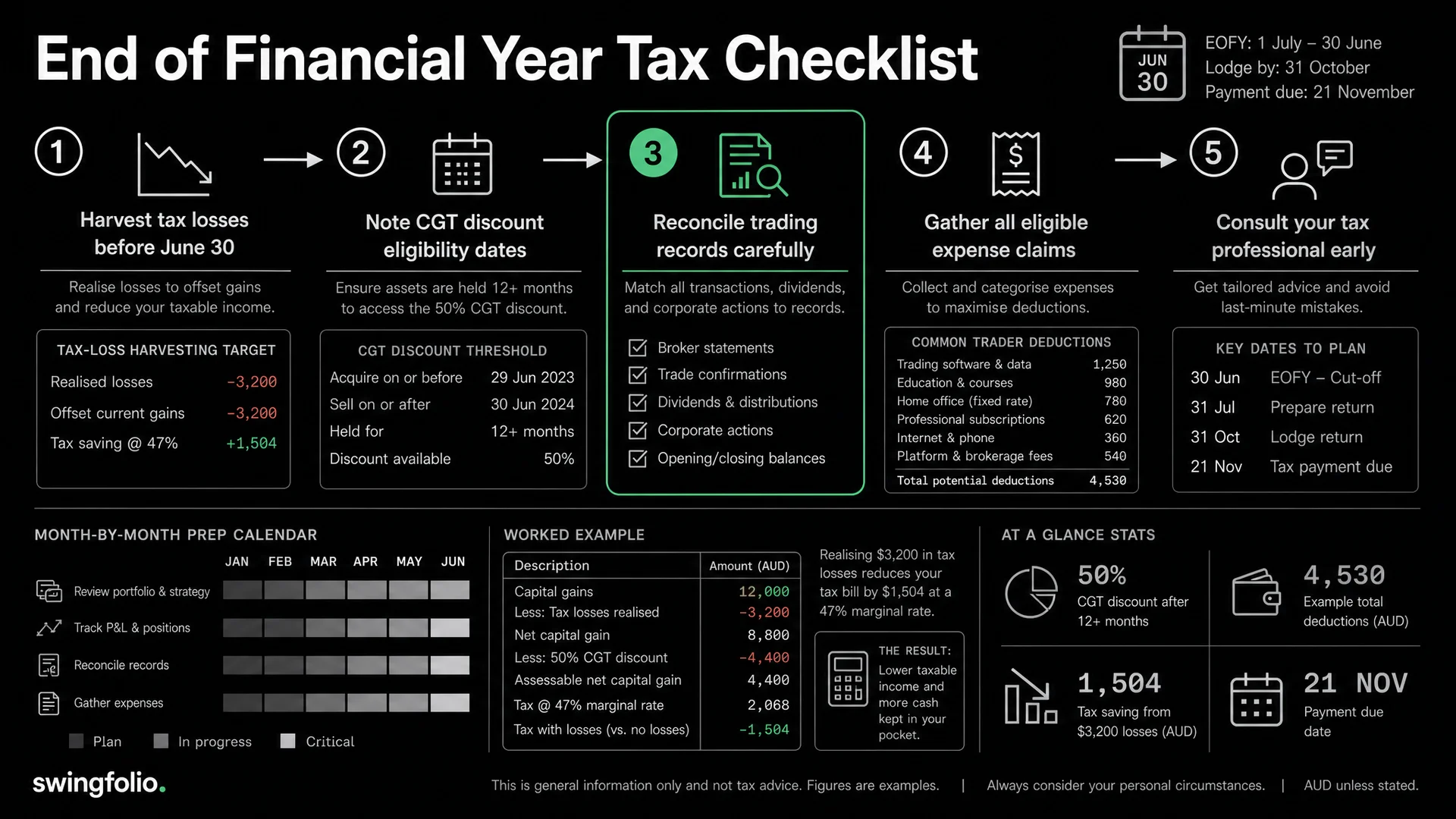
EOFY Tax Checklist for Australian Share Traders
Use this copyable EOFY timeline to review share disposals, CGT parcels, tax-loss decisions, deductions and your accountant handover.

ASX Sectors for Swing Traders: Six Practical Comparisons
Compare six ASX sectors by catalysts, liquidity, gap risk and strategy fit, then use sector rotation to build a focused watchlist.
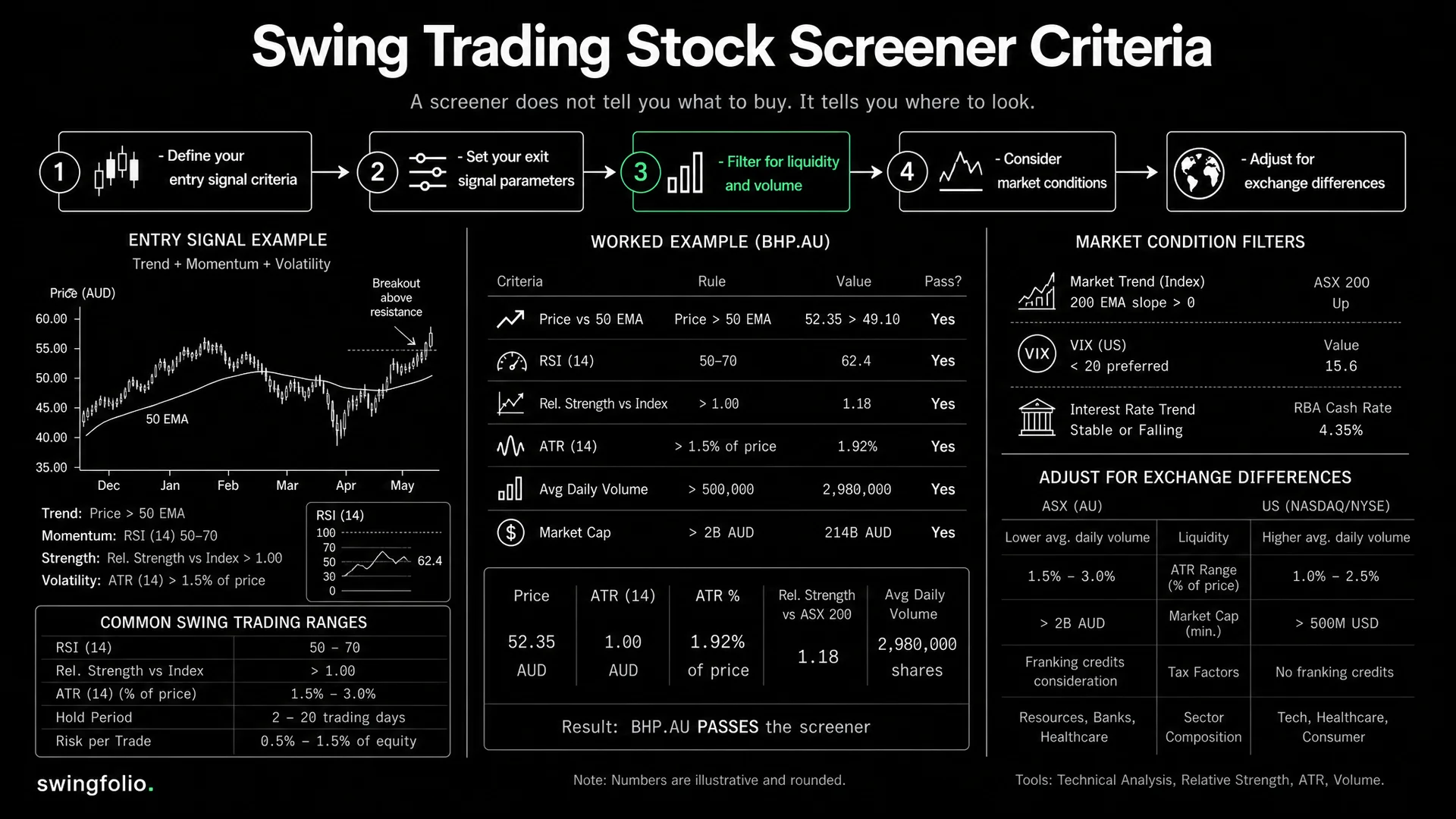
How to Set Up a Stock Screener for Swing Trading
Learn which swing trading screener criteria define a tradable universe, which rank candidates and how two complete example screens fit together.
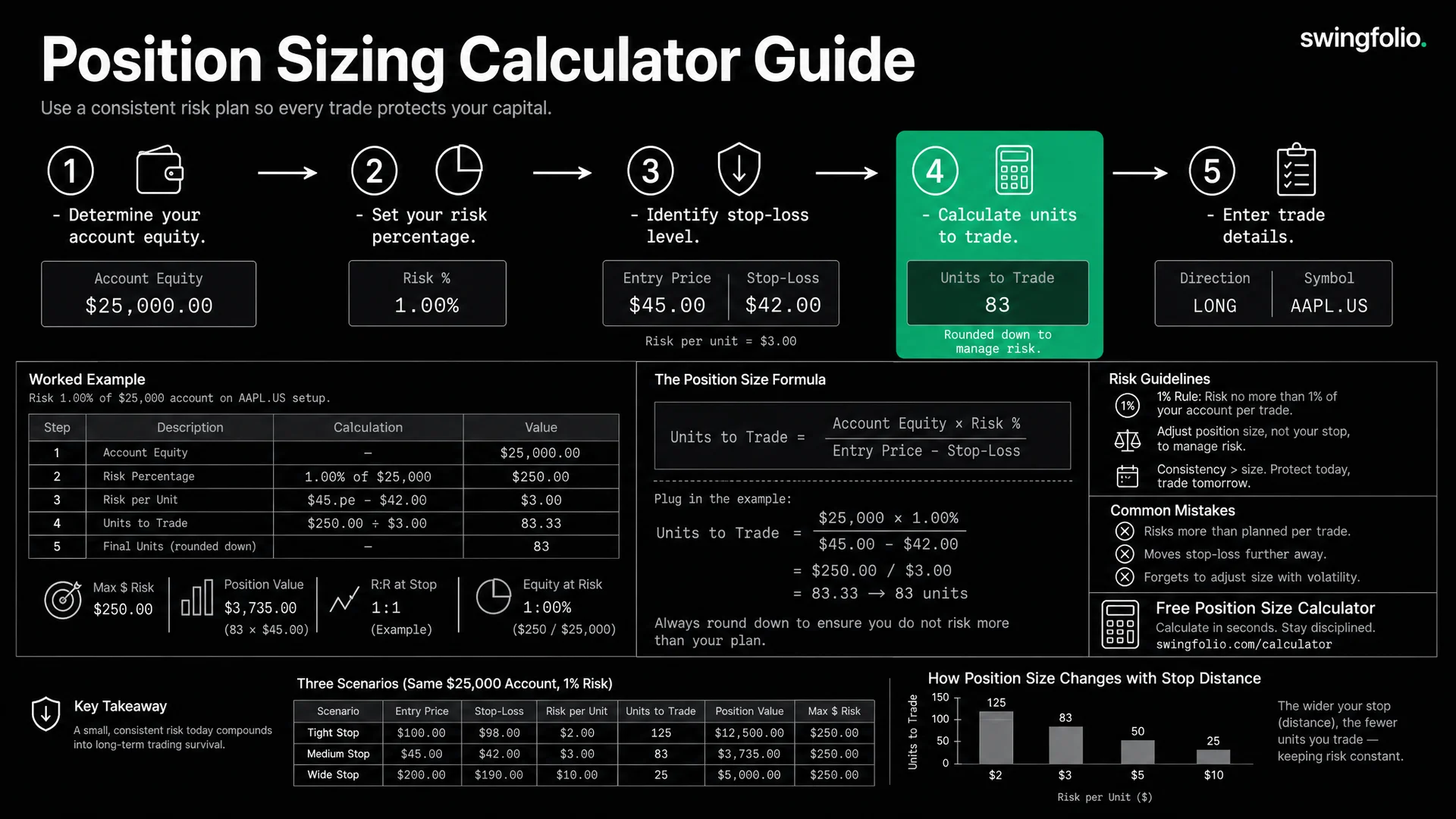
How to Use a Position Size Calculator
A practical position sizing guide with three worked examples, the calculator's exact inputs and the constraints the formula can miss.
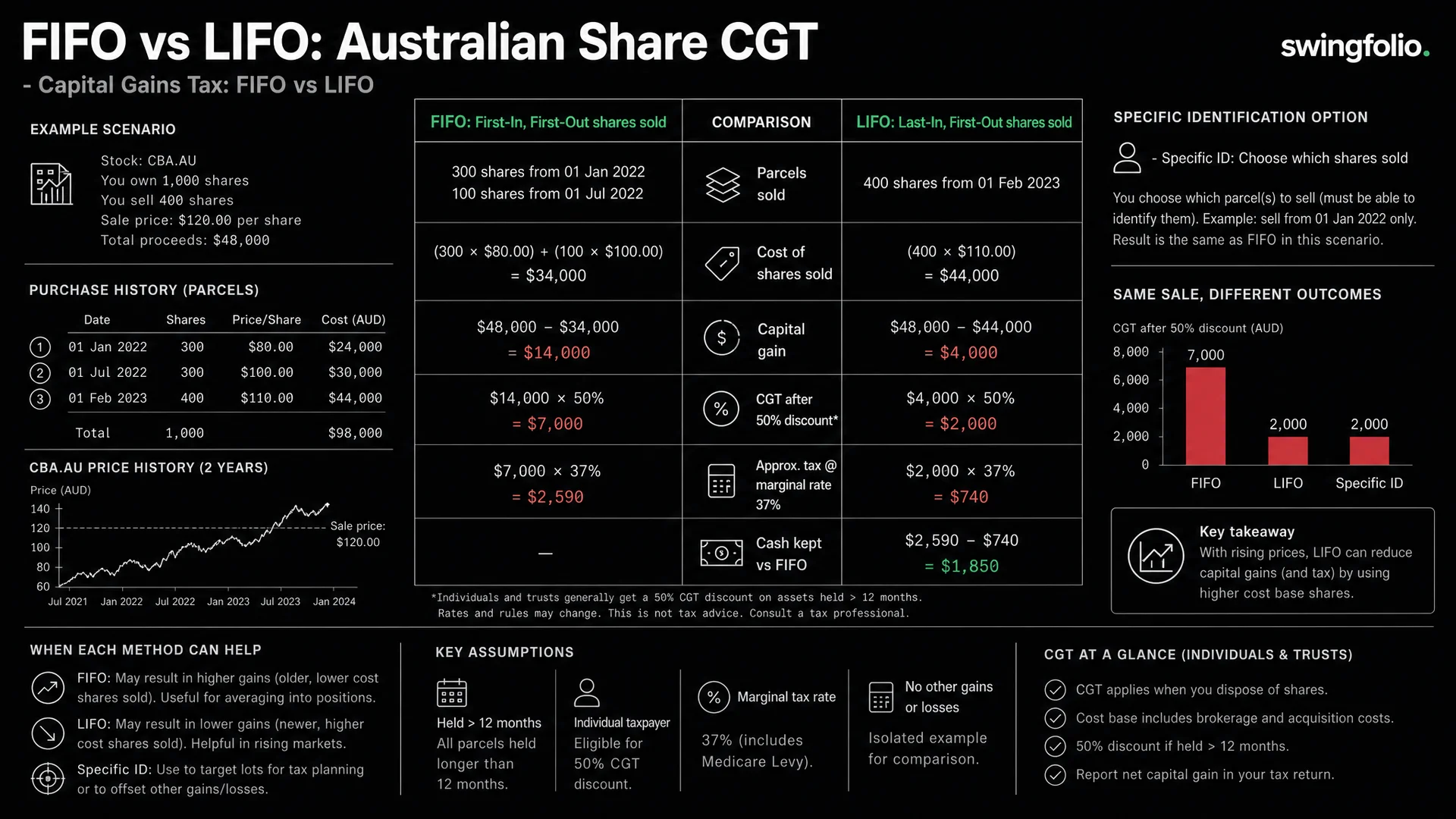
FIFO vs LIFO for Australian Share Traders: A Worked CGT Example
See how FIFO, LIFO and specific parcel selection change the gain on the same Australian share sale, with full arithmetic and record rules.

Understanding R-Multiples: Calculator and Examples
Learn R-multiple formulas through four worked trades, then use costs, partial exits, a distribution and expectancy to judge results.
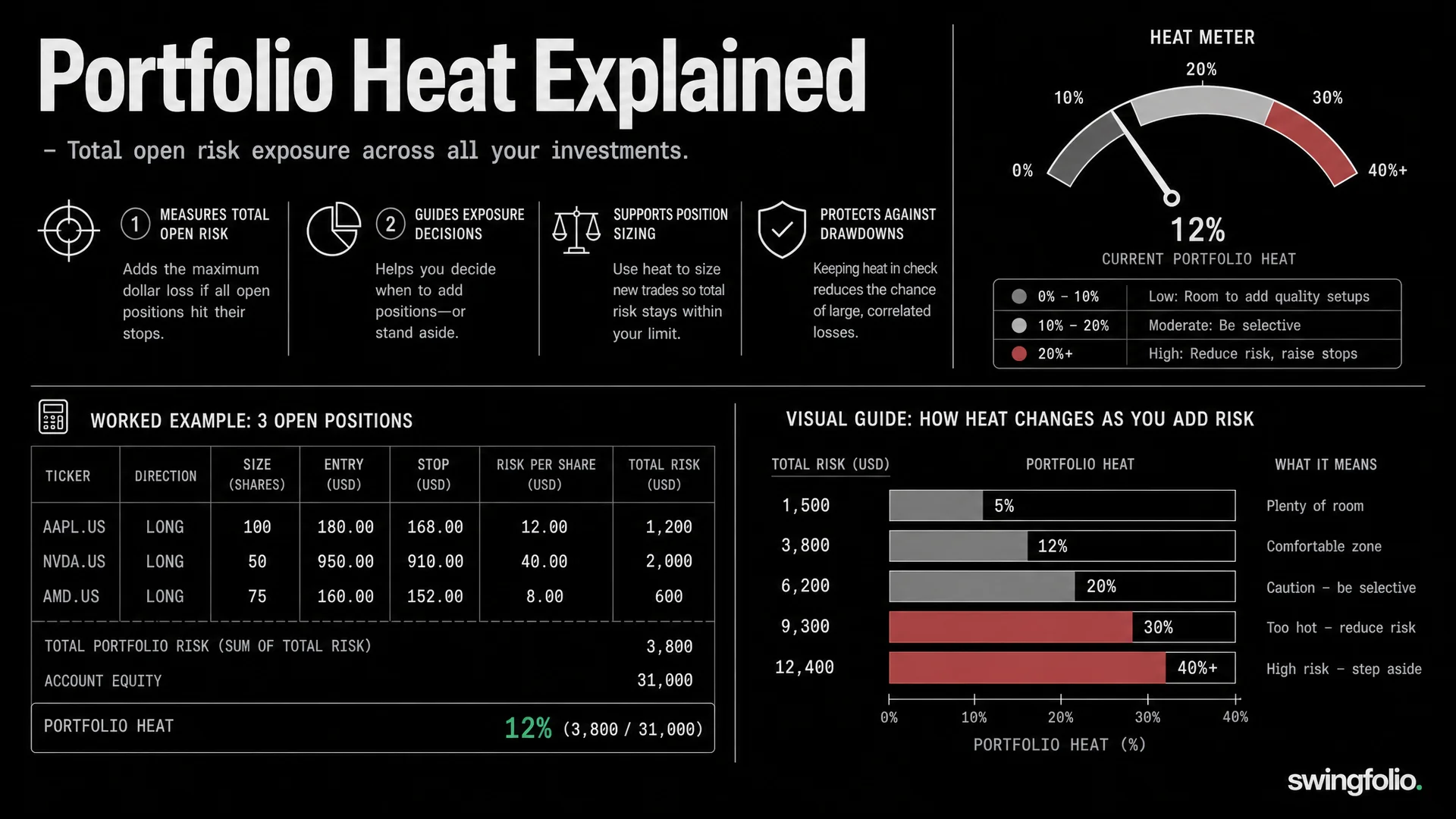
How to Track Portfolio Heat Before a New Trade
A practical workflow for measuring total open risk, checking concentration and deciding how much risk capacity remains before a new trade.

Can You Swing Trade in Your SMSF? Rules and Records
An SMSF can swing trade, but the fund's deed, investment strategy, records, ownership and retirement purpose must support the activity.
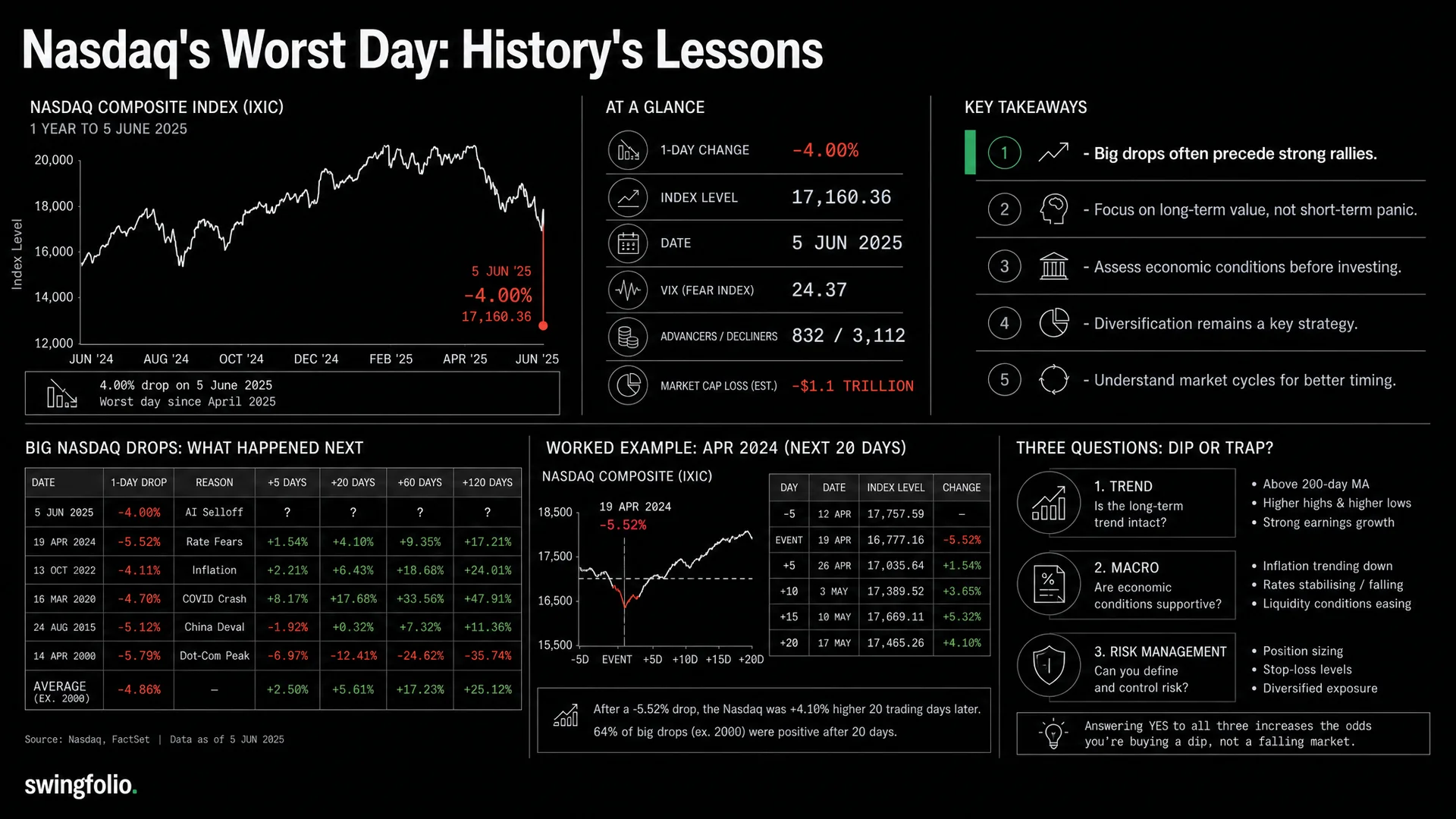
The Nasdaq-100's 5% Fall on 5 June 2026: What Happened Next
The Nasdaq-100's June selloff led to an uneven recovery. Compare the four-week, eight-week and September outcomes with a practical risk plan.
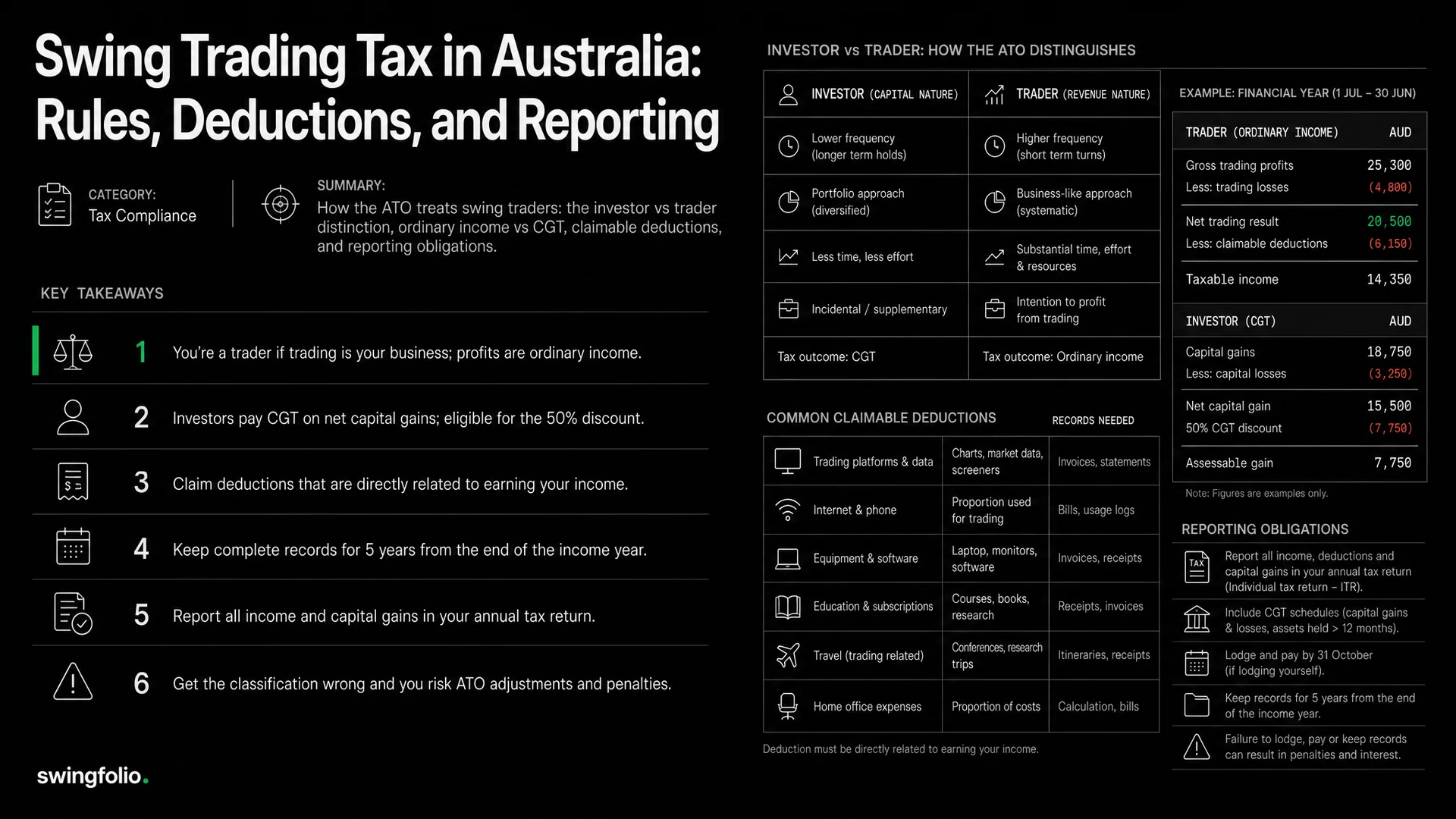
Swing Trading Tax in Australia: A Practical Guide
A practical 2025-26 workflow for Australian swing traders covering investor versus business treatment, gains, losses, expenses and records.

SpaceX IPO Pop and the Lock-Up Supply Risk
SpaceX rose 19.2% on debut after pricing at $135. The next supply tests depend on the filed lock-up terms, eligible shares and investor demand.
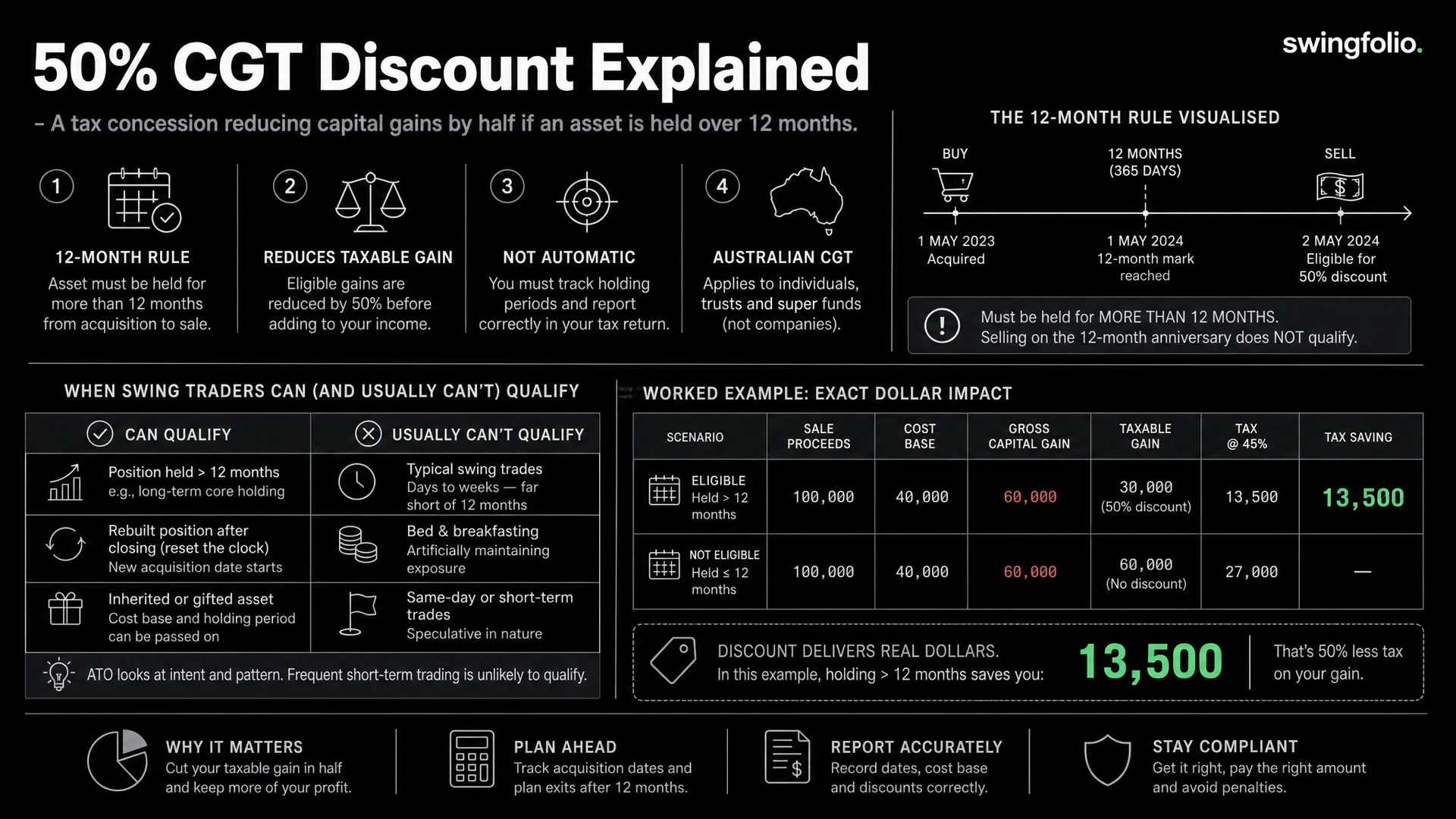
The 50% CGT Discount for Active Traders
How the 50% CGT discount works for Australian investors in 2025-26, why share traders miss it, and what changes from 1 July 2027.

SpaceX IPO: What 45 Years of IPO History Says About Year One
SpaceX listed at $135 in June 2026. Long-run IPO data shows why the offer price, first close and your entry price lead to very different returns.
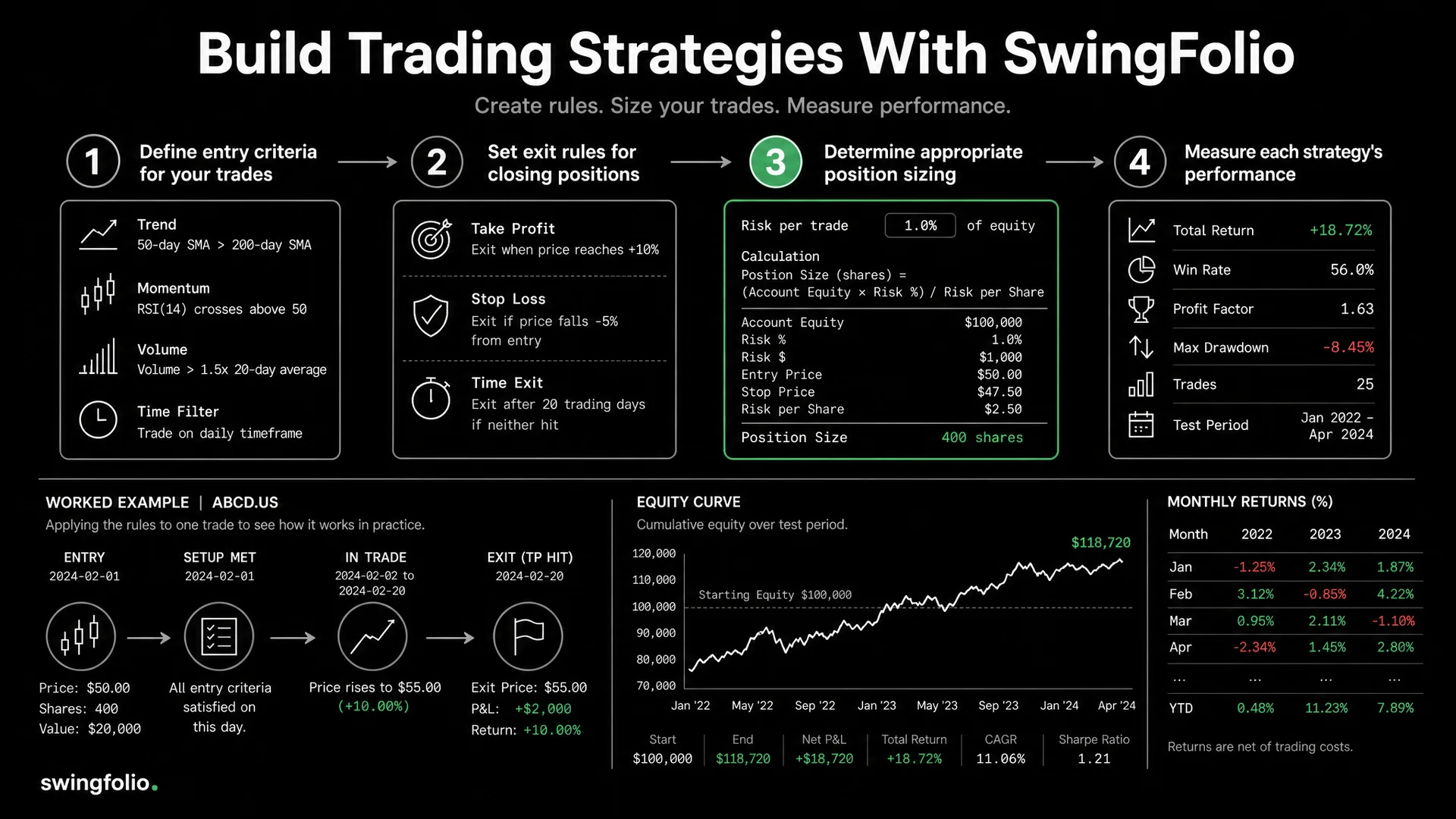
How to Use Swingfolio's Strategy Builder
Turn a trading idea into reviewable entry rules, exit rules and risk settings, then use completed trades to judge the strategy.
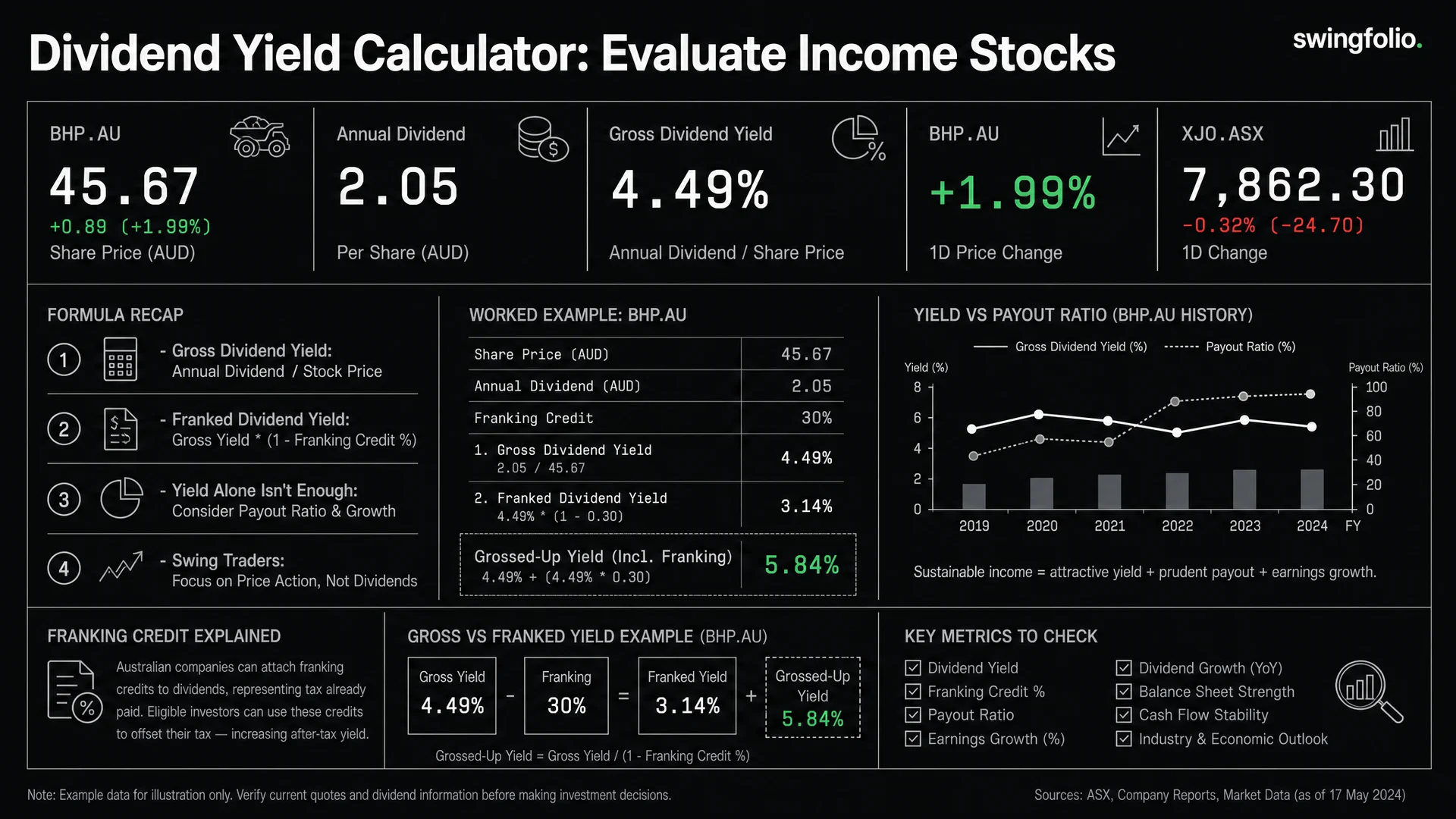
Dividend Yield Calculator for Australian Shares and Franking
Calculate dividend yield and annual cash income, then test whether price moves, special dividends or weak earnings make the yield misleading.
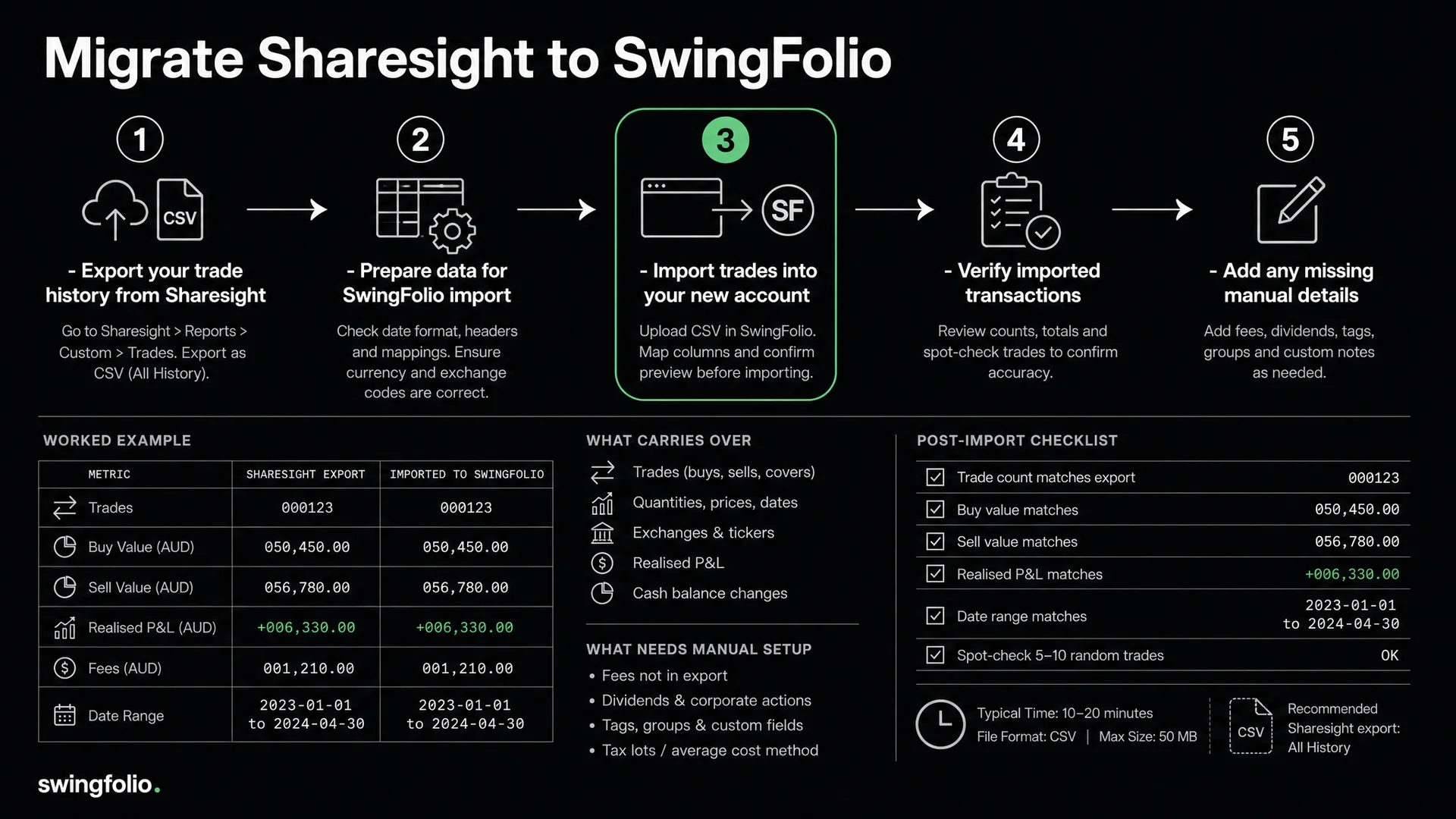
How to Move from Sharesight to Swingfolio
A careful Sharesight-to-Swingfolio workflow covering export, import review, reconciliation and the records that need separate handling.
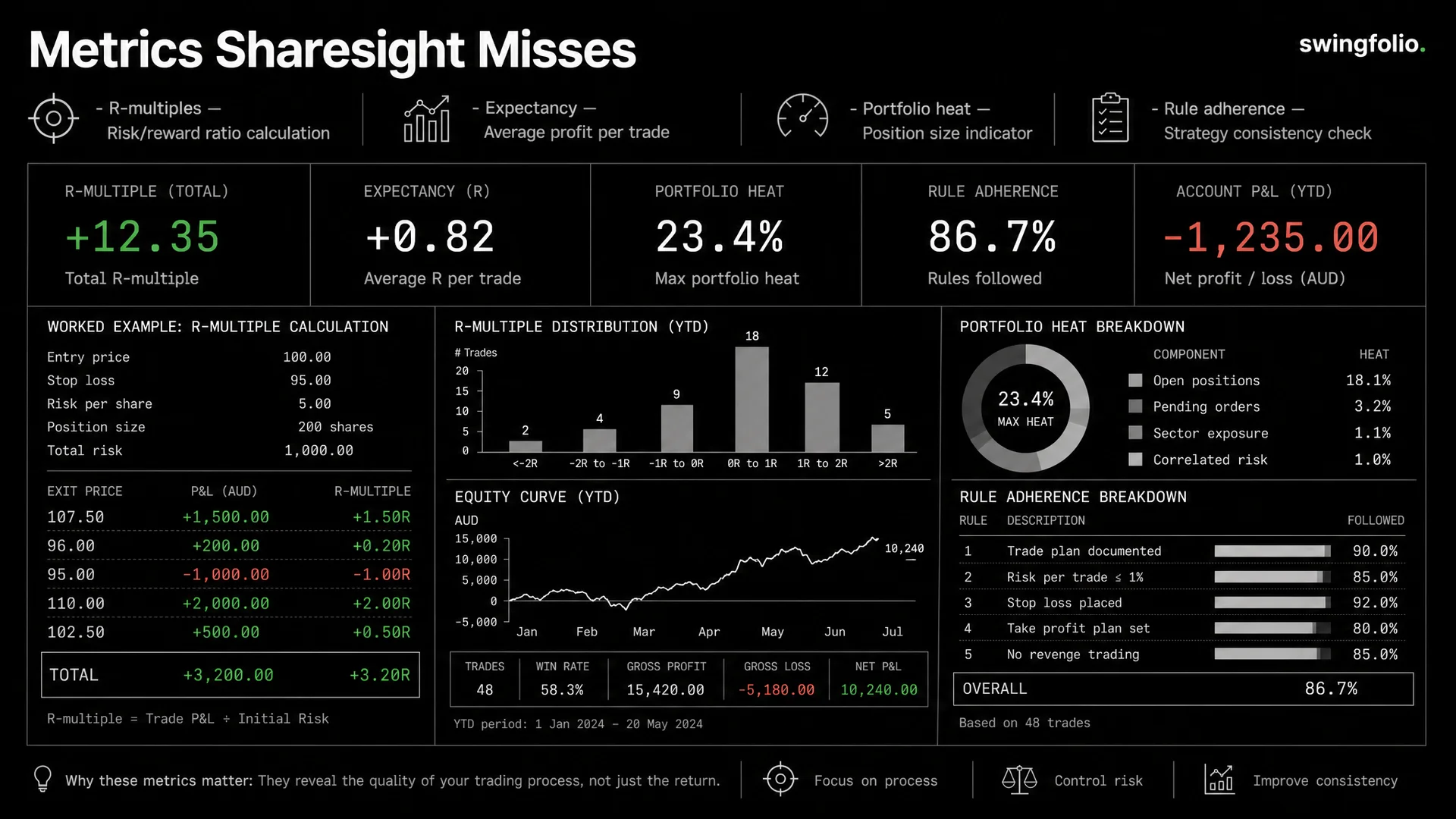
Sharesight for Swing Traders: 8 Metrics to Add to Your Review
Sharesight reports portfolio outcomes well. Learn which trade-level metrics add context for active strategy and execution reviews.
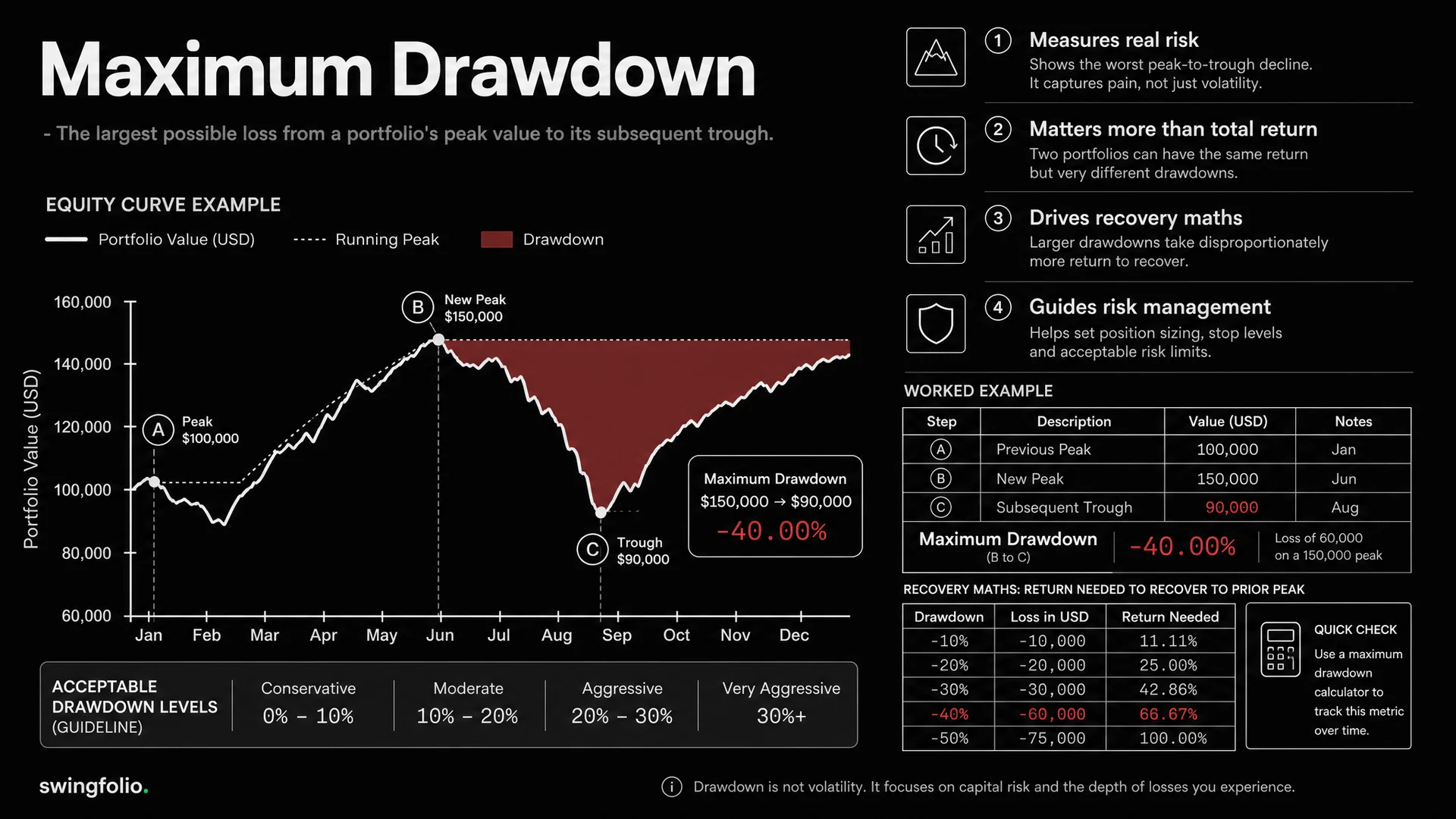
Maximum Drawdown: How to Calculate and Use It
Learn maximum drawdown with a worked equity path, recovery maths, cash-flow caveats and a practical review checklist.
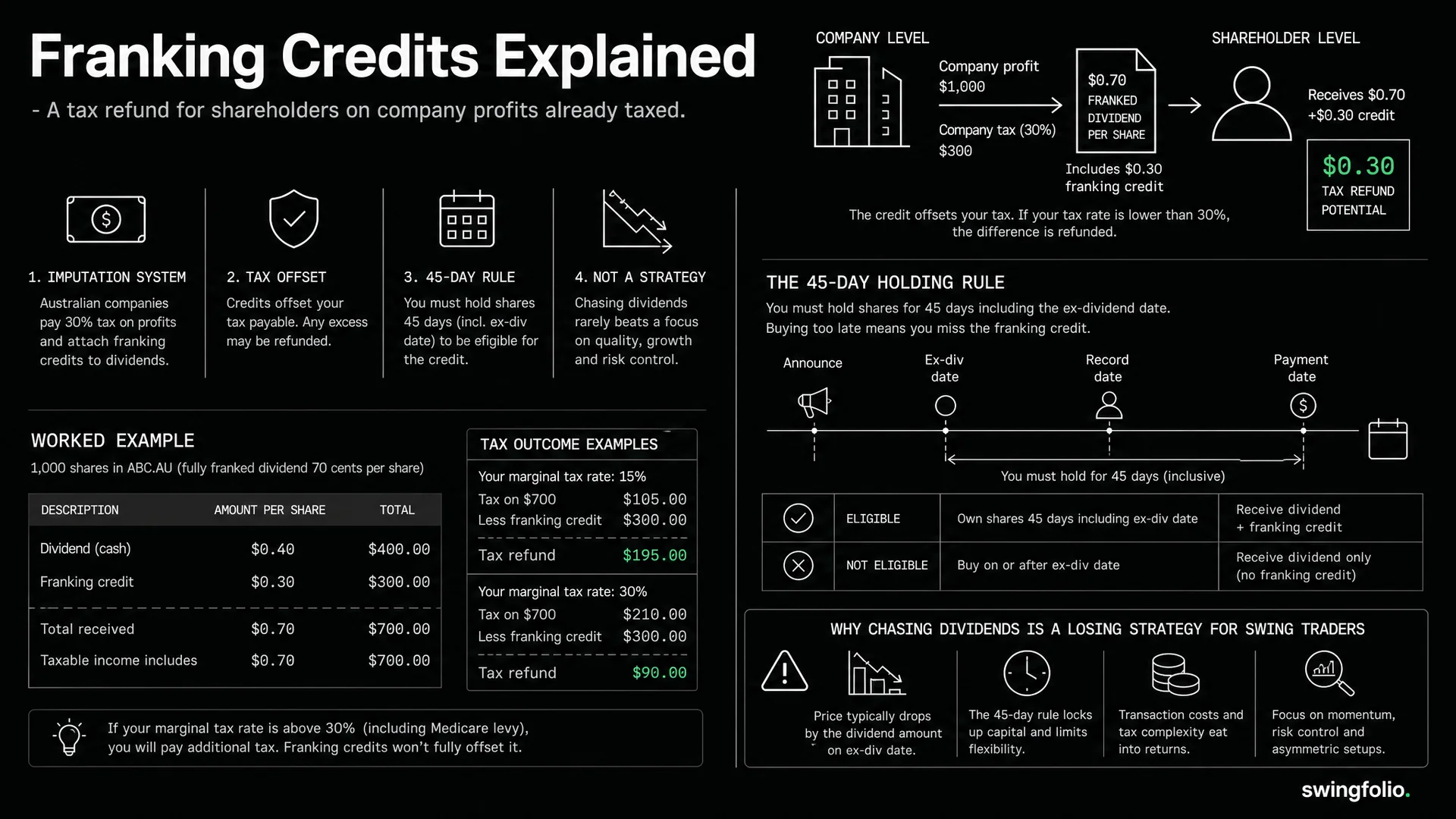
Franking Credits Explained for Australian Share Traders
A practical guide to franking credits, gross-up calculations, holding-period qualifications and dividend records for Australian share traders.
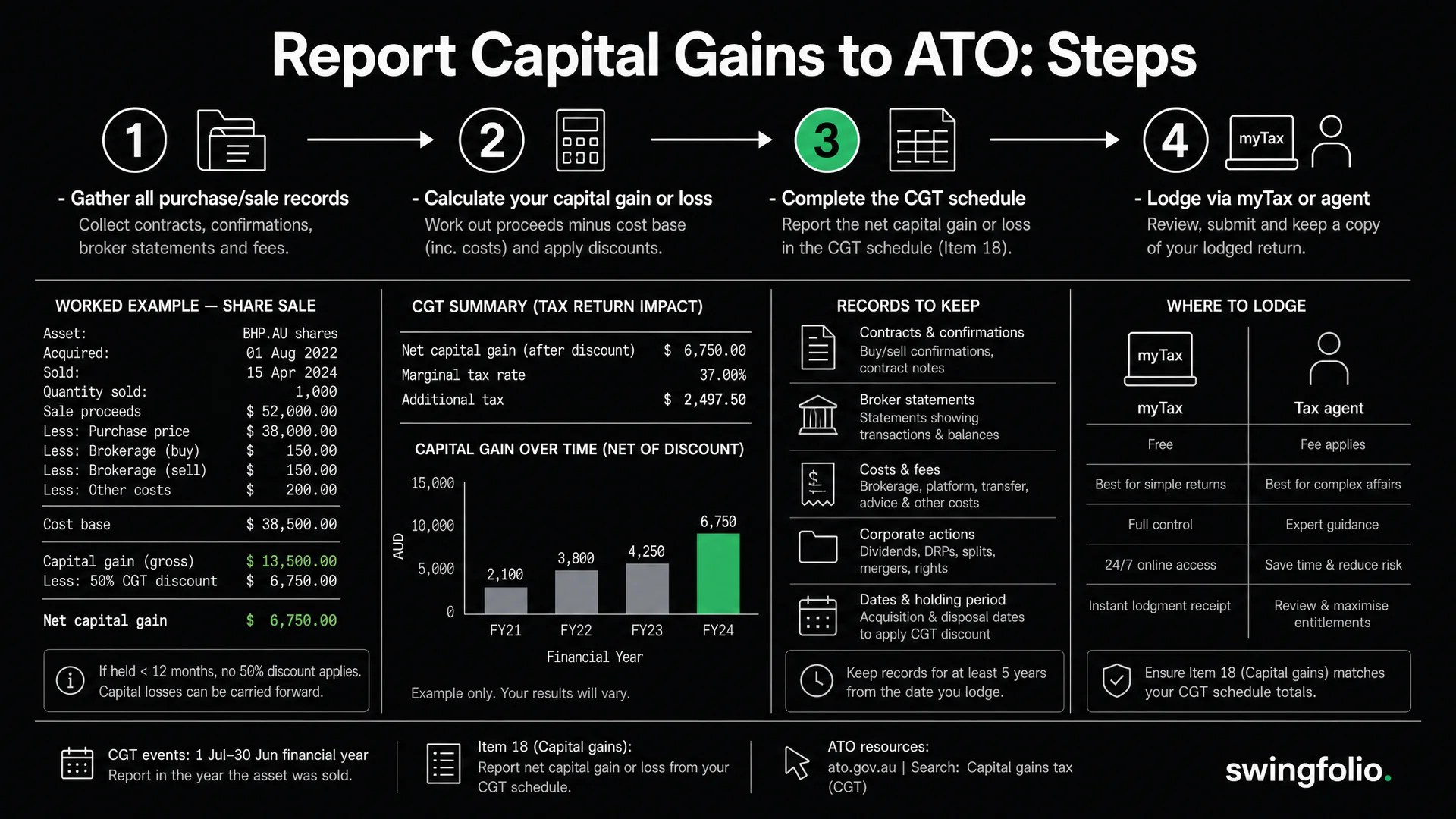
How to Report Capital Gains to the ATO Step by Step
A practical 2025-26 guide to preparing share-trade capital gains, applying losses and the CGT discount in order, and handing over clean records.
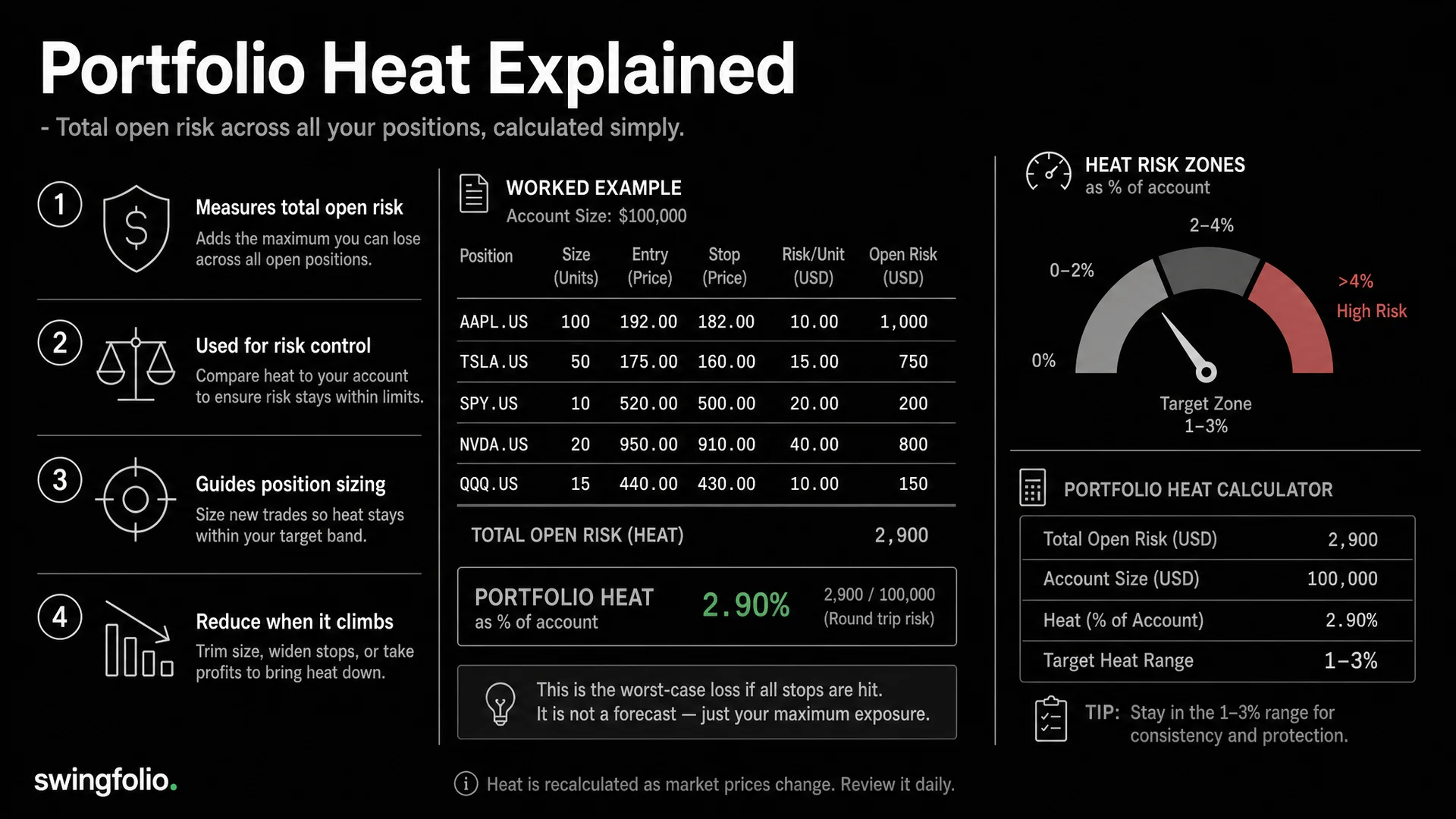
Portfolio Heat Explained With a Free Calculator
Learn how portfolio heat combines planned open risk, then use a worked example and free calculator to review new positions before entry.
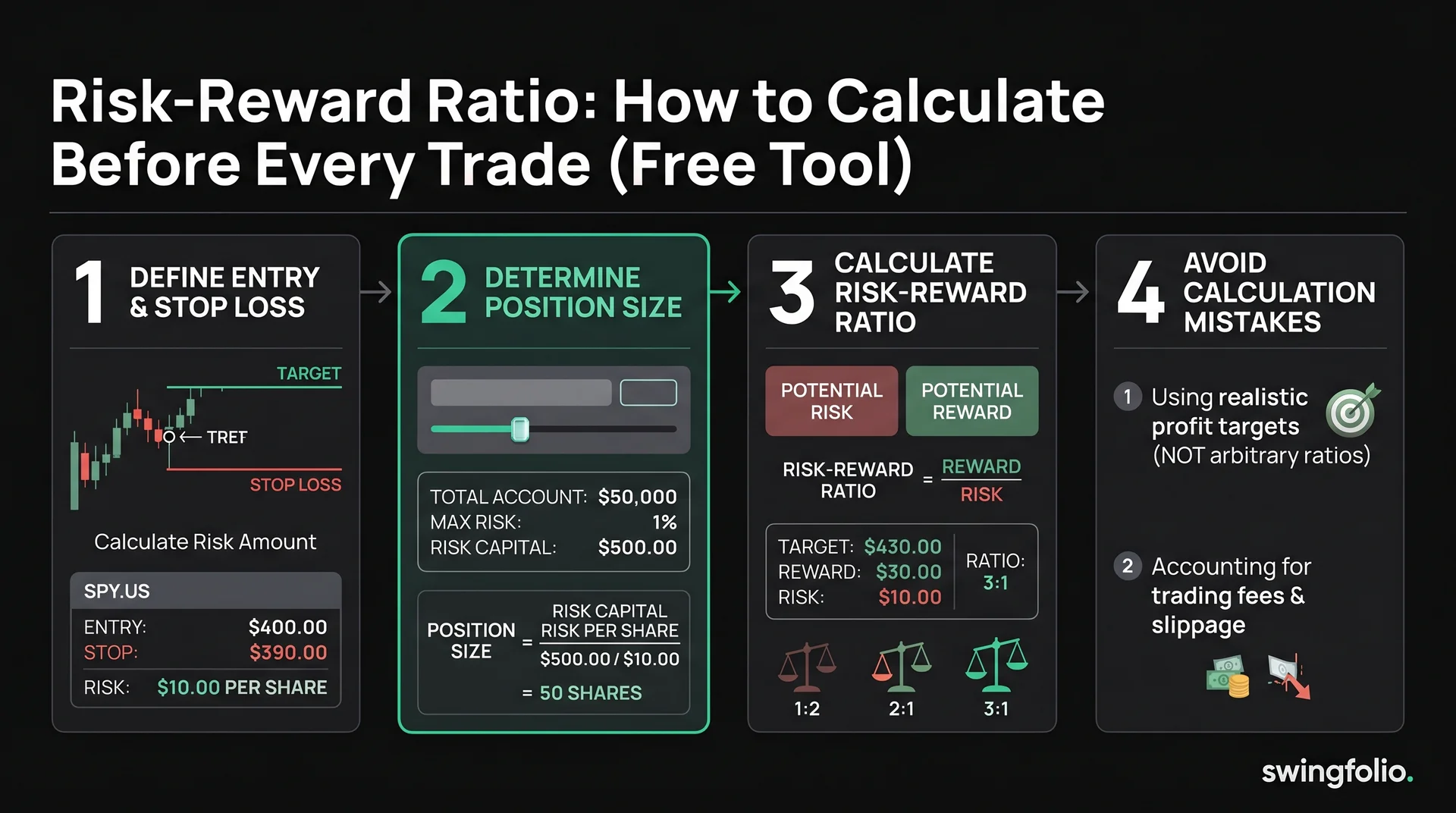
Risk-Reward Ratio: Calculate Every Trade Before Entry
Learn how to calculate risk-reward before entry, test the ratio against win rate and expectancy, and avoid common planning mistakes.

Foreign Stock Tax for Australian Investors
A practical guide to AUD cost bases, foreign dividends, withholding tax offsets and records for Australian residents who invest in overseas shares.

Wash Sale Rules in Australia for Traders
Australia has no fixed wash sale waiting period. Learn how the ATO looks at tax-driven loss arrangements and what evidence supports a genuine trade exit.

2026-27 Federal Budget: CGT and Negative Gearing Changes
The 2026-27 Budget's CGT and negative gearing reforms are now law. See what starts on 1 July 2027 and which records investors need.

Division 296 Tax for SMSF Traders in 2026
The enacted Division 296 rules start in 2026-27. See how the thresholds and realised earnings approach affect SMSF trading records and planning.

SMSF Audit Preparation for Active Traders
A practical SMSF audit checklist for reconciling trades, cash, income and holdings before you hand the fund records to your accountant and auditor.

Trading Journal Template for Every Stage of a Trade
A copyable trading journal template for planning, recording and reviewing swing trades, with a complete fictional example and repeatable review prompts.

How to Start Swing Trading on the ASX
A practical beginner workflow for ASX swing trading, with a fictional risk example, paper trading plan, watchlist process and pre-trade checklist.

Australian Broker Comparison for Swing Traders
Shortlist an Australian swing trading broker by total workflow, including ASX fees, ownership model, order tools, exports and international access.

CommSec vs Stake vs Selfwealth for Swing Traders (2026)
Compare CommSec, Selfwealth and Stake for ASX swing trading using current fees, realistic round-trip costs and the workflow questions that matter.

How to Start a Trading Journal From Scratch
Build your first trading journal with a manageable template, a worked trade entry and a review habit that grows with your needs.

Trading Journal Examples: 4 Complete Trade Entries
Four complete hypothetical trade entries show how to document a winner, planned loss, process mistake and changed exit, then review them together.

When a Trading Spreadsheet Stops Working
A trading spreadsheet can calculate and chart almost anything. The question is whether maintaining it still supports the reviews you need.

Digital vs Paper Trading Journal: Which Should You Use?
Choose between a physical notebook, digital trading journal or hybrid workflow based on the records you keep and questions you review.

ASX Trading Hours for Swing Traders
Learn what happens in each ASX market phase and how auctions, Sydney time, overseas moves and public holidays can affect swing trade orders.

What a Portfolio Tracker Can't Tell You About Your Trading
A portfolio tracker shows holdings and returns. A trading journal adds the strategy, risk and decision context active traders need to review.

Why Portfolio Returns Alone Don't Measure Trading Skill
A strong return can come from skill, market exposure or excess risk. Use this review framework to understand what produced the result.

6 Common Trading Mistakes Your Journal Can Reveal
Your own journal can reveal early exits, stretched stops, inconsistent sizing and other trading mistakes hidden by a single return figure.

What Is a Trading Journal? A Practical Guide for Traders
A trading journal records the setup, risk, execution, outcome and review behind each trade. Use this guide to create your first useful entry.
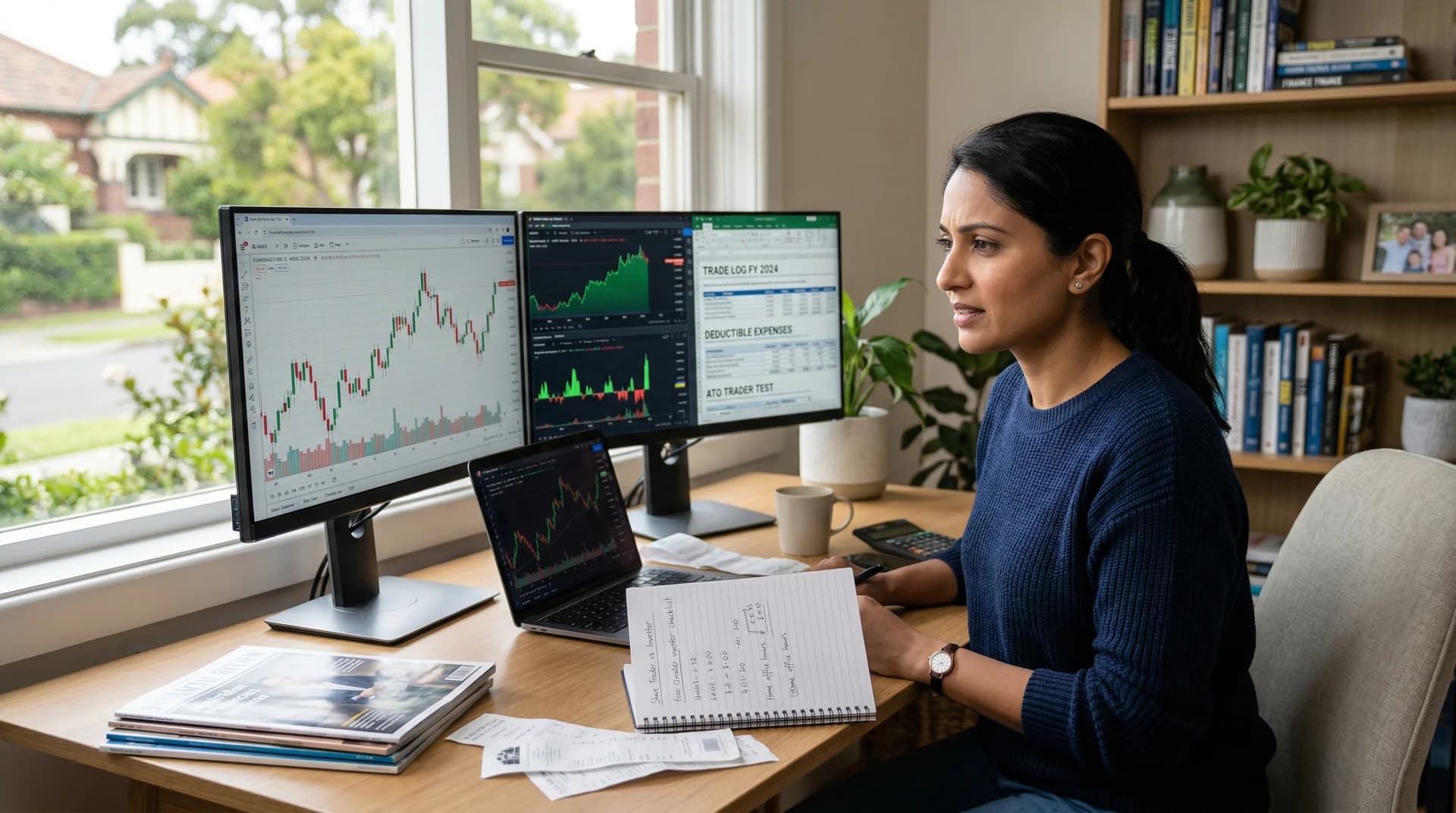
Tax Deductions for Active Traders in Australia
Your tax deductions depend on whether the ATO treats your shares as investments or trading stock. Check your status, expenses and records before claiming.

How to Paper Trade a Swing Trading Strategy
Follow a complete paper trading process for a swing strategy, including rules, realistic fill assumptions, a worked trade and a review routine.

What to Track in a Paper Trading Journal
A useful paper trading journal records the plan before entry, the assumptions behind each fill and the result after exit.

When to Stop Paper Trading and Go Live
No score proves that you are ready to trade live. Use your journal to assess your rules, records, execution assumptions and risk plan.

Paper Trading vs Real Trading: What Changes
Paper trading can test your written process, but live orders add uncertain fills, costs and real financial consequences.

CGT Reports for Active Traders in Australia
Learn what to record for an Australian CGT report when you have multiple share parcels, partial exits, brokers or foreign currency trades.

Trading as a Business in Australia: Essential Tax Rules
The ATO treats a share investor and a share trader differently: capital gains against ordinary income, and a different set of deductions. Here are the factors the ATO weighs, what changes on your return, and the records you need to keep.

Trading Journal vs Portfolio Tracker: Which One Do You Need?
A portfolio tracker records holdings and returns. A trading journal adds the strategy, risk, decisions and review behind each trade.

Best Portfolio Tracker for Swing Traders in 2026
Generic portfolio trackers miss what swing traders actually need. Here is what to look for and how to evaluate your options.

Best Swing Trading Journal in 2026: What to Look For
A swing trading journal has to hold multi-day positions, partial exits and R-multiples, not just buys and sells. Here are the five features that separate a working journal from a spreadsheet, and the mistakes that leave one unread.

How to Track Capital Gains on Shares in Australia
Learn how to record share parcels, calculate gains and losses, check CGT discount eligibility, and prepare figures for your Australian tax return.

How to Measure Your Trading Edge With Expectancy and R-Multiples
R-multiples and expectancy with the arithmetic shown: what each measures, five worked win rate and reward combinations, and what sample size does not fix.

Trading Journal vs Spreadsheet: Where a Spreadsheet Stops Working
A spreadsheet tracks trades until silent formula errors, manual entry and missing analytics cost more than the tool saves.

A Portfolio Tracker for Swing Traders: What a Holdings Tracker Misses
A holdings tracker records what you own. A swing trading tracker also records the stop, the open risk it implies, the strategy and each partial exit.

Mastering the Fibonacci Pullback Trading Strategy
Learn how to use the Fibonacci Pullback trading strategy to identify high-probability entries in trending markets using key retracement levels and RSI filters.

The EMA Pullback Trading Strategy: Entry Rules, Stops and Position Size
How the 20-day and 50-day EMA stack, an RSI band and a 3% stop combine into one entry, and what a 2.5R target implies for the breakeven win rate.

The Consolidation Breakout Trading Strategy: Rules, Volume and Risk
What a consolidation breakout is, the ATR and volume conditions this article uses, and the entry, exit and position size arithmetic around a 3R target.

The 50-50 Strategy: A Trading Guide to the 50-Day MA and RSI 50
The 50-50 strategy pairs the 50-day moving average with the 50 level on the RSI. Here are the entry conditions, the exits, and the sizing arithmetic behind them.

The Volume Breakout Momentum Trading Strategy: Rules and Risk
The Volume Breakout Momentum trading strategy pairs a 20-day high with a volume filter. Here are the entry rules, the exits, and the arithmetic behind a 3R target.

The Triple Moving Average Filter Trading Strategy: Rules and Risk
The Triple Moving Average Filter takes a trade only where price sits above the 20, 50 and 200-day averages. Here are the rules, the exits and the arithmetic.

The Stochastic Momentum Trading Strategy: Rules, Filters and Risk
The Stochastic Momentum trading strategy pairs a %K crossover under 20 with a trend filter. Here are the three entry rules, the two exits and the risk arithmetic.

The RSI Oversold Bounce Trading Strategy: Rules, Filters and Risk
The RSI Oversold Bounce trading strategy waits for the reading to cross back above 30 inside an uptrend. Here are the filters, the exits and the risk arithmetic.

The RSI 2 Trading System: Connors' Mean Reversion Rules
The four steps Larry Connors set out for the RSI 2 trading system, where this article departs from them, and the R-multiple arithmetic a wide stop creates.

The Resistance Breakout Trading Strategy: Entry, Volume and Risk
What a resistance level is made of, why a close matters more than a spike, how far above average the volume has to be, and the arithmetic behind the stop and target.

20 and 50 EMA Crossover Strategy for Swing Trading
Why a crossover is a late signal by construction, what the ADX filter removes, and the stop, target and position size arithmetic behind each trade.

The MACD Crossover Trading Strategy: Rules, Filters and Risk
What the MACD line, signal line and histogram each measure, why two of the three say the same thing, and the entry, exit and position size arithmetic around the cross.

The Fibonacci Pullback Trading Strategy: Levels, Filters and Risk
Where the 38.2%, 50% and 61.8% retracement levels come from, the two filters that turn a level into a rule, and the stop, target and position size arithmetic behind each trade.

The EMA Pullback Trading Strategy: A Beginner's Guide
The EMA pullback strategy waits for price to retrace to the 20-day EMA inside a confirmed uptrend, then enters with the stop already set. This guide covers the three entry rules, the RSI filter, both exits, and the position sizing behind them.

The Bollinger Squeeze Breakout Trading Strategy: Rules and Risk
The Bollinger squeeze breakout written as rules, with John Bollinger's own statements on what the bands do and do not tell you, plus the position size arithmetic behind a 4% stop.

The ATR Volatility Expansion Trading Strategy: Rules and Risk
The ATR measures volatility and forecasts nothing. This guide sets out the expansion setup as rules: the 2x range trigger, the breakout condition, and why the stop has to be sized from the new range.

The ADX Trend Strength Trading Strategy: Rules, Filters and Risk
The ADX measures how persistent a move is, not which way it points. This guide sets out the strategy as rules: Wilder's levels, the EMA direction filters, the exits and the sizing arithmetic.

The 52-Week High Breakout Trading Strategy: Rules and Risk
The 52-week high breakout strategy written as rules: the entry filters, the two exits, the position size that follows from the stop, and what the 2004 study behind it actually measured.

Swing Trading Strategies: Rules for Multi-Day Positions
How multi-day swing trading rules fit together: what a strategy has to specify, why overnight gaps are not capped by your stop, and how position size follows from stop distance.

Position Sizing for Swing Traders: A Risk Framework
The 1% rule stated in R terms, a worked share count with the rounding checked, how portfolio heat adds up across open positions, and what an overnight gap does to a stop.

AI Trade Performance Reviews: Find the Weaknesses in Your Trading
What a generated performance review reads from your closed trades, what its card prints, the patterns it cannot see, and which Analytics cards hold those instead.

Trading Earnings Season: Opportunities and Risks
What US and Australian reporting rules actually require, why a stop fills at the reopening price after a results gap, and the trade-offs in four ways of handling a report.
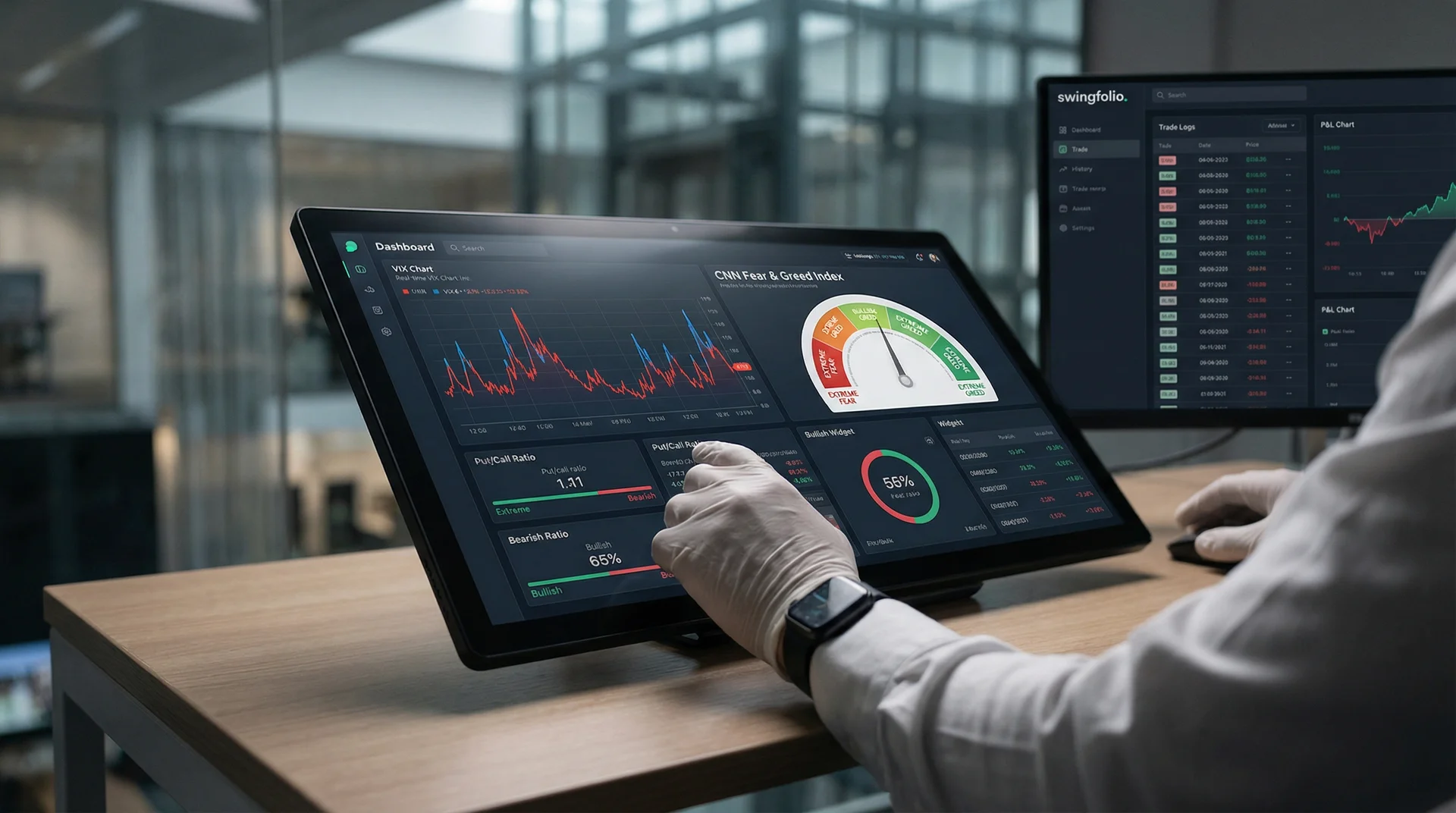
Market Sentiment Indicators Every Trader Should Watch
What the VIX, the put/call ratio, the AAII sentiment survey, CNN's Fear and Greed Index and market breadth each measure, described by their publishers, and where each reading fits in a weekly routine.

How to Read Market Trends
Identify uptrends, downtrends and ranges from the sequence of swing highs and lows, confirm them with moving averages and ADX, and record the trend each trade was taken in.

Win Rate vs Profit Factor: Which Metric Matters More?
Two accounts, the same arithmetic: why a 70% win rate can earn less than half as much per trade as a 40% one, and where expectancy fits above both metrics.

Sector Rotation Strategy for Swing Traders
What the business cycle model of sector rotation says and where it stops, how relative strength turns it into a measurement, and how to read the four rotation quadrants.

How to Analyze Your Trading Performance
A five-step method for analysing trading performance, with worked segment tables, the sample sizes a finding needs, and the questions each review answers.

Portfolio Tracking: Tools and Best Practices
The fields to record for every position and closed trade, what brokers, spreadsheets and tracking software each do with them, and the practices that keep the record accurate.

Key Metrics Every Trader Should Track
Ten metrics that show what your trading results came from, each with its formula and a worked example: win rate, profit factor, expectancy, R-multiple and drawdown.

Why Every Trader Needs a Trading Journal
A trading journal is where the reason you entered can be compared with the reason you remember. What to record, how to review it, and which tool fits.

Why Traders Fail and How to Be Different
The quoted failure rates for traders carry no citation. Here are ten failure modes you can check, and the two studies that do name their population.

The Psychology Behind Cutting Losses
The psychology behind cutting losses: the loss-aversion research, the recovery arithmetic, and the card that shows how long you hold losers.

Building Trading Discipline: A 30-Day Plan
Building trading discipline starts with measuring the gap between the rules you wrote and the trades you took. A 30-day plan to adapt to your own numbers.

FOMO in Trading: How to Avoid Chasing Trades
Chasing a trade after it moves changes your entry, not the target. See what that does to reward-to-risk, share count and breakeven win rate.

How to Overcome Fear and Greed in Trading
What fear and greed each change about a trade, five techniques for each, and the checks to run before the order goes in.

Trading Psychology 101: Mastering Your Emotions
Fear, greed, hope, revenge and overconfidence, each described by what it changes about a decision, with the studies behind them.

Diversification for Traders: Spreading Risk Across a Portfolio
Five positions in one sector behave as one. The arithmetic behind spreading risk, the limits worth writing down, and where diversification stops helping.

R-Multiples Explained: Measuring Trade Performance
Your result divided by the risk you took, so a $12 stock and a $300 one land in the same column. Worked arithmetic, distributions and expectancy.

How to Recover from a Losing Streak
Five losses in a row is what a 60% win rate produces. The probability arithmetic, what each risk level costs, and the protocol to write first.

The 1% Rule for Trading Risk Management
Cap the loss on any one trade at 1% of the account, and the share count follows from the stop distance. Worked examples and the streak arithmetic.

Understanding Risk-Reward Ratios in Trading
Reward divided by risk, the breakeven win rate it implies, and the expectancy arithmetic that decides whether a strategy makes money.

Position Sizing: How to Calculate Your Trade Size
Your share count is decided by two numbers: how much you will risk and how far the stop sits from entry. The arithmetic, worked step by step.

Stop Loss Strategies: Protecting Your Capital
Hard stops, mental stops and trailing stops, where each one belongs on the chart, and the arithmetic that decides how wide a stop you can afford.

Chart Patterns: Head and Shoulders, Flags, and Triangles
Head and shoulders, flags, pennants and triangles: the entry, stop and measured move each shape defines, and the checks to run before trading one.

Fibonacci Retracements: Trading with the Golden Ratio
The Fibonacci tool draws lines at fixed fractions of a move. Where the ratios come from, how to anchor them, and what confirms a bounce.

Bollinger Bands Strategy for Swing Trading
Bollinger Bands measure volatility, and the same band touch means continuation in a trend and exhaustion in a range. Four setups and their conditions.

How to Identify Trend Reversals
How to tell a trend reversal from a pullback: the warning signs, the patterns, and the break that has to happen before either is confirmed.

Candlestick Patterns Every Trader Must Know
What each candlestick pattern requires, what counts as confirmation, and why the trend before the pattern decides how to read it.

Volume Analysis: What Trading Volume Tells You
Volume states how many shares were behind a price move. Compare volume to its average, confirm breakouts, and read OBV divergence.

Support and Resistance Levels: Finding Key Price Zones
How to find support and resistance levels on a chart, judge which ones are worth trading, and handle the flip when a level breaks and changes sides.

Moving Averages: How to Use the 20, 50, and 200 Day MA
How the 20, 50 and 200 day moving averages work: SMA against EMA, pullback entries, the trend filter, and reading all three lines together.

MACD Explained: A Guide for Swing Traders
How the MACD indicator works on a daily chart: signal line crossovers, the zero line, what the histogram reports before a cross, and divergence.

RSI Trading Strategy: How to Use the Relative Strength Index
How to read RSI on a daily chart: the overbought and oversold levels, why they fail in trending markets, divergence setups, and the 50 centerline.

Building Your First Swing Trading Watchlist
Build and maintain a swing trading watchlist. Set your screening criteria, organize the list by setup stage, and keep it current with a daily routine.

Swing Trading Entry and Exit Strategies
Four ways into a swing trade and four ways out, with the risk per share, position sizing and reward-to-risk arithmetic worked through on each one.

How Long Should You Hold a Swing Trade?
Holding period is produced by your exit rules, not chosen in advance. What sets the duration, when to leave early, and how to read your own hold times.

Best Timeframes for Swing Trading: Daily vs 4-Hour Charts
Which chart timeframes suit swing trading, how the daily and 4-hour charts divide the work between direction and timing, and what to do when they disagree.

7 Characteristics of the Best Swing Trading Stocks
Not every stock suits a multi-day holding period. Seven properties decide which ones do, with the arithmetic that links a stock's volatility to your position size.

How to Start Swing Trading: A Step-by-Step Blueprint
A 90-day path from no experience to a first trade you can justify: four weeks on the concepts, a week on the market and the broker, two weeks writing the plan, five weeks paper trading it, then live money at a fraction of your intended size.

Swing Trading vs Day Trading: Which Strategy Is Right for You?
Compare swing trading and day trading on time commitment, capital rules, risk and temperament, and work out which style fits your schedule.

What is Swing Trading? A Complete Guide
Swing trading holds a position for days or weeks to capture one move in price, then closes it. This guide covers the four decisions that shape every swing trade: what to buy, when to enter, how much to risk, and where to get out.