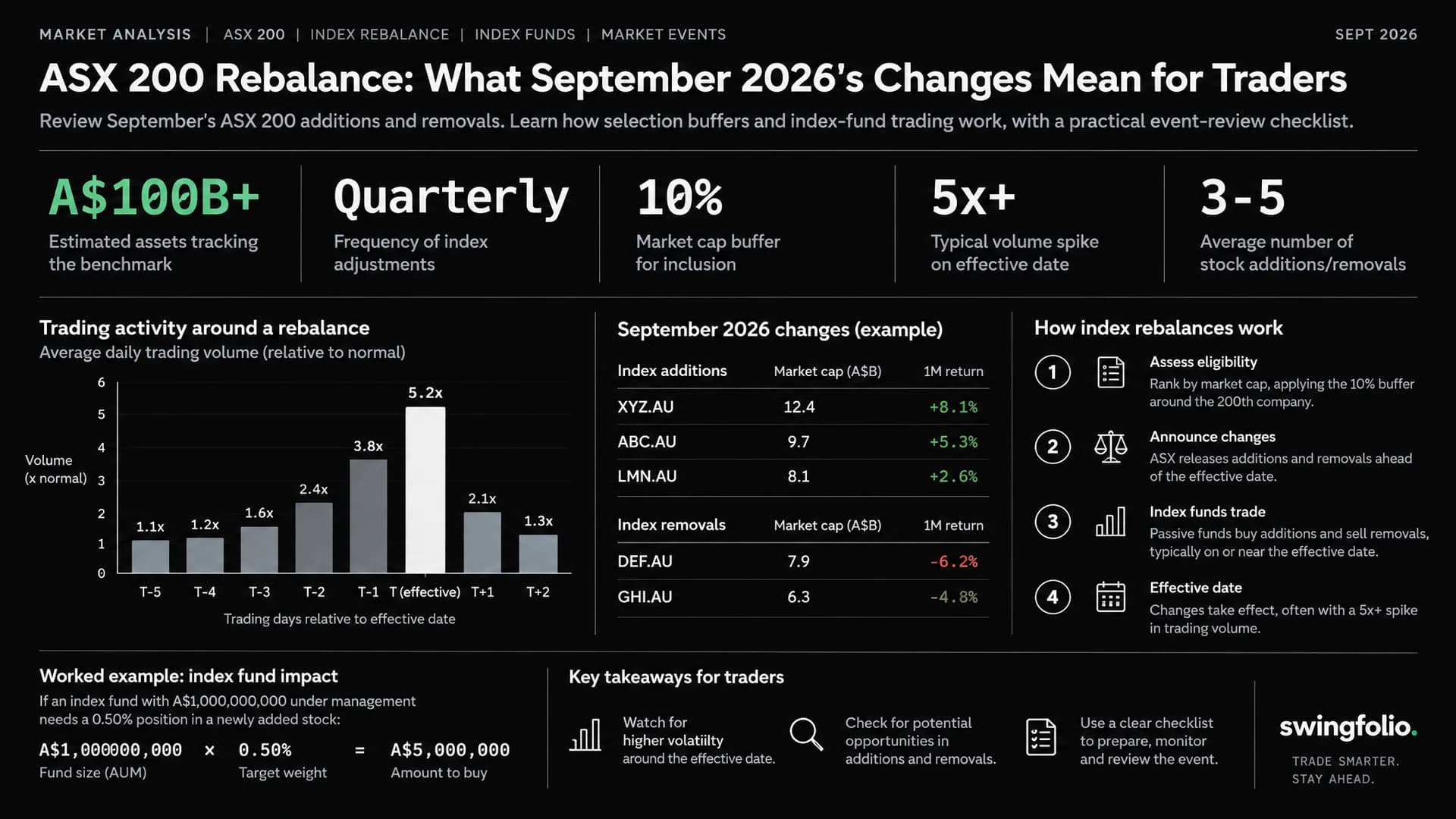
An ASX 200 rebalance changes which companies the index includes. Funds that track it must respond to the new composition, but an inclusion does not guarantee a share-price rise and a removal does not guarantee a fall.
For September 2026, the useful trading question is how confirmed index changes interact with prices, trading costs and your holding period. The announcement alone is not a complete entry rule.
September's additions and removals
S&P Dow Jones Indices identified the following changes in its 16 September rebalance commentary.
| Added to the ASX 200 | Removed from the ASX 200 |
|---|---|
| Elsight | Pantoro Gold |
| Smartgroup | Tuas |
| Sunrise Energy Metals | EVT |
| Service Stream | GrainCorp |
| Weebit Nano | GQG Partners |
The rows pair names for space, not to imply that each addition directly replaced the removal alongside it.
S&P described selection using three-month average float-adjusted market capitalisation, ranking buffers and other eligibility conditions. Its September explanation referred to a 179-rank entry buffer and a 221-rank exit buffer. Some removals reflected the need to accommodate qualifying additions rather than simply crossing the exit buffer.
Read the provider's announcement for the relevant index and effective date. The date a commentary appears is not necessarily the date funds implement a change.
Why market capitalisation needs a qualifier
A company's total market capitalisation is its share price multiplied by shares outstanding. A float-adjusted measure also accounts for the portion available to public investors under the index methodology.
That can make a ranking different from a screen sorted by total company value. A single day's rally may also differ from the average used at a rebalance reference date.
Liquidity and eligibility matter alongside size. Avoid treating “company number 200 by market cap today” as an automatic answer to whether it belongs in the ASX 200.
Index buying creates a requirement, not a promised profit
A tracking fund needs exposure consistent with its mandate. Traders may anticipate that demand before the effective date. Other investors may sell into it, and company news can move the price at the same time.
Consider a hypothetical stock:
| Point in the event | Share price |
|---|---|
| Before the inclusion announcement | $8.00 |
| After the announcement, when you enter | $8.80 |
| At the implementation close | $8.60 |
The stock remains 7.5% above its starting price, but an investor who bought at $8.80 has lost about 2.27% before costs. A true statement about the whole event can therefore describe a losing individual trade.
This example is invented to explain entry timing. It is not the observed performance of any September addition.
Separate the event dates
Keep a record of:
- Reference date: the point used for the provider's eligibility calculations.
- Announcement date: when the changes became public.
- Implementation date: when the index composition changes.
- Your decision and execution times: when you could act on the information.
Mixing these dates can make a backtest look better than a tradable strategy. If a list became public after a session closed, a simulated purchase at that session's closing price needs justification.
The backtest-versus-live guide explains how to keep information timing and execution assumptions consistent.
Watch volume without assigning a cause too quickly
An unusually busy session is a reason to investigate. It is not proof that every trade came from passive funds.
Inspect the company's announcements, broader market move and sector performance. Compare the event's volume with an appropriate recent baseline, and record whether trading concentrated near the close.
The ASX trading-hours guide explains the closing auction. A large closing print can reflect an auction match rather than continuous trading at that price throughout the afternoon.
If your plan relies on that close, check how your broker accepts auction orders and how an unfilled instruction behaves. Do not assume a chart's closing price was available for your entire intended quantity.
A repeatable rebalance review
Use a small event sheet rather than a list labelled “stocks index funds must buy.”
| Field | Record |
|---|---|
| Source | Provider notice and date retrieved |
| Event | Addition, removal or other change; correct index |
| Entry rationale | The specific behaviour you intend to test |
| Execution | Date, session, price, size and costs |
| Comparison | Market and sector returns over the same window |
| Outcome | Net result, adverse move and rule adherence |
Choose the review window before seeing which endpoint looks best. Review removals as well as additions so the result does not reflect a hand-picked sample.
For a broader watchlist, the stock-screening guide helps apply liquidity and risk filters independently of index membership.
Common questions
Does an ASX 200 addition mean a company is undervalued?
No. Index membership describes eligibility and construction, not a valuation recommendation.
Should I buy an addition before the effective date?
The membership announcement does not answer that. You still need an entry price, a tested rationale, costs and a plan for an adverse move.
Can I use the September list as a permanent watchlist?
Keep it as a dated event sample. Future company developments and index reviews can change the relevant facts.
Reviewed 27 September 2026. Constituent changes come from S&P's cited commentary. The price-path example is hypothetical; no event-return study is claimed.