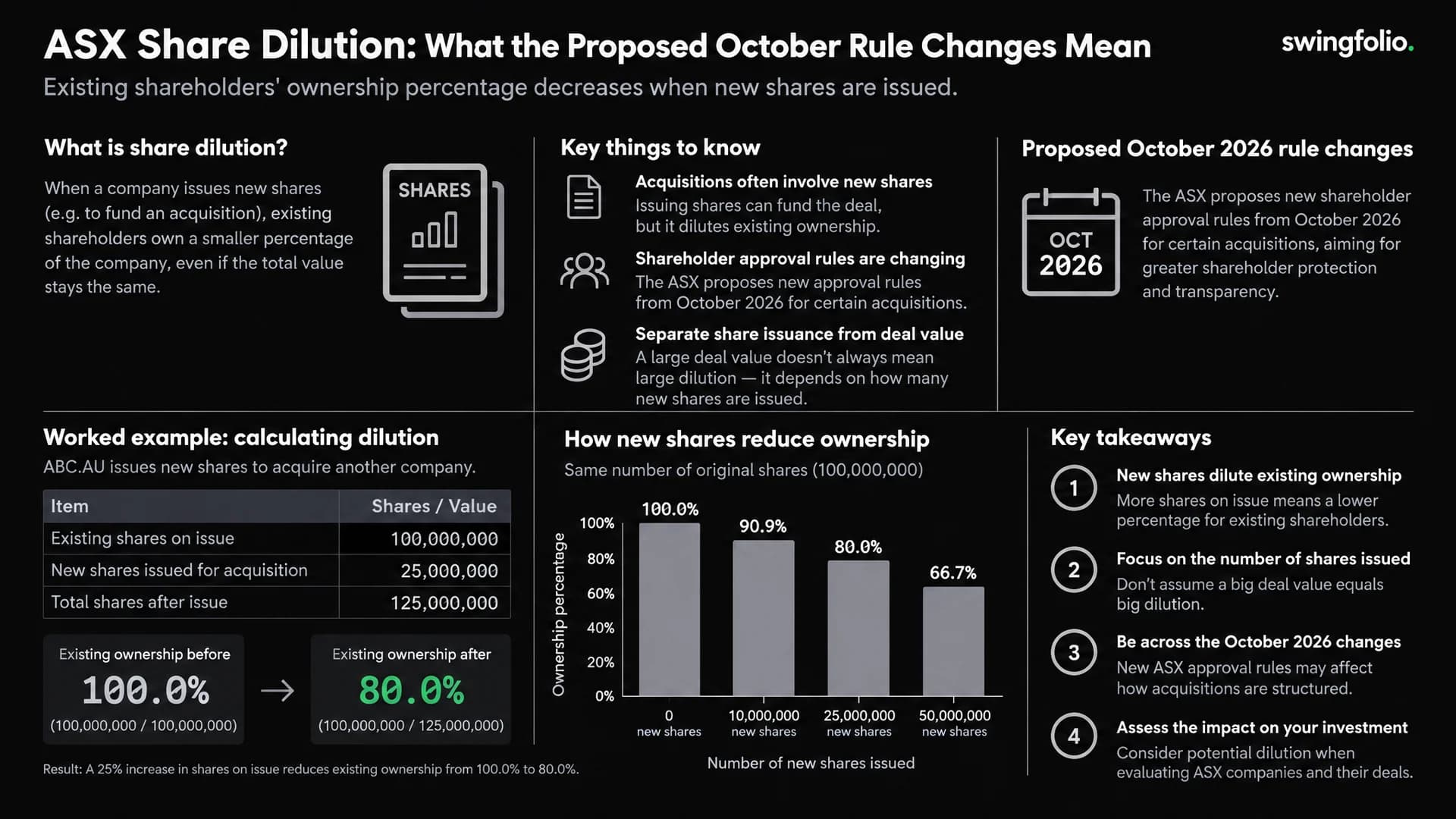
Share dilution occurs when additional shares reduce an existing holder's percentage ownership, assuming that holder does not acquire more shares. Whether an acquisition benefits that holder also depends on what the company receives for the shares it issues.
ASX's September 2026 rule-change response makes this distinction timely. Investors need to understand both the proposed shareholder-approval framework and the economics of the particular transaction.
Where the October changes stand
ASX's 18 September consultation update says amended Listing Rules and Guidance Notes are intended to commence on 21 October 2026, subject to completion of the statutory rule-change process. ASX says it will confirm completion through a Market Notice.
As checked on 27 September, the cited announcement describes that conditional timetable. Do not present the proposed commencement date as proof that every amendment is already operating.
The September response paper retains a framework involving a 25% limit for specified equity issuance by S&P/ASX 300 entities in regulated takeovers or mergers without shareholder approval. It also addresses changes in admission status and voluntary delisting.
That is not a universal statement that every ASX company may issue 25% for any purpose. The final rules, definitions, exceptions, approvals and transition provisions determine the treatment of a transaction.
Calculate ownership before judging the deal
Suppose a company has 100 million ordinary shares. You own 10,000, representing:
10,000 ÷ 100,000,000 = 0.01%.
The company proposes to issue 30 million new shares to acquire another business. If you keep the same 10,000 shares:
| Measure | Before issue | After issue |
|---|---|---|
| Company shares outstanding | 100 million | 130 million |
| Your shares | 10,000 | 10,000 |
| Your percentage ownership | 0.0100% | About 0.00769% |
Your proportionate ownership falls by about 23.08%, calculated as:
1 − (100 million ÷ 130 million) = 23.08%.
The new shares equal 30% of the old share count. That does not mean your percentage ownership falls by 30%. The denominator after issuance is larger.
These numbers illustrate ownership arithmetic. They are not an application of the proposed legal threshold to a real transaction.
Ownership dilution and earnings dilution are different
Assume the original company earns $10 million annually on its 100 million shares. That is earnings per share of $0.10.
If the acquired business adds $3 million of annual earnings, the combined company would have $13 million of earnings over 130 million shares: also $0.10 per share.
You own a smaller fraction of a larger company, while this simplified earnings-per-share figure is unchanged.
Now change the acquired earnings assumption:
| Added annual earnings | Combined earnings | Shares | Simplified EPS |
|---|---|---|---|
| $1 million | $11 million | 130 million | About 8.46 cents |
| $3 million | $13 million | 130 million | 10.00 cents |
| $5 million | $15 million | 130 million | About 11.54 cents |
The example excludes integration costs, financing, purchase accounting, tax changes and timing. Real disclosures may use adjusted earnings that differ from statutory earnings. Reconcile the definitions before accepting an “EPS-accretive” headline.
Inspect what the buyer is paying for
Read the transaction announcement and shareholder materials with a small set of questions:
- What consideration consists of cash, shares, debt or contingent payments?
- Is the number of shares fixed, or can it change with prices or conditions?
- Which earnings figures are historical and which are management forecasts?
- What costs or benefits sit outside the headline comparison?
- Which approvals and funding arrangements remain outstanding?
- What happens if the transaction does not complete?
A lower ownership percentage can accompany a sensible purchase. It can also accompany an expensive or poorly executed one. Share-count arithmetic alone cannot establish value.
Use the latest company documents. A proposal can change after negotiations, financing updates or shareholder feedback.
Record the event sequence
Keep the announcement, vote, conditions, completion and share-issue dates separate. A proposed issue is not the same as issued capital already in the market.
If you hold the stock through the process, decide which developments would trigger a review. Examples include a larger issue than first disclosed, altered funding terms or a change in the target's expected contribution.
For execution planning, distinguish a company announcement from an index-provider decision. The event-risk checklist helps record known dates; the position-sizing guide helps connect the plan to an amount at risk.
Make the trade review about the original assumptions
Before entry, write down the expected post-deal share count and the value assumption you are relying on. Keep management forecasts labelled as forecasts.
After the event, compare those assumptions with the completed transaction. A share-price gain does not prove every assumption was correct, and a short-term fall does not independently prove the deal destroyed value.
In Swingfolio, keep a link to the announcement with the trade thesis and review notes. If the transaction changes your own holdings or creates a corporate action, reconcile the resulting records with the broker rather than treating a proposal as an executed trade.
Common questions
Does a 30% share issue cause 30% ownership dilution?
Not in the simple example above. Issuing 30 shares for every 100 existing shares reduces an unchanged holder's percentage by about 23.08%.
Does shareholder approval make an acquisition a good investment?
No. Approval and investment merit are different assessments. Review price, assets acquired, funding and execution risk.
Do the October proposals apply to every capital raising?
No. Read the scope and the final rule status. Do not use the acquisition framework as a substitute for the rules governing another kind of issue.
Reviewed 27 September 2026. Check the ASX Market Notice and final rules before relying on a commencement date. Examples are hypothetical; this is general information, not legal or investment advice.