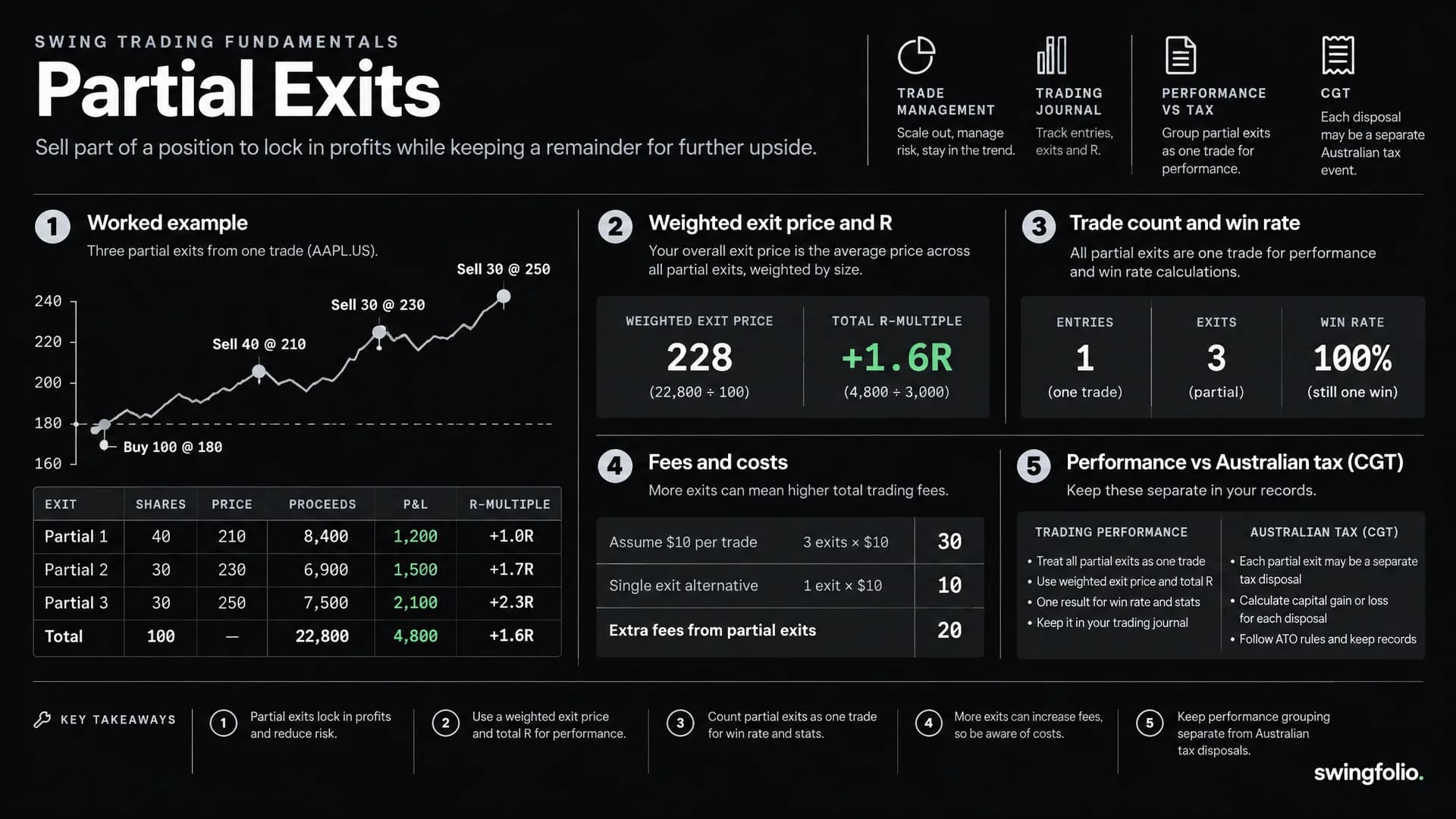
A position sold in several parts can remain one trade for performance review while producing several disposal records for tax. The right count depends on the question and the journal's definition.
Keep both views: the complete position for evaluating the trading decision, and each execution or disposal for quantities, costs and dates.
Define the performance unit first
Suppose you buy 600 shares once and sell 200 on three later dates. A position-based journal can treat that as one trade with three exits.
An execution-based report may count the rows differently. Neither convention should be mixed silently with the other. If you compare win rates across systems, check how they group fills, partial exits and open remainders.
In Swingfolio, inspect the parent trade and its exit records. After the final sale, verify that remaining units and the closed status are correct. Do not assume a particular entry route always produces the intended grouping.
Calculate the units-weighted exit price
Weighted exit price = total sale proceeds before fees ÷ total units sold
If you sell 500 shares at $11 and 100 at $14:
(500 × $11 + 100 × $14) ÷ 600 = $11.50
A simple average of $11 and $14 gives $12.50, which incorrectly gives equal influence to unequal parcels.
This weighted price summarises the fills. Preserve the individual records because dates, fees and tax treatment still attach to them.
A three-exit R-multiple example
Assume 600 shares bought at $10 with an original stop at $9. Original planned price risk is $600.
| Exit | Units | Sale price | Price profit |
|---|---|---|---|
| First | 200 | $11 | $200 |
| Second | 200 | $12 | $400 |
| Final | 200 | $13 | $600 |
| Total | 600 | $12 weighted average | $1,200 |
Before costs, the result is $1,200 ÷ $600 = +2R.
If purchase brokerage was $10 and each of the three exits cost $10, net profit is $1,160. Using the stated $600 initial-risk denominator, net R is about +1.93R.
State whether costs are included in the numerator and how initial risk is defined. Our R-multiple calculation guide explains the product's calculation conventions.
Does scaling out improve performance?
The realised price result is the weighted average of the exits actually taken. It cannot exceed the best of those exit prices for a long position, but that arithmetic does not decide whether scaling out was a better strategy.
Comparing with “sell everything at the best price reached” uses hindsight. A valid comparison needs an alternative rule that could have been followed at the time.
Scaling out changes remaining exposure, fees and the distribution of outcomes. It can affect both risk and expectancy. It does not universally improve the worst case or guarantee a better average.
Costs depend on the broker's charging model
Under a hypothetical flat $10 charge per order, one entry and one exit cost $20. One entry and three exits cost $40.
Real fees may depend on trade value, minimums, market and order structure. Use actual charges rather than multiplying a generic fee by the row count.
Do not allocate the full entry fee to every partial disposal. Reconcile allocated costs to the original total.
Separate realised results from the open remainder
After the first sale in the example, 400 shares remain exposed. A realised gain on the 200 sold units does not describe the final result of the whole position.
Track remaining units, realised profit, current unrealised value and the original risk record separately. Moving a stop after taking profit should not erase the original denominator used to review the trade.
Australian tax disposals use their own dates
The ATO's share-record guidance requires parcel and acquisition details sufficient to identify the shares sold.
Each partial sale needs its own disposal record. Holding-period eligibility, fees and available losses can differ across disposals. Do not collapse all sales into the final date or assume a 50% discount applies to every owner and year.
See CGT reports for active traders for the reporting context.
A reconciliation checklist
- Original units equal sold units plus remaining units.
- Sale proceeds equal the sum of actual fills.
- Entry and exit fees are counted once.
- The weighted price uses units, not a simple price average.
- Original risk is preserved.
- Performance trade count and tax disposal count are labelled.
Do three profitable exits mean three wins?
Not under a position-based win-rate definition. They are parts of the same position. An execution report may count them differently, so state the convention.
Can I calculate R before the position is fully closed?
You can describe realised progress relative to original risk, but label it as partial. The remaining position can still change the final outcome.
General information only. Examples are hypothetical; tax treatment depends on your circumstances.