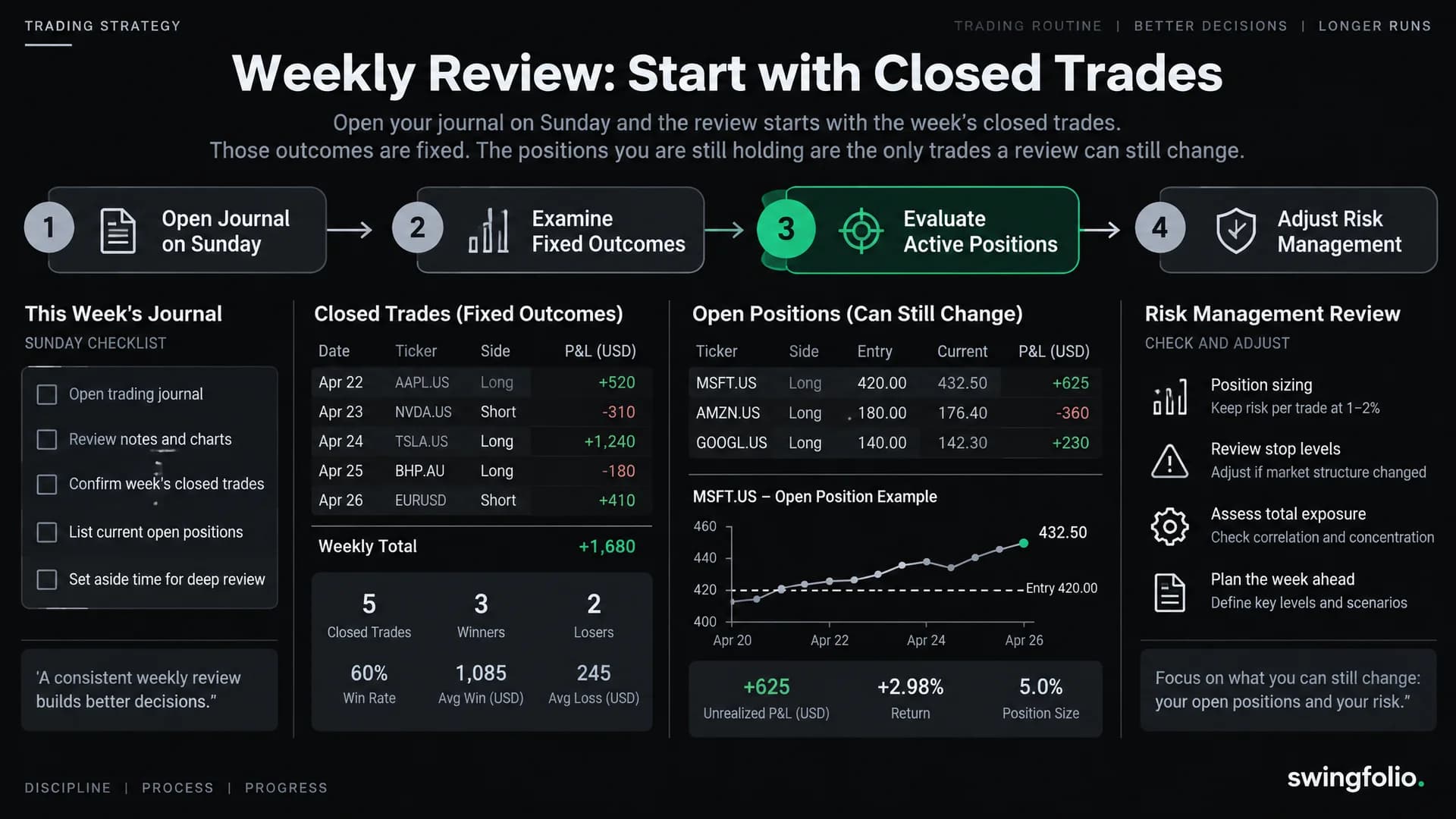
Your weekly review starts with the trades you can no longer change
Open your trading journal on Sunday and the review begins the same way it always does. You pull the week's closed trades, work out the win rate, check which setups paid, and write down one thing to do differently.
Every one of those outcomes is already fixed. Nothing you decide on Sunday can move them.
Meanwhile the positions you are still holding sit in another tab, and they are the only trades a review can still change.
Why do weekly reviews start with closed trades?
Because closed trades are the only ones that produce a clean number, and a review built around numbers goes where the numbers are.
One widely used weekly framework runs six steps in thirty minutes: read the calendar view of daily profit and loss, compare the week against a thirty day baseline, sort winners from losers, look for deviations by setup and time and ticker, write three observations, make one adjustment. It is a good framework. It also never mentions a position you are still holding.
That is the norm. Published checklists that do include open positions tend to reach them late and in passing: one options-focused review lists them third of four, as "flag open positions that need action" after the closed-trade summary and the plan-adherence check.
Our own library does the same thing. The review routine on this site walks you through a weakness report for the previous five days, matching your recorded emotions against your equity curve, and updating the playbook. It is useful and it is entirely retrospective.
None of that is a mistake. A closed trade is where your edge becomes measurable, and you cannot compute expectancy from a position that has not finished. The problem is the ordering. A review that only looks backwards can improve the next trade you take. It cannot improve the four you are already in.
Should you review a position while it is still open?
There is a real argument that you should not, and it deserves a straight answer.
While a position is open the outcome is undecided, so your judgement is not neutral. You are holding an unrealised loss and your brain would prefer that loss not to be real. Look at the position in that state and you will find reasons to keep it. One description of the mechanism has your brain generating narratives that feel like analysis: the market is irrational, this is temporary, I know it will reverse. Traders who hide their unrealised profit and loss report the same effect from the other direction. When you cannot see the number, you cannot anchor to it.
That argument is correct about one specific activity. Judging how a trade is going is not something you can do honestly while the trade is going, so do not try.
Checking a position against a rule you wrote earlier is a different activity, and it is safe for the same reason the first one is dangerous. It never asks how the trade is doing. It asks what you wrote down, and whether that condition has been met. The number that compromises your judgement plays no part in it.
So the open book gets a rules check and the closed book gets the performance review. Run them together and you will keep skipping the first.
What does a review of open trades actually look at?
Four things, none of which is the current profit or loss.
The condition you wrote at entry. You recorded a reason for the trade and, if you were thorough, the thing that would show the reason was gone. Has it happened? This is a yes or no question about a sentence you already wrote, which is why it survives contact with an open position.
Where the stop sits now. Not whether you like where it sits. Whether it is still where your rules say it should be, and whether you have moved it since entry without writing down why.
How long you have held it. A position drifts out of its own thesis by sitting there. If you entered on a setup that resolves in a fortnight and you are three weeks in, the trade has already told you something and it did not need a price move to do it.
What is scheduled. Results, dividends and other dated events arrive whether or not your review remembered them, and they arrive on dates you can look up in advance.
Each of those four is a comparison against something you recorded before the position opened, or against a date on a calendar. None of them asks for an opinion about the price today.
Which of these does Swingfolio check for you?
Swingfolio classifies open positions using thirteen named triggers, and not one of them is unrealised profit or loss.
The list runs: near target, near stop, overdue, earnings soon, dividend soon, negative sentiment, recent news, high volume, trailing stop update, trailing stop triggered, time stop approaching, time stop reached, and price sensitive filing. Priority follows which trigger fired rather than how much money is involved, so a position sitting near its stop outranks one sitting near its target regardless of what either is worth.
Those triggers feed the AI briefing on your dashboard, one of the features covered by a subscription or a trial, which counts the positions flagged as high priority and tells you which reasons fired for each one. The defaults are ten percent of the remaining distance for near stop and near target, thirty days before a position counts as overdue, and a seven day lookahead for scheduled events.
Two limits come with that.
Your stop and your target are optional fields. If you did not record them, the near stop and near target checks have nothing to compare against and they stay silent. They do not warn you that they are silent. A position entered without a stop produces a shorter list rather than an error, which is a good reason to record the level at entry rather than intending to add it later.
The open positions table also shows unrealised profit and loss, and the day's move alongside it. The software does not protect you from the number by hiding it. The discipline is in which column you read first, and the table does at least give you two of the trigger-shaped columns to read instead: progress towards target, and time held against your time stop.
One check works for everybody from the first day. Overdue runs on the entry date alone, so it fires whether or not you recorded anything else.
What still belongs to the closed book?
Everything you were doing already.
Patterns need volume to appear, and a pattern is a statement about trades that finished. Which setup earns its place, whether your average result is positive, whether your losses cluster on particular days: none of that can be answered from positions still running, and reading a trend into three open trades is how you end up rebuilding a strategy around noise. That analysis wants a body of completed trades and it wants the outcome to be final.
The distinction is what each half of your record is for. Your closed trades are a dataset and you study them. Your open trades are decisions in progress and you check them. For turning that dataset into something useful, our AI-assisted performance review covers the closed half, and portfolio heat covers the one open-book number that is worth reading on its own.
Change the order and nothing else about your Sunday has to change. Open the positions you are still holding, run the four checks, then go and do the review you were going to do anyway.
Frequently asked questions
Should I review open positions or closed trades first?
Open positions first. Their outcomes are the only ones a review can still influence, and the checks take a few minutes because each one is a yes or no question against something you recorded earlier. Closed trades are where you measure performance, and that work is unaffected by being second.
Is it a bad idea to look at a trade while it is still open?
It is a bad idea to judge how a trade is going while it is open, because an unrealised loss pulls your reasoning towards holding. Checking the position against a written rule avoids that, because the check never asks how the trade is performing. Keep the two apart and the risk disappears with the question.
What should I check on an open position?
Whether the condition that would invalidate your reason has occurred, whether the stop is still where your rules put it, how long you have held the position against the horizon you expected, and whether anything is scheduled for that company in the next week or so. All four are comparisons against something recorded in advance.
Does reviewing open trades mean I should close them?
No. A review of open positions tells you which trades have met a condition you wrote down, and what you do about that is your strategy's decision rather than the review's. The purpose of the check is that the decision gets made deliberately rather than by not noticing.
General information only. Not financial advice. Software behaviour described here reflects the product at the time of writing.