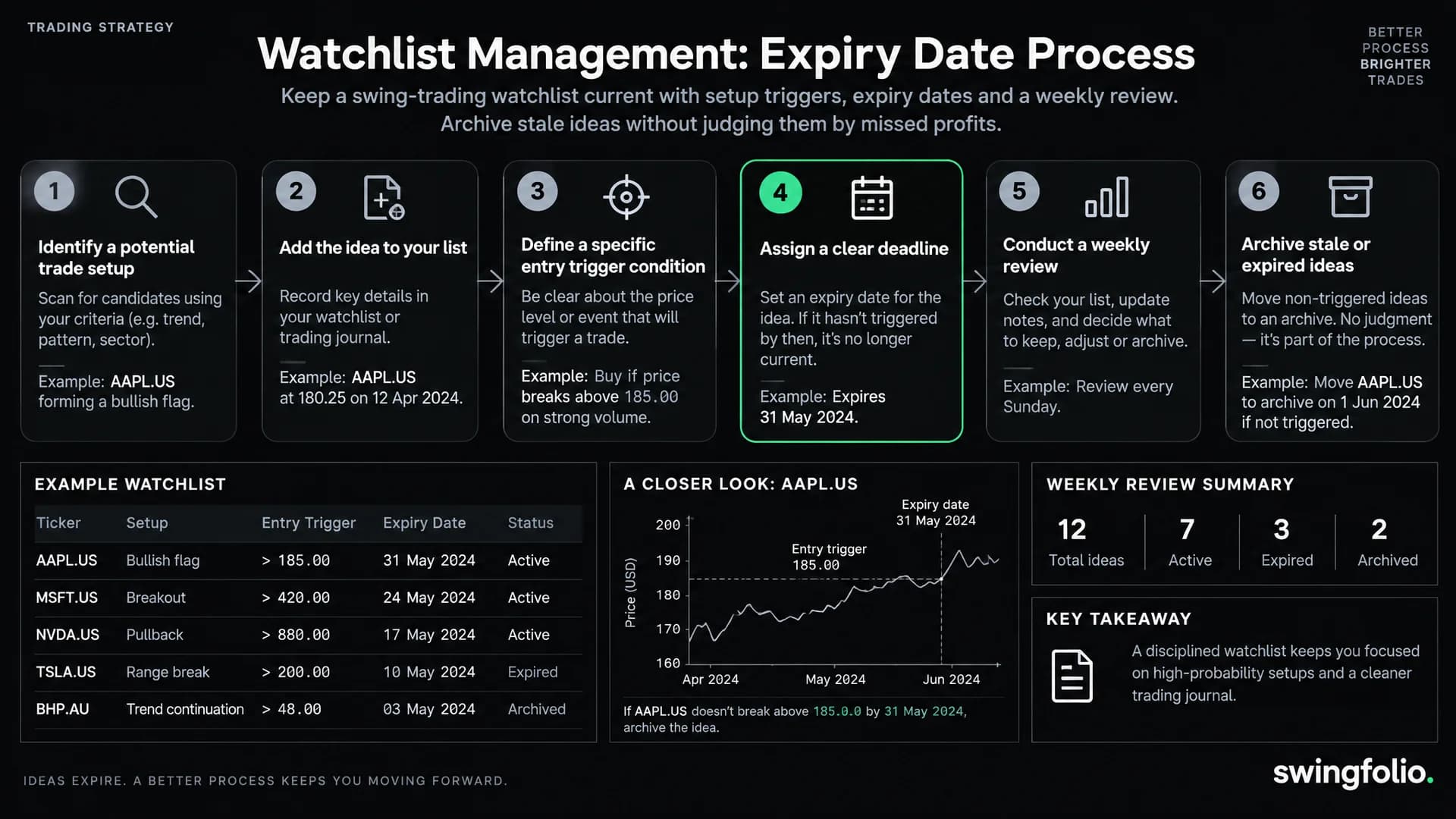
A trade-idea expiry date is the point at which you reassess or retire an untriggered setup. It prevents a watchlist from becoming a collection of reasons that made sense months ago.
Set the date when you record the idea. Keep the original reason and explain any extension, so the review reflects a decision rather than an automatic rollover.
A stock can remain interesting while an idea expires
A company may stay on your research radar for years. A particular breakout or event setup has a shorter life.
Separate the broad research list from the actionable list. The latter should contain ideas whose entry conditions, risk and timing you can still explain.
Start with building a swing-trading watchlist if you need an initial screening process. This article covers what happens to ideas after you add them.
Record more than a ticker
| Field | Why it matters |
|---|---|
| Setup and reason | Explains why the idea was added |
| Entry condition | Defines what would make it actionable |
| Invalidation | Defines what would cancel the idea |
| Catalyst date | Identifies time-sensitive information |
| Review or expiry date | Prevents indefinite carryover |
| Source date | Shows how old the supporting information is |
A price alert only tells you that a price condition occurred. Recheck the whole setup before converting it into a trade.
Choose a window that fits the setup
A catalyst-based idea may expire when the event passes. A technical setup may need a stated number of sessions to develop.
For example, you might review a hypothetical breakout candidate after five sessions and retire it if the original range no longer exists. That is a method to test, not a universal five-day rule.
A longer-term idea can have a longer window. The useful constraint is that you decide the interval intentionally and can explain why it fits the premise.
Run a weekly watchlist review
For each actionable idea, ask:
- Is the original reason still valid?
- Has the entry condition already occurred?
- Has an event date or material fact changed?
- Is the planned size still feasible at current prices?
- Would I add this idea today using the same rules?
- Should it remain active, be revised or be archived?
If you extend the window, retain the previous date and the reason. Otherwise repeated extensions make an expiry date meaningless.
Measure the list without turning it into hindsight
Useful records include how many ideas triggered, were passed over, expired or were invalidated before entry. Also record why a valid trigger was not taken: no cash, excessive related exposure or an unavailable trading window.
Do not label every expired idea that later rallied a mistake. It may not have met your rules at the time.
You can test whether expiry rules are too restrictive, but do it over a defined set of all expired ideas and with a preselected method. Selecting only the later winners creates survivorship bias.
Using expiry in Swingfolio
Swingfolio's current trade-idea interface includes an expiry date and an expired filter. Expiry helps identify potential or active ideas whose date has passed; it does not mean the idea was automatically deleted or that a broker order was cancelled.
Review the rationale and choose the appropriate next status. Keep the reason for discarding or extending an idea so you can learn from the process.
If a field or view is unavailable in your account, record the date explicitly in the rationale and use the same review routine. The discipline should not depend on remembering every ticker.
Keep the actionable list small enough to review
There is no evidence-based universal maximum number of watchlist names. Capacity depends on your setup, timeframes and available attention.
Measure the time it takes to check the list. If you repeatedly skip records or cannot explain the setup, reduce the actionable set or improve the information attached to it.
The trading journal template and survivorship-bias guide help keep the review consistent.
Is expiry the same as a time stop?
No. Idea expiry applies before entry. A time stop manages an open position. Neither is automatically a broker order.
Can an expired idea return to the list?
Yes. Record the new evidence and a new review window. Preserve the old outcome rather than pretending the original idea remained valid throughout.
General information only. Not financial advice.