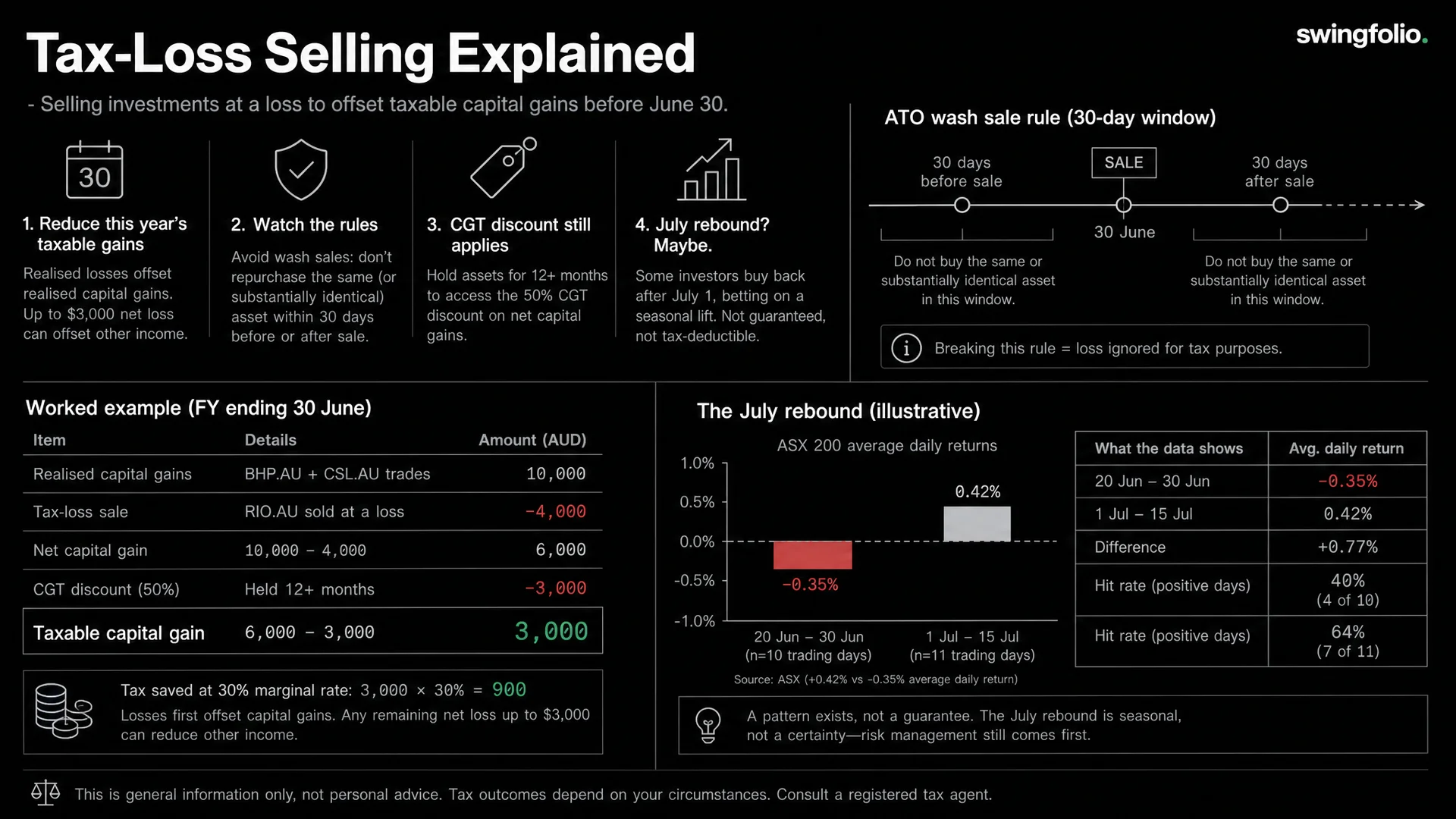
Tax-loss selling means disposing of an asset at a capital loss so the realised loss can reduce capital gains. It is legal in Australia. The problems begin when a taxpayer overstates the benefit, uses the loss against the wrong type of income, or enters a pre-planned arrangement that leaves their economic exposure substantially unchanged.
A separate idea is the "July rebound": shares sold for tax reasons in June may recover after 30 June. Australian research found July seasonality in historical data, especially among small companies, but it did not prove a reliable modern trading rule or establish tax-loss selling as the sole cause.
What a capital loss can and cannot do
An unrealised loss does not enter the tax calculation. A CGT event, such as a disposal, must happen before the capital loss can be used.
For an investor, a capital loss can reduce capital gains. It cannot reduce salary, interest or other ordinary income. If total capital losses exceed capital gains, the remaining net capital loss can generally be carried forward for use against future capital gains, subject to the applicable rules.
This article assumes the shares are held on capital account. A person carrying on a share-trading business may deal with shares as trading stock and recognise gains or losses on revenue account. "Swing trader" alone does not decide the classification.
Worked loss-offset arithmetic
Assume an Australian resident individual has:
- a $10,000 capital gain on shares eligible for the 50% CGT discount
- a $4,000 capital gain on shares held for less than 12 months
- a $4,000 capital loss
Capital losses are applied before the discount. The taxpayer can generally choose which capital gains to reduce. Applying losses first to gains that do not qualify for the discount is often more tax-effective.
| Loss allocation | Short-held gain | Discount gain before discount | Discount applied | Net capital gain |
|---|---|---|---|---|
| Apply $4,000 loss to short-held gain | $0 | $10,000 | $5,000 | $5,000 |
| Apply $4,000 loss to discount gain | $4,000 | $6,000 | $3,000 | $7,000 |
The same $4,000 loss produces a $2,000 difference in the net capital gain in this simplified example. It does not create a $4,000 refund. The eventual tax effect depends on the taxpayer's rate, other gains and losses, eligibility for the discount, offsets and entity type. The 50% CGT discount guide for active traders explains the 12-month timing and eligibility rules.
Which date puts the loss in the financial year?
For a normal sale of listed shares, the CGT event generally occurs on the contract date. That is usually the date the trade executes, not the later settlement date.
A sell order entered on 30 June but not filled does not create a disposal. A trade executed by 30 June may fall in that financial year even if settlement occurs in July. Keep the contract note as evidence of the execution date.
The EOFY tax checklist for Australian traders provides a reusable April-to-July workflow and an accountant handover list.
Where tax-loss selling becomes a wash sale
ATO Taxpayer Alert TA 2008/7 and Taxation Ruling TR 2008/1 address arrangements that crystallise a loss. The concern is that the taxpayer retains or quickly regains substantially the same economic exposure. Part IVA may cancel a tax benefit when obtaining it was the dominant purpose of the scheme.
Australia does not have a universal 30-day safe harbour. Waiting 31 days does not automatically make an arrangement acceptable, and buying back sooner does not let a short article decide the outcome without the surrounding facts.
Higher-risk facts include:
- a sale and repurchase planned together
- buying back the same quantity of the same asset soon after sale
- transferring the exposure to an associate or controlled entity
- using derivatives to preserve substantially the same economic position
- records that show the tax loss was the dominant purpose of the round trip
A genuine decision to exit a failed trade can still have a tax consequence. Record the investment reason, the timing and any later decision separately. For worked ATO examples and practical boundaries, read the Australian wash-sale rules guide.
What the Australian July rebound research found
Brown, Keim, Kleidon and Marsh studied Australian share returns from 1958 to 1981. Their 1983 Journal of Financial Economics paper was "Stock Return Seasonalities and the Tax-Loss Selling Hypothesis". They documented pronounced December-to-January and June-to-July seasonal behaviour. Small companies showed the strongest seasonal effects.
That result matters because Australia's 30 June tax year gives the tax-loss-selling hypothesis a different calendar test from the US December year end. But the authors found the relationship between the tax year and observed seasonality could be correlation rather than proof of causation. A Stanford summary of the research likewise describes ambiguity in the hypothesis's predictions.
The evidence has clear limits for a trader in 2026:
- the sample ended in 1981
- the strongest effects were associated with smaller companies
- the study did not provide a current hit rate for buying June losers
- trading costs, liquidity and market structure have changed
- an average seasonal effect does not predict which share will rebound next July
Claims such as "the rebound works 72% of the time" need a defined sample, dates, security universe, return basis, costs and endpoint rule. Without those inputs, the percentage cannot be checked and should not drive a trade.
How to test a July rebound claim properly
A useful modern test would define:
- Universe: for example, all ordinary shares in a stated ASX index, with rules for additions and removals.
- Tax-loss candidate: a transparent measure such as negative return from 1 July to a fixed June date.
- Entry and exit: closing prices on specified trading days, with a rule for suspensions and delistings.
- Return basis: price return or total return, with dividends and splits handled consistently.
- Costs and liquidity: brokerage, spread assumptions and a minimum trading-value rule.
- Comparison: the broader market and non-loser shares over the same July window.
- Sample period: enough years to show whether the result depends on a few unusual Julys.
Until that work is done, the 1958-81 evidence supports a historical seasonality worth researching. It does not support a guaranteed next-July setup.
Keep the tax reason without rewriting strategy history
If tax affected the timing of an exit, record that fact in the trade notes. Keep the original strategy and actual result intact so the full performance sample remains honest.
You can compare two views during review: all trades, and trades filtered by a documented tax-related exit reason. The filtered view may explain why June outcomes differed, while the complete view prevents inconvenient losses from disappearing from the record.
A useful note for the fictional security ORB.AU might read: "Strategy exit was already valid after support failed. Sold on 18 June. The realised capital loss was reviewed as part of EOFY planning. No repurchase was planned at disposal."
A decision checklist before selling
- Does the investment case or trading setup support an exit?
- Is the loss realised, and does the contract date fall in the intended year?
- What capital gains and carried-forward losses already exist?
- Which gains should losses reduce before any discount is applied?
- Is any repurchase, associate transfer or derivative likely to preserve the exposure?
- Are the trade reason and tax calculation documented separately?
- Does a registered tax agent need to review the arrangement before action?
Swingfolio can keep entries, exits, fees and trade notes together for an EOFY review. It does not determine wash-sale treatment or certify tax calculations. CSV import is available during an active trial, and you review imported trades before Save.
Frequently asked questions
Can I sell shares at a loss and buy them back the next day?
Australia has no universal 30-day safe harbour. A next-day repurchase is not automatically decided by the number of days, but a pre-planned sale and repurchase that restores substantially the same exposure may attract the wash-sale rules. Get registered tax advice for the actual arrangement.
How long can a capital loss be carried forward in Australia?
An unapplied net capital loss can generally be carried forward indefinitely and used against future capital gains, subject to the applicable rules. It is not a deduction against ordinary income.
Can a capital loss reduce my salary?
No. For an investor holding shares on capital account, a capital loss reduces capital gains, not salary or other ordinary income.
Does the 50% discount come off before or after losses?
Apply current-year and carried-forward capital losses before the CGT discount. Where the rules permit a choice, applying losses first to gains that do not qualify for the discount can preserve more of the discount benefit.
Start the 30-day trial to keep each trade reason, disposal record and tax-review note together in Swingfolio.
This article is general information and not tax advice.