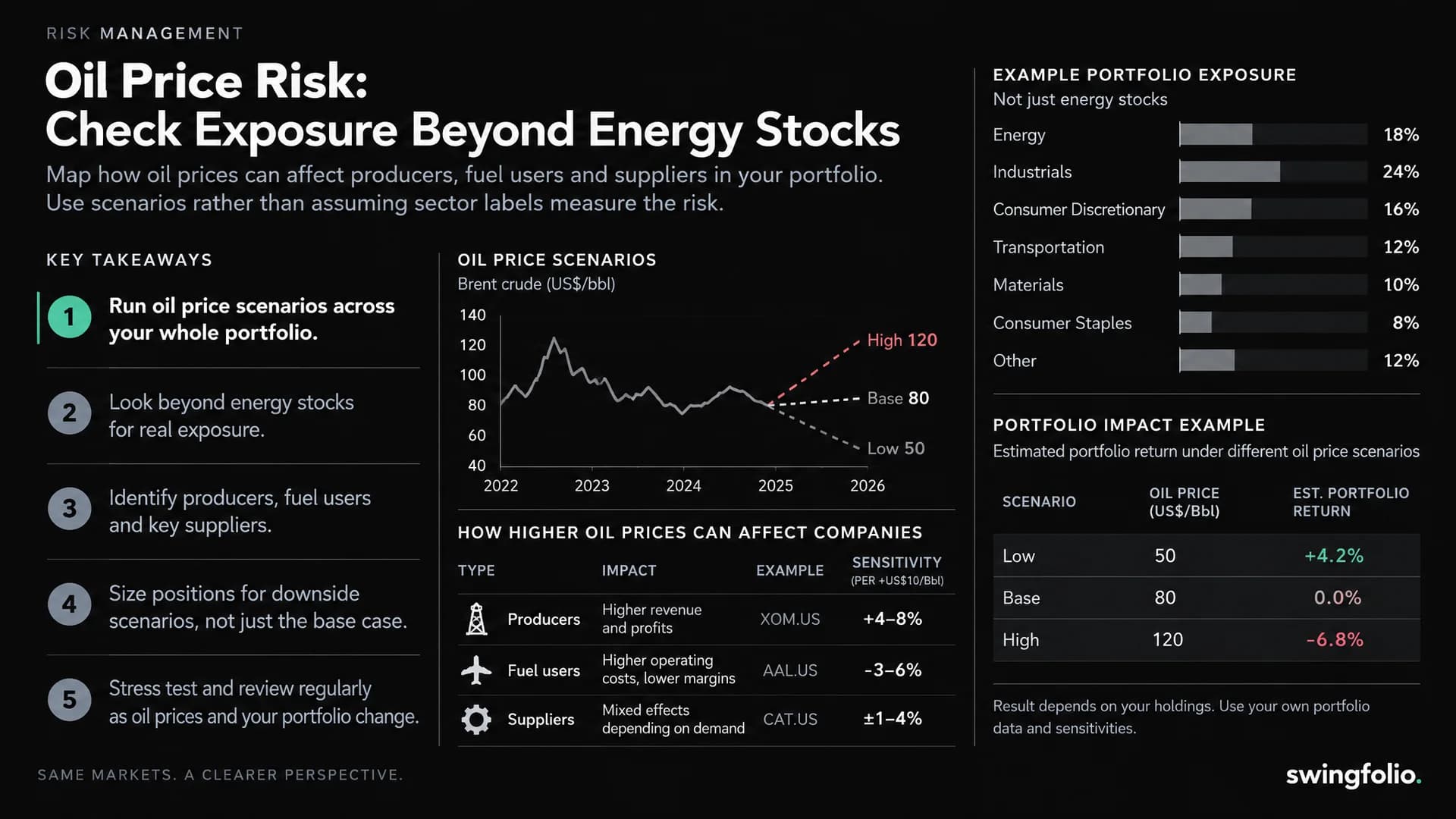
Oil-price exposure can appear outside the energy sector. Airlines buy fuel, transport firms may pass costs to customers, and suppliers may depend on producers' investment spending. The effect on a particular company depends on contracts, hedging, currency and demand.
A portfolio review should identify those channels and test scenarios. Counting energy tickers alone misses part of the question.
Start with the business mechanism
For each holding, ask how a change in oil prices could reach revenue, costs or financing needs.
| Business type | Possible channel | What could change the effect |
|---|---|---|
| Oil producer | Revenue from output | Production costs, hedges and volumes |
| Airline | Fuel expense | Hedging, fares and passenger demand |
| Shipping or transport | Fuel and operating costs | Surcharges and contract terms |
| Equipment supplier | Customer capital spending | Order backlog and customer mix |
| Consumer business | Customer spending and input costs | Pricing power and product mix |
These are hypotheses to check in company disclosures. An oil move does not determine the share-price reaction by itself.
Do not infer a hedge from opposite business exposures
A producer and a fuel user may respond differently to oil, but that does not make an equal-dollar pair a reliable hedge.
Both can fall during a broad equity sell-off. Their sensitivities can change, and currency or company news can dominate the oil effect.
Use the shared portfolio-risk framework to distinguish a narrative from a measured exposure.
A six-position scenario
Suppose a portfolio contains six $10,000 positions, for $60,000 total value. Under a hypothetical oil-supply shock, you assign these stress moves:
| Position | Assumed share-price move | Value change |
|---|---|---|
| Producer A | +5% | +$500 |
| Producer B | +3% | +$300 |
| Supplier | +1% | +$100 |
| Transport company | −4% | −$400 |
| Airline | −6% | −$600 |
| Other holding | 0% | $0 |
| Portfolio | −$100 |
The net loss is about 0.17% of the portfolio. Five holdings were affected, but the direction and magnitude partially offset.
This demonstrates why “five names depend on oil” is not a calculation of portfolio loss. The assumed moves are illustrative, not forecasts or measured betas.
Run a second scenario
Now suppose weaker global demand lowers oil prices while also hurting company revenues. Producers, transport and consumer businesses may all face pressure through different channels.
Change the assumptions explicitly and explain why. A supply shock and a demand shock can produce different relationships even if the oil-price move looks similar.
Do not take the best-performing scenario as the expected outcome. Keep the full range and the assumptions used.
Use current disclosures
Review the latest annual or interim report for fuel hedges, sales contracts, debt, geographic revenue and currency exposure. A sector classification alone cannot supply that information.
If you include a current oil price in your notes, state the benchmark, unit, date and source. Brent, WTI and an energy company's realised selling price are not interchangeable.
The process remains useful whether oil is above or below a round-number headline. It does not depend on a claim that today's price must persist.
Connect the scenario to position decisions
Before adding a holding, record which existing exposures it shares. Then check the proposed position's size, stop and event calendar.
Swingfolio's allocation views and sector information can help you locate the positions to inspect. They do not automatically calculate a complete oil-sensitivity model for your portfolio.
Use the ETF-overlap guide if funds also hold the same companies. Use portfolio heat for planned stop risk, keeping scenario losses separate.
Can I have oil exposure without energy shares?
Yes. Fuel costs, customer spending and supply-chain relationships can create exposure. Confirm the channel for each business.
Does an oil-price rise always hurt airlines and help producers?
No. Those are possible channels, not guaranteed share-price outcomes. Hedging, expectations, demand and company-specific factors matter.
General information only. The portfolio and price moves are hypothetical.